China Releases AI Terminal Intelligence Grading Standard
On May 13, 2026, China’s Ministry of Industry and Information Technology (MIIT) and the State Administration for Market Regulation jointly issued GB/Z 177—2026, Intelligence Grading for Artificial Intelligence Terminals. The standard newly includes ‘IIoT Air Monitoring’-class smart sensors in mandatory AI interoperability assessment — a first for national standards. Exporters targeting markets adopting this standard — including the EU, South Korea, and the UAE — must now provide proof of Level 3 (scenario-adaptive) or higher AI capability. Smart sensor exporters in China are intensively undertaking algorithm registration and edge inference verification.
Event Overview
On May 13, 2026, MIIT and the State Administration for Market Regulation jointly published GB/Z 177—2026 Intelligence Grading for Artificial Intelligence Terminals. This document formally incorporates ‘IIoT Air Monitoring’-type smart sensors into the scope of mandatory AI interoperability evaluation. For exports to jurisdictions that adopt the standard — explicitly named as the European Union, South Korea, and the United Arab Emirates — certification demonstrating at least Level 3 (scenario-adaptive) AI functionality is required. Chinese smart sensor export enterprises are currently conducting algorithm filing and edge inference validation in response.
Industries Affected
Direct Exporters of Smart Sensors
These enterprises face immediate compliance obligations: their products must meet L3-level AI interoperability requirements to access designated export markets. Impact manifests in product certification timelines, technical documentation updates, and potential re-engineering of on-device inference logic to satisfy scenario-adaptation criteria.
Manufacturers of IIoT Air Monitoring Sensors
As the only sensor category explicitly named in the standard’s interoperability scope, manufacturers in this subsegment are directly subject to new testing and validation protocols. Their impact centers on firmware architecture, embedded AI model deployment, and real-time adaptation logic — not merely data acquisition or connectivity.
Supply Chain Service Providers (e.g., Certification Bodies, Lab Testing Services)
These entities may experience increased demand for AI-specific conformity assessments, particularly edge inference benchmarking and interoperability protocol validation. However, no official accreditation framework for these new tests has been publicly announced as of May 2026.
Key Considerations and Recommended Actions
Monitor official implementation guidance and test methodology releases
GB/Z 177—2026 is a guidance standard (denoted by ‘Z’), not a mandatory standard (‘GB’). Its enforceability depends on subsequent regulatory instruments — such as ministerial notices or customs inspection protocols — which have not yet been published. Enterprises should track announcements from MIIT, SAMR, and China Customs.
Focus verification efforts on L3 AI capability claims for targeted markets
The requirement applies specifically to exports to the EU, South Korea, and the UAE — not global shipments. Enterprises should prioritize documentation and testing only for units destined to those markets, avoiding premature system-wide upgrades without confirmed market-level enforcement.
Distinguish between policy signal and operational mandate
The standard’s publication signals regulatory intent but does not yet constitute an enforceable export barrier. Current activity — e.g., algorithm registration and edge inference verification — reflects anticipatory industry action, not a legally binding deadline. Businesses should treat ongoing preparations as risk-mitigation, not compliance completion.
Prepare internal alignment on AI capability definitions and evidence formats
L3 (scenario-adaptive) AI is defined in GB/Z 177—2026 as systems capable of modifying inference behavior based on environmental context shifts without cloud dependency. Exporters should align engineering, QA, and regulatory teams on how to demonstrate and document this behavior — especially for air monitoring use cases involving dynamic particulate, gas, or humidity conditions.
Editorial Perspective / Industry Observation
Observably, this standard functions primarily as a policy signal rather than an immediately enforceable regulation. Its inclusion of IIoT Air Monitoring sensors — a high-growth segment in industrial and environmental monitoring — suggests prioritization of AI-integrated physical infrastructure in China’s cross-border digital trade strategy. Analysis shows the timing aligns with ongoing EU AI Act implementation reviews and South Korea’s AI Semiconductor Export Promotion Plan, indicating coordinated alignment efforts across key trading partners. However, the absence of referenced test methods, accredited labs, or phased rollout dates means actual market impact remains contingent on further implementation steps — not the standard’s issuance alone.
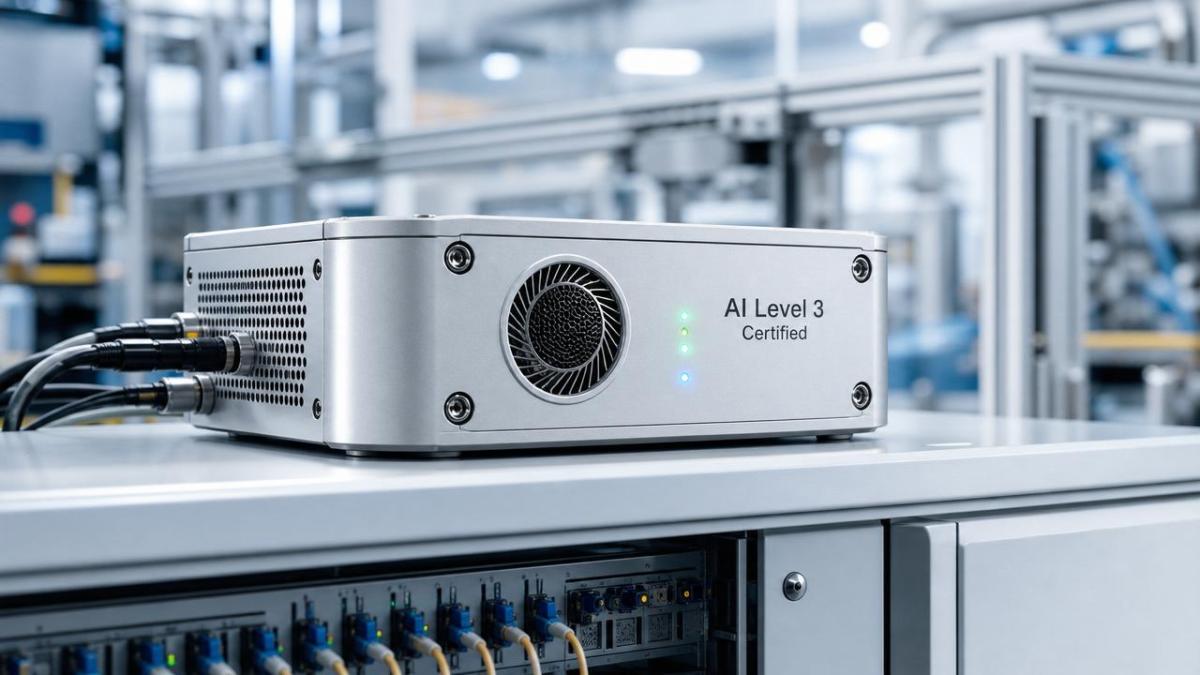
This development is best understood not as an abrupt regulatory shift, but as the formalization of an emerging expectation: AI-enabled industrial devices must demonstrate verifiable, context-aware functionality to qualify for priority export markets. It marks the beginning of a traceability layer for AI behavior in hardware — one that begins with air monitoring sensors but may extend to other IIoT categories in future revisions.
Information Sources
Primary source: Official announcement issued jointly by the Ministry of Industry and Information Technology (MIIT) and the State Administration for Market Regulation (SAMR), dated May 13, 2026. No supplementary technical annexes, test specifications, or enforcement timelines have been released as of publication. Ongoing observation is required for updates on implementation mechanisms, accredited laboratories, and market-specific customs enforcement procedures.
Get weekly intelligence in your inbox.
No noise. No sponsored content. Pure intelligence.
 Oct 21, 2026How often is cleanroom certification required under ISO 14644-2?Cleanroom Certification is generally recommended annually under ISO 14644-2. Learn when risk-based extensions apply and which changes trigger earlier testing to plan with confidence.
 Oct 21, 2026FASEB Comments on NIH Draft Policy for Research Involving BiohazardsFASEB comments on NIH’s draft biohazard research policy call for risk-based biosafety oversight. Explore potential implications for laboratories, suppliers, and compliance teams.
 Oct 20, 2026How to disinfect ultrasound machines without damaging surfacesLearn how to disinfect ultrasoundmachines without surface damage. Explore compatible products, wet contact times, and probe care to protect patients and equipment.
 Oct 20, 2026Ultrapure Water in Semiconductor Manufacturing: Reuse and Quality Control InsightsExplore ultrapure water reuse in semiconductor manufacturing, key UPW quality benchmarks and analytical insights to help evaluate suppliers and protect process purity.
 Oct 19, 2026How cooling affects warpage in injection-molded consumer electronics housingsOptimize plastic injection molding for consumer electronics with cooling strategies to reduce housing warpage and improve assembly fit. Discover practical checks for stable, efficient production.
 Oct 18, 2026Can air leaks prevent a dehumidifier from holding its target dew point?Why can't our dehumidifier maintain the target dew point? Discover how air leaks increase moisture loads, spot hidden faults, and find practical fixes to restore reliable dew-point control.
 Oct 17, 2026How semiconductor process water treatment removes trace organicsSee how semiconductor process water treatment removes trace organics with RO, UV oxidation, and polishing. Learn how TOC monitoring helps verify purity and pinpoint contamination.
 Oct 16, 2026How to choose ultra pure water piping materials to limit leachingChoose ultra pure water piping with confidence. Compare PVDF, PFA, and stainless steel, assess leaching risks, and learn how to qualify your system for reliable purity.
 Oct 15, 2026How to size a skid-mounted deionized water system for peak demandCompare deionized water systems skid configurations for peak demand. Learn how to balance production, storage, and pump capacity to prevent shortages and avoid costly oversizing.
 Oct 14, 2026When is collaborative laboratory robotics suitable for sample sorting?Explore when collaborative laboratory robotics suits sample sorting. Discover key checks for safety, traceability, container compatibility, and throughput before choosing your solution.
 Oct 13, 2026How sandwich panel joints affect airtightness in cleanroom systemsCleanroom Systems sandwich panels need reliable joints for airtightness. Discover how gaskets, sealants, and testing help reduce leakage and protect cleanroom pressure control.
 Oct 12, 2026How to verify USP compliance for ultra pure water systemsUltra Pure Water Systems USP compliance: learn how to verify water quality, sampling, sanitization, trends, and validation controls at every point of use.
 Oct 11, 2026How tight temperature control prevents cleanroom process driftCleanroom process temperature control systems prevent costly drift by stabilizing critical conditions, improving repeatability, and protecting sensitive production workflows.
 Oct 10, 2026When does organic contaminant removal require TOC treatment?Organic contaminant removal requires TOC treatment when dissolved organics threaten product quality, equipment reliability, or process control. Learn how to assess risks and choose the right solution.
 Oct 08, 2026What affects lead times for sheet metal bending services in Canada?Sheet metal bending services Canada: discover how material supply, tooling, tolerances, finishing, documentation, and freight affect lead times for reliable project delivery.
 Oct 07, 2026How HVAC design for semiconductor fabs prevents airborne contaminationHVAC design for semiconductor fabs prevents airborne contamination through advanced filtration, pressure cascades, airflow control, and real-time monitoring. Explore key strategies for cleaner, more reliable wafer production.
 Oct 06, 2026How photovoltaic modules waterproof technology prevents moisture damagephotovoltaic modules waterproof technology prevents moisture damage with durable seals, drainage, and junction-box protection. Explore practical selection and testing insights.
 Oct 05, 2026How ISO 14644 Europe requirements affect cleanroom qualificationISO 14644 Europe requirements shape cleanroom qualification, from particle classification and recovery testing to monitoring, GMP alignment, and change control.
 Oct 04, 2026How to assess a pharmaceutical cleanroom solutions supplier’s ISO capabilityPharmaceutical Cleanroom Solutions supplier assessment guide: evaluate ISO 14644 capability, validation evidence, airflow design, documentation, and long-term GMP readiness.
 Oct 03, 2026What EU standards govern the design of BSL-3 laboratories in Europe?BSL-3 laboratories Europe: explore EU directives, EN standards, HVAC containment, commissioning, and practical design strategies for compliant, resilient high-containment facilities.
 Oct 02, 2026How EN 1822 defines HEPA filtration efficiency for cleanroomsHEPA filtration EN 1822 explained: learn how MPPS testing, local leakage limits, and filter classes support reliable cleanroom decisions.
 Oct 01, 2026How pharmaceutical process water systems control microbial riskProcess water systems pharmaceutical teams rely on can control microbial risk through hygienic design, monitoring, and validated sanitization. Explore practical compliance strategies.
 Sep 30, 2026When does a negative pressure laboratory need BSL-3 containment?Negative pressure laboratory or BSL-3? Discover the risk factors, engineering controls, and containment requirements needed for safe, compliant laboratory planning.
 Sep 29, 2026How to evaluate a TOC-zero water treatment supplier for UPW systemsChoose a TOC-zero water treatment supplier with confidence. Compare UPW performance, monitoring, validation, materials, service capability, and lifecycle cost.
 Sep 28, 2026What drives sustainable cooling cost in high-precision facilities?Sustainable cooling cost in high-precision facilities depends on thermal stability, energy, water, controls, and resilience. Explore smarter lifecycle strategies.
 Sep 27, 2026How to compare freight forwarding services for time-critical shipmentsCompare freight forwarding services for time-critical shipments with practical insights on routing, customs, visibility, specialized handling, and contingency planning.
 Sep 26, 2026How environmental integrity in laboratories supports reliable test resultsEnvironmental Integrity in laboratories safeguards samples, instruments, and staff. Discover practical controls for contamination, monitoring, and reliable test results.