How pharmaceutical process water systems control microbial risk
How Pharmaceutical Process Water Systems Control Microbial Risk
In pharmaceutical manufacturing, microbial control is not a single barrier but a system-wide discipline. Process water systems pharmaceutical teams rely on must integrate robust treatment, hygienic distribution, continuous monitoring, and validated sanitization to protect product quality and patient safety. For quality and safety leaders, understanding how these controls work together is essential for maintaining compliance, preventing biofilm formation, and reducing contamination risk across critical operations.
Water is deceptively difficult to control because it is both a utility and, in many applications, a raw material. It may contact product, equipment surfaces, packaging components, or cleanroom tools. Even where water is not intended to become part of the finished medicine, a poorly controlled system can introduce microorganisms into an area where they can persist, spread, or complicate investigation work. The relevant risk is therefore not limited to the quality leaving the treatment skid. It extends to every storage tank, valve, sample point, hose connection, dead leg, return line, and point of use.
A microbiologically sound water system is designed around a practical principle: prevent conditions that allow organisms to enter, attach, multiply, and detach. This sounds straightforward, but the engineering implications are extensive. Treatment technology matters, yet piping geometry, temperature control, flow behavior, maintenance access, monitoring strategy, and operator discipline often determine whether a system remains in control over years of operation.
The risk begins after purification, not only before it
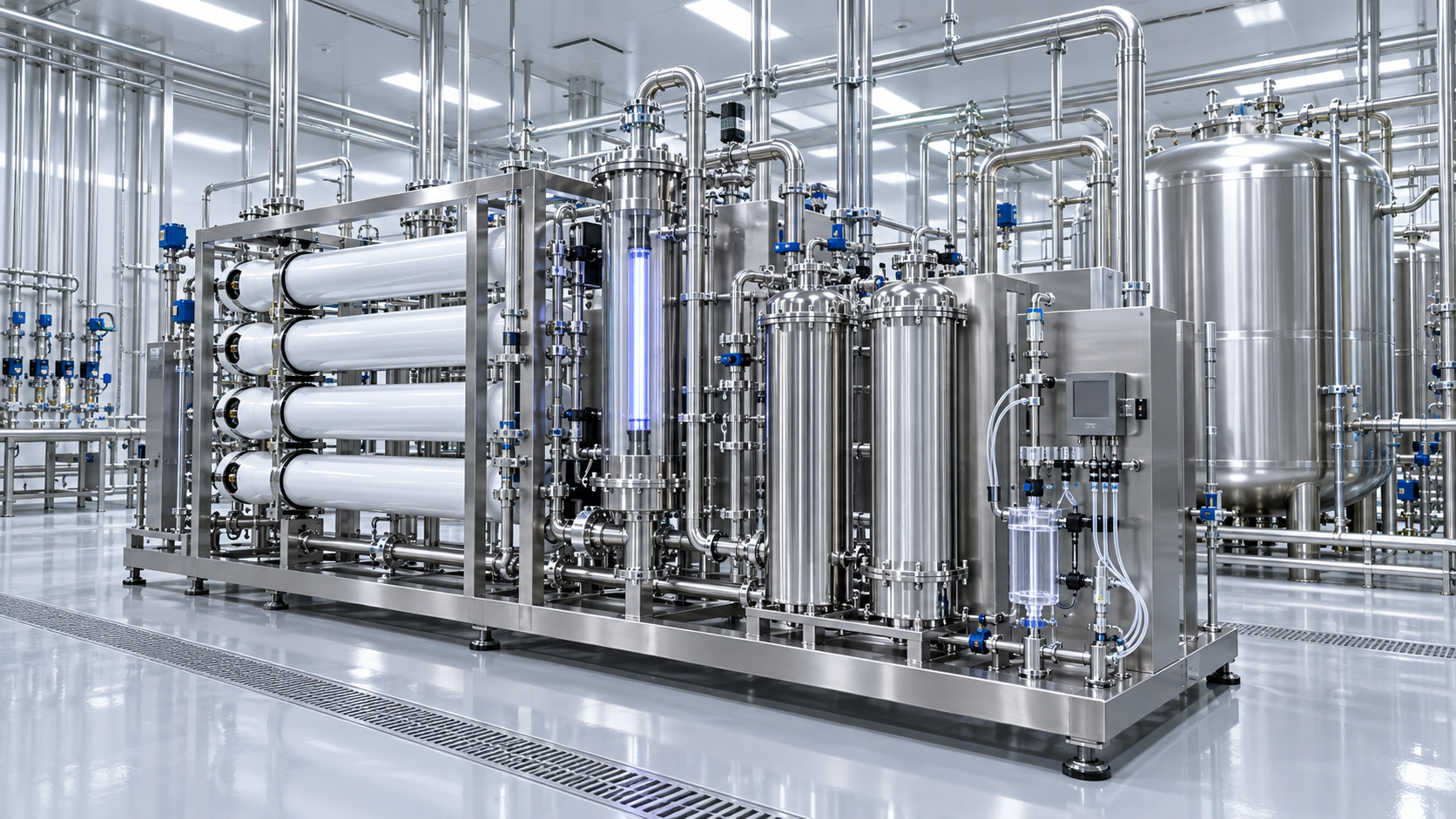
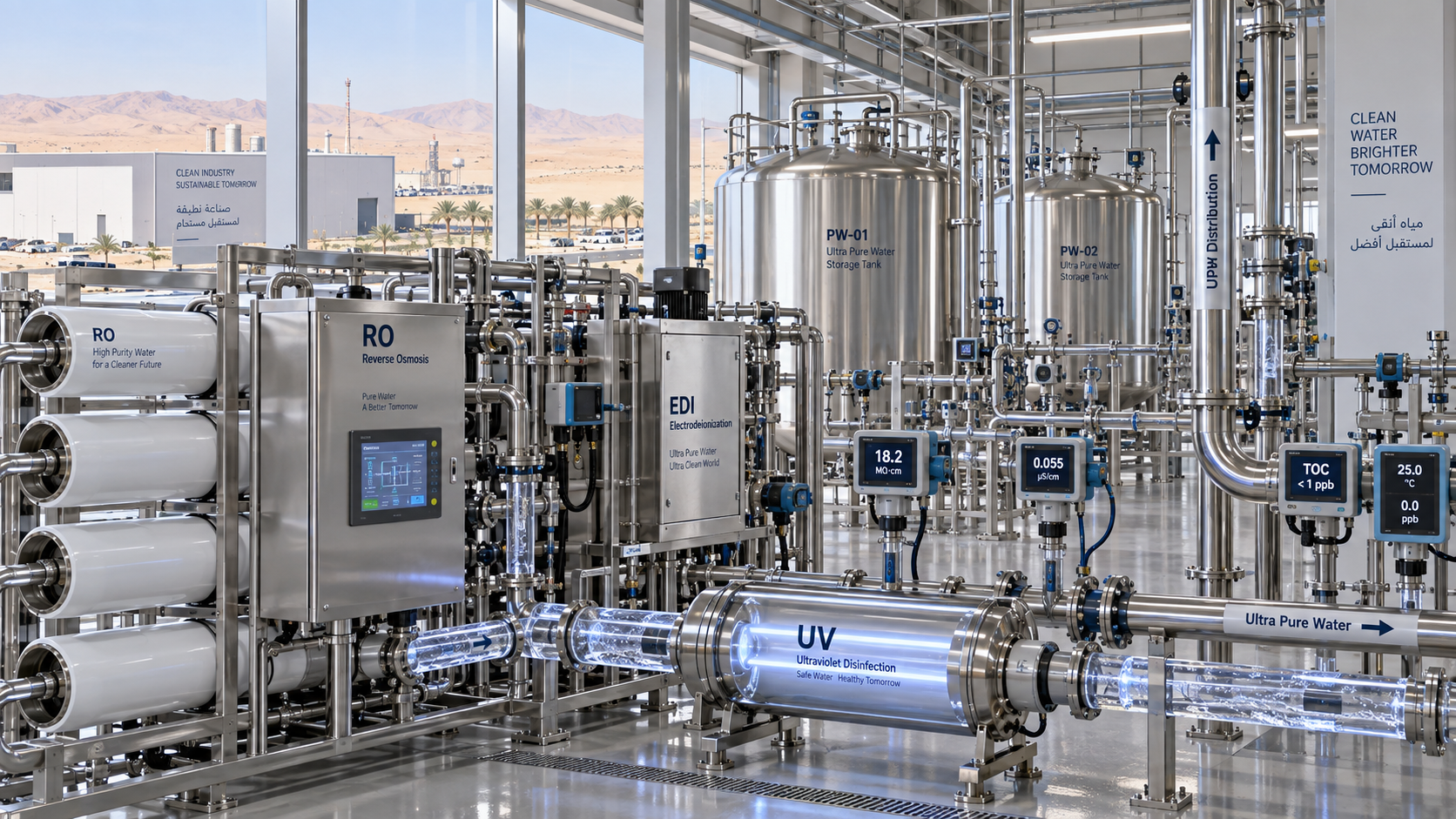
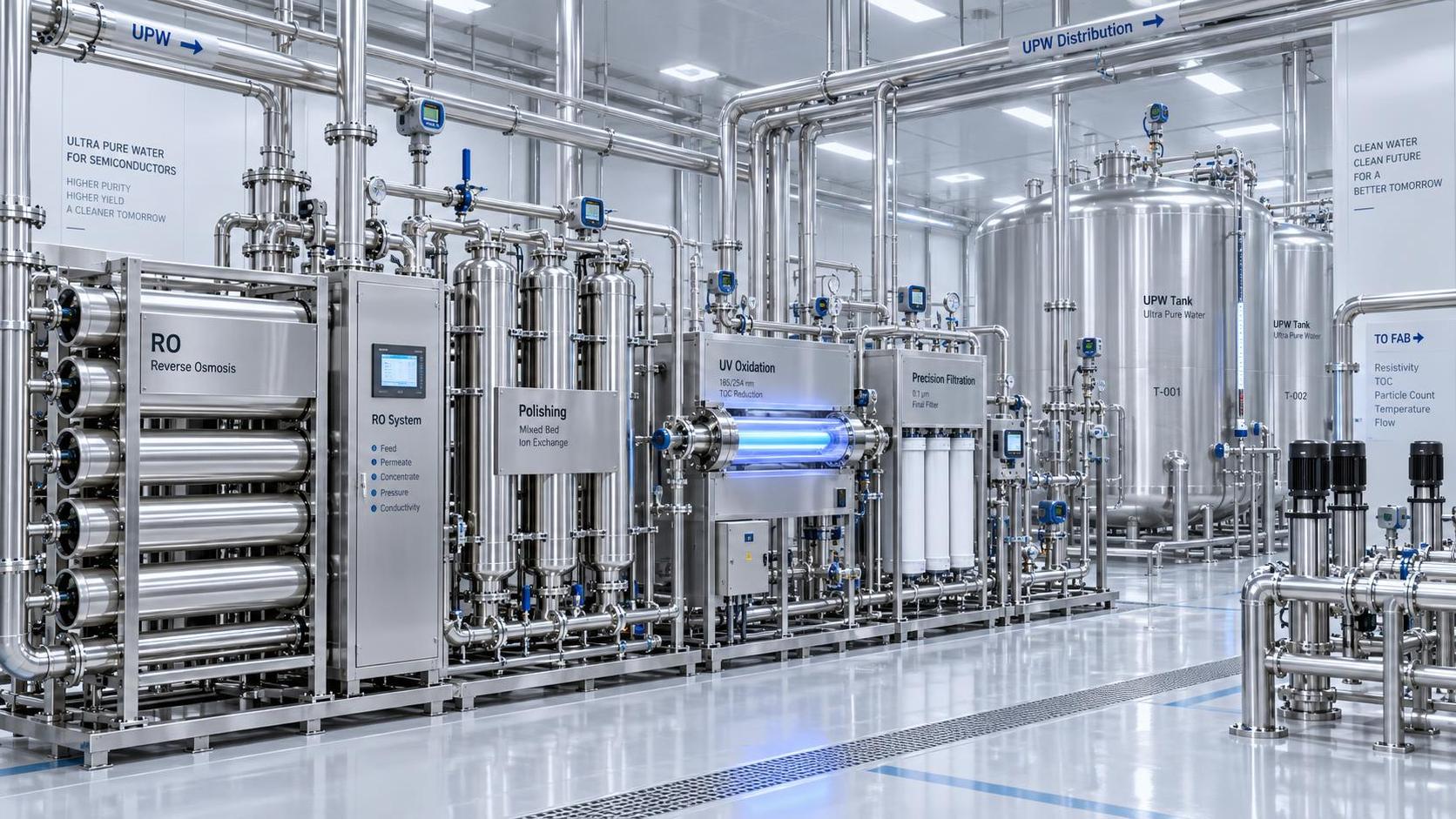
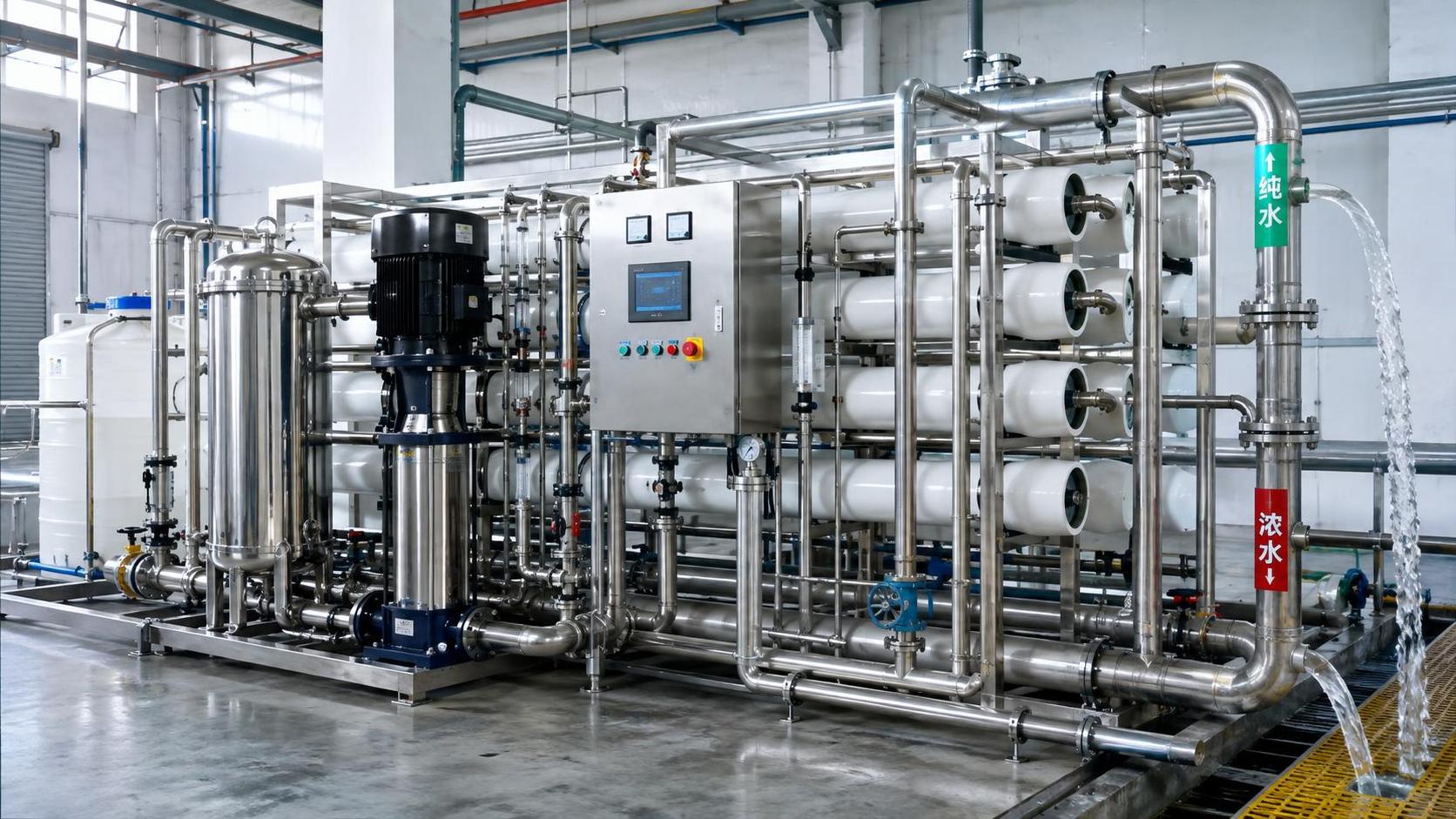
Source water contains a variable microbial burden influenced by season, municipal treatment performance, local infrastructure, and site conditions. Pretreatment commonly reduces suspended solids, oxidants, hardness, and organic load so that downstream technologies can operate reliably. Depending on the required water grade and process, a treatment train may include filtration, softening, activated carbon, reverse osmosis, electrodeionization, ultraviolet treatment, ultrafiltration, or other unit operations.
However, purified water is not inherently sterile. In fact, highly treated water can be vulnerable to recontamination if it stagnates or encounters unsuitable materials and surfaces. Reverse osmosis membranes, carbon beds, storage tanks, low-flow branches, and poorly drained components can all become locations where microbial populations establish themselves. A system may show acceptable conductivity or total organic carbon results while microbiological control is weakening. Chemical purity and microbial purity must be assessed together, but they are not interchangeable indicators.
The most persistent problem is biofilm. Microorganisms attached to a wetted surface can form a protective matrix that makes them harder to remove than free-floating cells. A brief high microbial count at a sample point may be manageable; a recurring excursion from the same location can indicate an established niche. Once biofilm is present, routine flushing alone may not be sufficient. The response may require a structured review of sanitization effectiveness, system hydraulics, component condition, and maintenance history rather than repeated resampling without a root-cause hypothesis.
Hygienic distribution is a microbial control measure
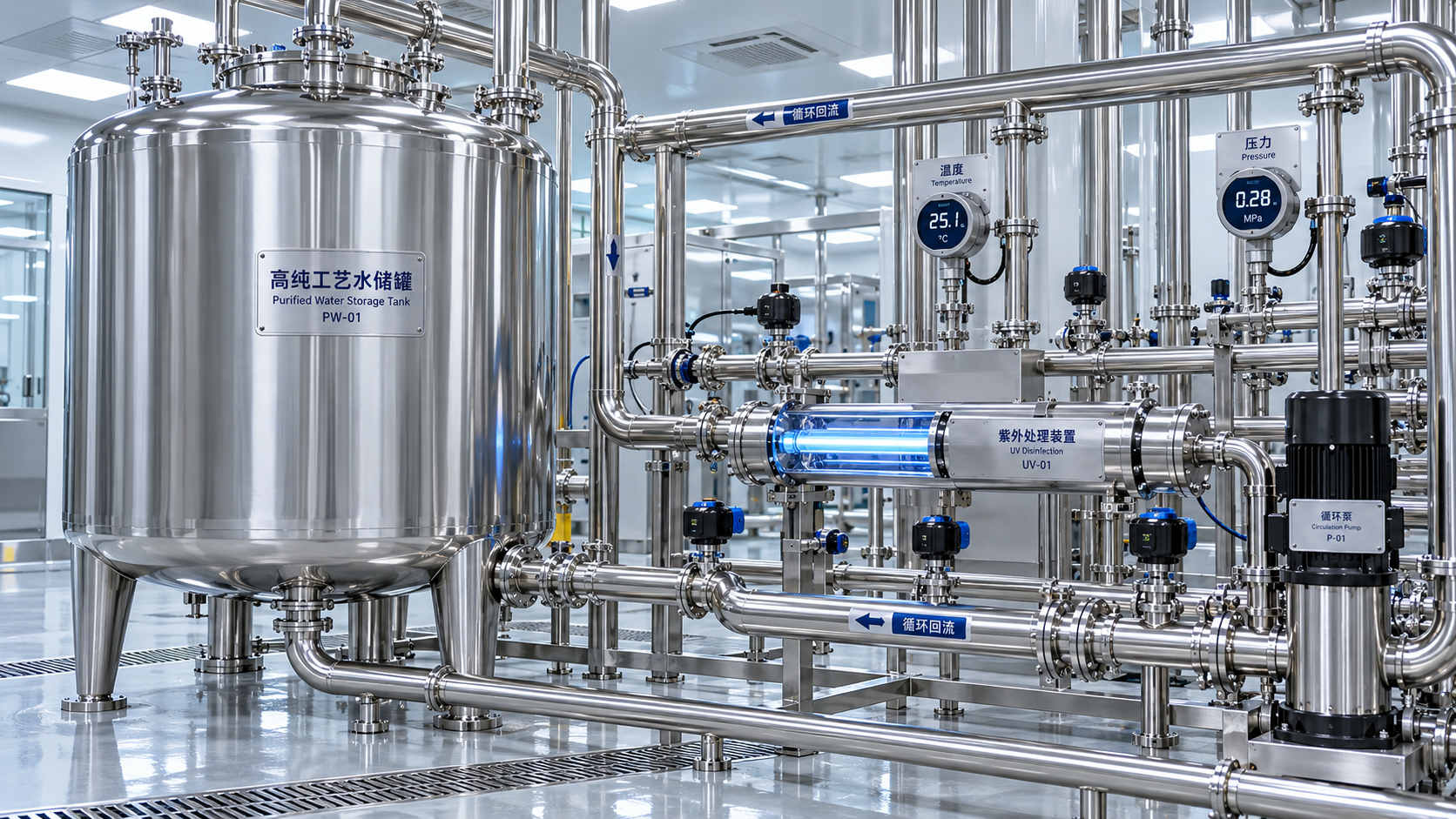
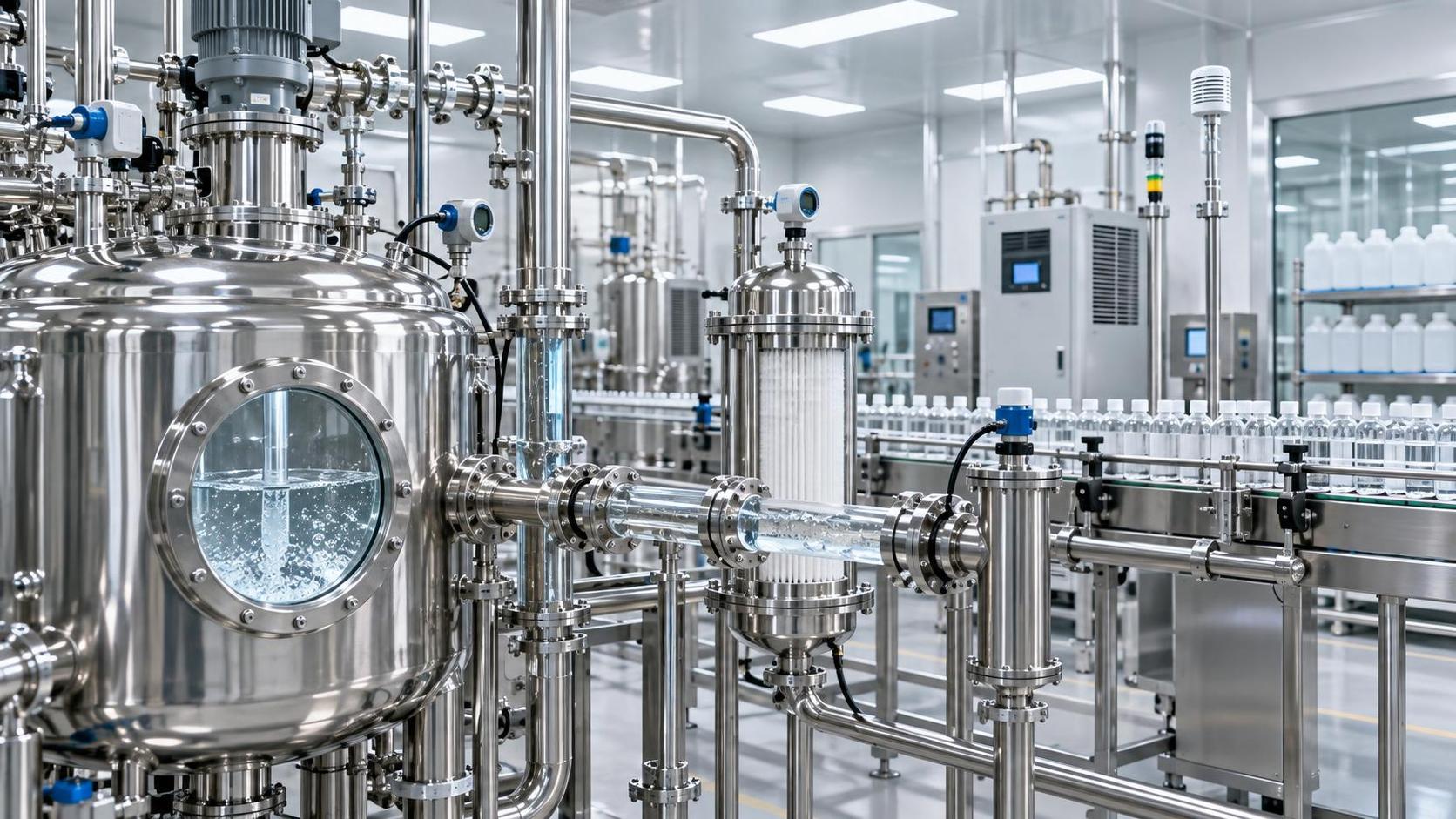
Distribution loops are sometimes treated as passive plumbing. In a pharmaceutical setting, they are part of the control strategy. A loop should maintain conditions that discourage microbial growth and allow sanitization to reach all wetted surfaces. This generally means continuous circulation, carefully considered pipe slopes and drainability, minimized hold-up volume, hygienic joints, suitable elastomers, and branches designed to avoid prolonged stagnation.
The term “dead leg” is frequently used, sometimes too casually. The real concern is not merely a geometric ratio on a drawing; it is whether a branch experiences insufficient exchange, retains water, or creates an inaccessible surface where organisms can survive a sanitization cycle. Design review should examine actual flow conditions, valve internals, instrument connections, sample assemblies, and operating modes. A line that looks acceptable during normal production may behave differently during shutdown, low demand, or maintenance bypass.
Material selection also deserves more than a specification check. High-quality stainless steel is common in hygienic loops, but microbial performance depends on surface finish, weld quality, passivation, installation practice, and the compatibility of materials with the proposed sanitization method. Rough welds, damaged surfaces, incorrect gasket installation, or crevices around non-hygienic components can undermine an otherwise well-conceived design.
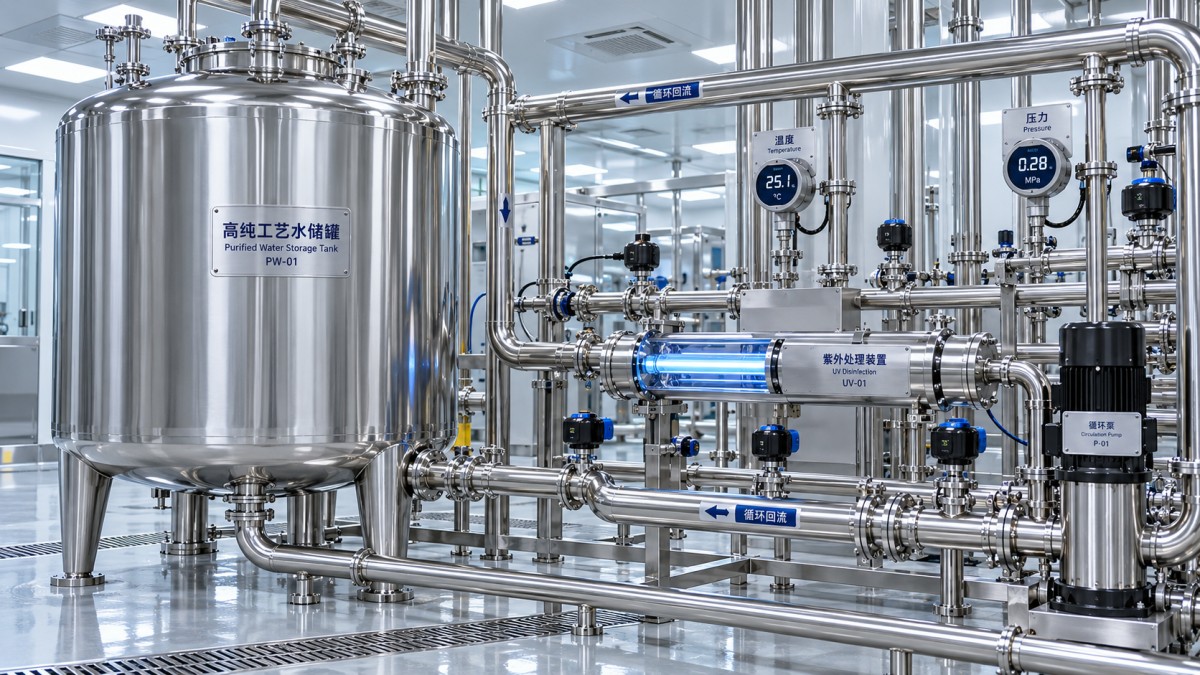
Temperature is another major design decision. Hot circulating systems use elevated temperature as a continuous microbial deterrent and can support thermal sanitization. Cold systems may be necessary for energy, process, or facility reasons, but they require a more deliberate approach to recirculation, periodic sanitization, and microbial trending. Neither approach is universally superior. The appropriate choice depends on the required water quality, demand profile, utility resilience, materials, production schedule, and the site’s ability to sustain the intended operating controls.
Treatment technologies work best as a coordinated barrier set
A robust system does not depend on one “final” technology to solve every risk. Each stage has a purpose and limitations. Pretreatment protects downstream equipment but may itself need close microbial management. Activated carbon, for example, is highly useful for removing chlorine or chloramine where needed, yet its large surface area can support microbial growth if operating, backwashing, and sanitization controls are weak.
Reverse osmosis provides a substantial barrier to dissolved contaminants and microorganisms, but it requires appropriate pretreatment, membrane integrity management, cleaning procedures, and protection against biofouling. Ultraviolet treatment can reduce microbial load or assist with total organic carbon control depending on wavelength and application, but it has no residual effect downstream. Ultrafiltration can provide an additional physical barrier, though it too must be integrated into a validated cleaning and integrity-management approach.
The useful question for a quality team is not, “Which technology is best?” It is, “What failure mode is each technology expected to control, and how will we know when that control is degrading?” That question connects engineering design with monitoring. It also prevents the common mistake of installing sophisticated treatment equipment while giving too little attention to storage, distribution, and operational behavior.
Monitoring must reveal loss of control early
Microbial monitoring should be based on risk and system knowledge rather than on a fixed set of sample points copied from another facility. Sampling locations normally need to represent treatment output, tank outlets, return loops, remote points of use, and locations with known hydraulic or operational sensitivity. The sample procedure itself matters. Poor aseptic technique, inappropriate flushing, unsuitable sample containers, or delayed laboratory processing can produce results that are difficult to interpret.
Routine results should be trended, not viewed in isolation. Alert and action levels are typically established as part of the site’s quality system and should reflect the applicable pharmacopoeial, regulatory, and process requirements. A result below an action level is not automatically reassuring if it represents a clear upward shift from the historical baseline. Conversely, an isolated result should not automatically be treated as proof of system failure before the sampling event, laboratory method, and operating context have been assessed.
Online instruments are valuable because they offer immediate visibility into parameters such as conductivity, temperature, flow, pressure, tank level, and, where configured, total organic carbon. These measurements do not replace microbiological testing, but they can help identify precursor events. A falling loop temperature, a prolonged low-flow period, an unexpected pressure change across a filter, or repeated tank level cycling may explain why microbial results later begin to drift.
This is where smart environmental monitoring becomes more than a dashboard exercise. Correlating water-system data with cleanroom operations, maintenance activity, utility alarms, and production schedules makes investigations faster and more defensible. G-ICE’s work across ultra-pure water, thermal management, contamination control, and digital monitoring reflects this wider view: critical utilities are not independent assets. They are interdependent conditions within a controlled manufacturing environment.
Sanitization needs validation, not assumption
Sanitization may be thermal, chemical, ozone-based, or a combination determined by system design and water use. Each method introduces constraints. Heat requires reliable temperature distribution and materials that tolerate repeated thermal exposure. Chemical sanitization requires concentration control, contact-time definition, adequate rinsing where applicable, operator protection, and assurance that difficult locations receive the intended exposure. Ozone can be effective in suitable systems but must be managed with attention to off-gas control, material compatibility, and downstream removal where required.
A sanitization procedure should define more than the nominal cycle. It should identify the required conditions at relevant points in the system, the evidence that those conditions were achieved, actions for incomplete cycles, and the steps needed before water is released for use. Validation should demonstrate that the procedure performs under representative conditions, including locations most likely to be difficult to sanitize. Changes to loop configuration, pump settings, valve arrangements, materials, or software logic may require formal impact assessment because they can alter sanitant reach or exposure.
One recurring weakness is using sanitization as a substitute for design correction. Frequent emergency sanitization may temporarily reduce counts, but it can mask inadequate recirculation, poor drainability, an aging component, or an unresolved source of ingress. The goal is a stable state of control, not an endless cycle of corrective disinfection.
Standards provide direction, but the system must fit its use
Pharmaceutical water requirements are shaped by intended use. Water used in non-product-contact cleaning does not carry the same risk profile as water used in formulation, final rinse steps, or sterile-product manufacturing. Quality teams commonly refer to relevant pharmacopoeial monographs and guidance, including the United States Pharmacopeia framework for pharmaceutical water, European Pharmacopoeia requirements where applicable, and expectations set by the local regulatory authority. Requirements should be confirmed for the marketed product, manufacturing location, and process application rather than inferred from a generic water-system specification.
Standards such as ASME BPE can inform hygienic equipment and piping decisions, while ISO 14644 is relevant to cleanroom contamination control around critical water-use operations. They do not remove the need for a facility-specific contamination-control strategy. The right documentation set normally links the user requirement specification, design qualification, installation and operational records, performance evidence, sanitization strategy, sampling plan, maintenance procedures, alarm management, and change control.
That documentation is not administrative overhead. It creates traceability when an excursion occurs. Investigators need to know what changed, which operating conditions applied, whether the water was used, how far any potential impact could extend, and whether prior signals were present in the trend data.
A practical review before approving a system
Before approving a new installation or major upgrade, quality and safety leaders should challenge the system at its weak points. Ask where water can stand still, how the furthest point is sanitized, how sample-point use avoids creating contamination, what happens during utility failure, and whether maintenance can be completed without introducing unassessed risk. Review the demand profile as well. A loop designed for continuous high use may perform poorly when production shifts to intermittent campaigns.
It is equally important to verify the handover model. Operators need understandable operating limits, maintenance teams need hygienic repair practices, and the quality unit needs data that can support trend review and deviation decisions. The most elegant piping diagram offers little protection if personnel cannot recognize abnormal conditions or if alarm data are unavailable when an investigation starts.
Microbial risk in pharmaceutical water is controlled through layers that reinforce one another: appropriate feed-water treatment, hygienic design, reliable circulation, targeted monitoring, validated sanitization, and disciplined change management. When reviewing a system, the decisive issue is not whether it contains advanced equipment. It is whether its design, controls, and daily use make microbial growth difficult to establish and easy to detect before product quality is placed at risk.
Get weekly intelligence in your inbox.
No noise. No sponsored content. Pure intelligence.
 Oct 01, 2026How pharmaceutical process water systems control microbial riskProcess water systems pharmaceutical teams rely on can control microbial risk through hygienic design, monitoring, and validated sanitization. Explore practical compliance strategies.
 Sep 30, 2026When does a negative pressure laboratory need BSL-3 containment?Negative pressure laboratory or BSL-3? Discover the risk factors, engineering controls, and containment requirements needed for safe, compliant laboratory planning.
 Sep 29, 2026How to evaluate a TOC-zero water treatment supplier for UPW systemsChoose a TOC-zero water treatment supplier with confidence. Compare UPW performance, monitoring, validation, materials, service capability, and lifecycle cost.
 Sep 28, 2026What drives sustainable cooling cost in high-precision facilities?Sustainable cooling cost in high-precision facilities depends on thermal stability, energy, water, controls, and resilience. Explore smarter lifecycle strategies.
 Sep 27, 2026How to compare freight forwarding services for time-critical shipmentsCompare freight forwarding services for time-critical shipments with practical insights on routing, customs, visibility, specialized handling, and contingency planning.
 Sep 26, 2026How environmental integrity in laboratories supports reliable test resultsEnvironmental Integrity in laboratories safeguards samples, instruments, and staff. Discover practical controls for contamination, monitoring, and reliable test results.
 Sep 25, 2026Healthcare trends reshaping laboratory automation investmentHealthcare Trends are reshaping laboratory automation investment. Explore how resilient infrastructure, data integrity, and smart monitoring improve scalable performance.
 Sep 24, 2026When chemical wastewater treatment systems need zero-liquid dischargeWastewater treatment systems for chemicals: learn when zero-liquid discharge reduces risk, recovers water, and supports resilient chemical operations.
 Sep 23, 2026How regulatory frameworks documentation supports audit-ready carbon trackingRegulatory Frameworks documentation creates audit-ready carbon tracking with traceable evidence, controlled methods, and compliant operational decisions.
 Sep 22, 2026How cleanroom architecture controls contamination risks in pharma productionCleanroom Architecture for pharmaceutical production: discover how airflow zoning, pressure cascades, cleanable finishes, and separated flows reduce contamination risks and strengthen GMP compliance.
 Sep 21, 2026What ultra pure water specifications matter most in Middle East projects?Ultra pure water Middle East projects demand resilient specifications. Explore point-of-use quality, feedwater variability, heat control, monitoring, and reliable distribution design.
 Sep 20, 2026How Process Environment Control systems prevent airborne contaminationProcess Environment Control systems prevent airborne contamination through managed airflow, pressure, filtration, and monitoring. Discover practical strategies for safer, compliant operations.
 Sep 19, 2026When does heat recovery make sustainable cooling worth the investment?Sustainable cooling technology heat recovery: learn when reliable heat demand, temperature matching, and lifecycle savings make recovery a smart investment.
 Sep 18, 2026How to set alarm limits for semiconductor cleanroom monitoringSemiconductor cleanroom monitoring: learn how to set risk-based alarm limits for particles, humidity, pressure, and airflow to protect yield and reduce nuisance alerts.
 Sep 17, 2026How plastic injection molding affects ESD protection in cleanroomsPlastic injection molding affects ESD protection in cleanrooms. Learn how resin choice, molding consistency, grounding, and particle control support reliable compliance.
 Sep 16, 2026What to verify before choosing an industrial air quality monitoring supplierIndustrial air quality monitoring supplier checklist: verify measurement accuracy, calibration traceability, data integration, compliance support, and lifecycle service before you buy.
 Sep 15, 2026Smart HVAC investment insights for North American heat recovery projectsSmart HVAC investment insights North America: evaluate heat recovery, lifecycle costs, controls, and performance for resilient project decisions.
 Sep 14, 2026How SEMI standards shape water treatment design for semiconductor fabsSemiconductor water treatment SEMI guidance shapes resilient UPW design, contamination control, monitoring, reclaim strategy, and fab-ready validation.
 Sep 13, 2026What drives Biosafety Containment Systems cost in BSL-3 projects?Biosafety Containment Systems cost in BSL-3 projects depends on HVAC, layout, decontamination, controls, and commissioning. Discover how to build a credible budget.
 Sep 12, 2026How to qualify a fine chemical process solutions supplier for purity controlFine Chemical Process Solutions supplier qualification guide: evaluate purity control, traceability, contamination prevention, and safety for reliable high-purity production.
 Sep 11, 2026What drives cleanroom certification cost for ISO Class 1–9 projects?Cleanroom certification cost depends on ISO Class 1–9 requirements, test scope, HVAC readiness, documentation, and retesting. Explore practical budgeting insights to control project risk.
 Sep 10, 2026When should Procurement Directors prioritize heat recovery payback?Procurement Directors: learn when heat recovery delivers reliable payback, lower lifecycle costs, and safe performance in controlled industrial environments.
 Sep 09, 2026How to select an environmental monitoring system for cleanroomsEnvironmental monitoring system selection for cleanrooms: compare sensors, alarms, data integrity, integration, and installation to ensure reliable control.
 Sep 08, 2026How temperature stability affects semiconductor manufacturing yieldSemiconductor manufacturing temperature stability directly affects yield, overlay, metrology, and process control. Explore practical HVAC, monitoring, and zoning strategies.
 Sep 07, 2026How to prepare for a Regulatory Frameworks audit of cleanroom controlsRegulatory Frameworks audit readiness for cleanroom controls: build traceable evidence, verify alarms and monitoring, and close compliance gaps with confidence.
 Sep 07, 2026How to choose reverse osmosis systems with the right recovery rateReverse osmosis systems: learn how to select the right recovery rate for reliable water quality, lower scaling risk, efficient concentrate control, and stable long-term performance.
 Sep 05, 2026How does a negative pressure room work to contain airborne contaminants?How does a negative pressure room work? Discover how inward airflow, controlled exhaust, monitoring, and room design help contain airborne contaminants safely.