How plastic injection molding affects ESD protection in cleanrooms
How Plastic Injection Molding Affects ESD Protection in Cleanrooms
Introduction: In cleanroom environments, plastic injection molding can directly influence ESD protection, particle control, and long-term equipment reliability for sensitive manufacturing processes.
For technical evaluators, material conductivity, additive selection, surface resistivity, and mold-process consistency must be assessed alongside ISO 14644 contamination-control requirements and operational conditions.
The central conclusion is straightforward: a molded plastic component is only ESD-safe when its material, geometry, processing history, cleanliness, grounding path, and verification method work together.
Choosing a resin merely because its datasheet says “conductive” or “static dissipative” is insufficient for semiconductor, pharmaceutical, precision-electronics, and advanced laboratory cleanrooms.
Why Molded Plastics Become an ESD-Control Decision
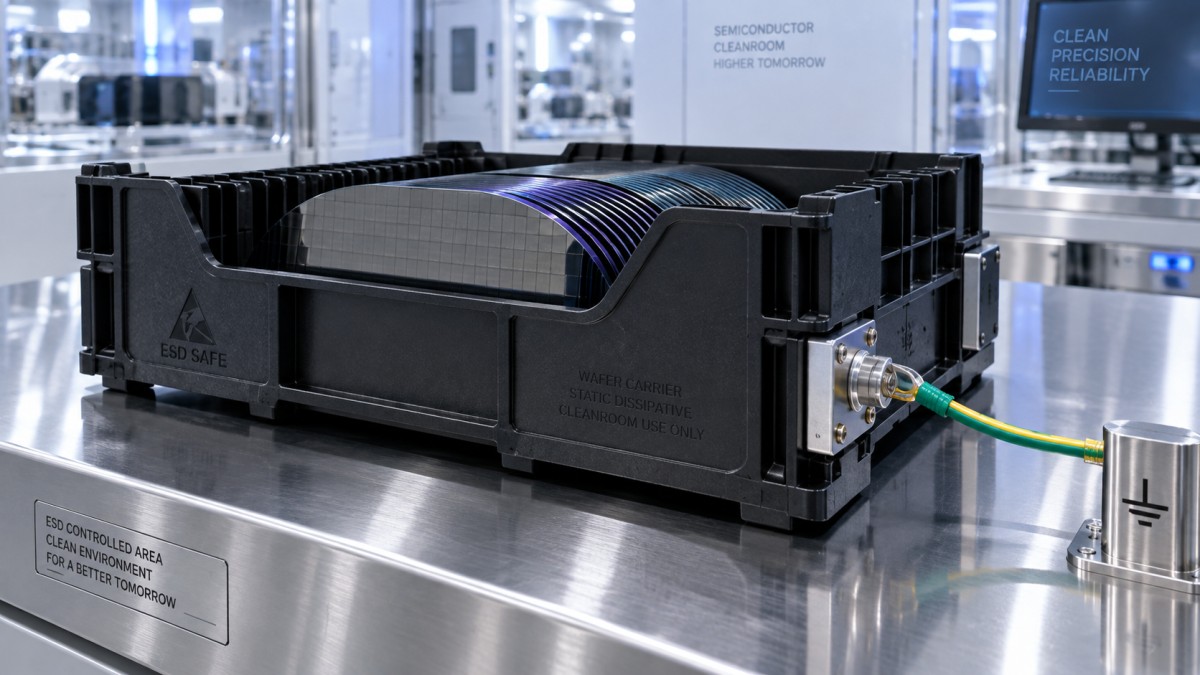
Plastic injection molding affects electrostatic discharge performance because molding changes how conductive additives distribute, orient, migrate, and appear at a component’s finished surface.
In a cleanroom, even a modest electrostatic charge can attract airborne particles, disrupt sensitive electronics, interfere with wafer handling, or create uncontrolled discharge events.
Technical evaluators should therefore treat injection-molded housings, trays, enclosures, fixtures, ducts, panels, and tool interfaces as functional parts of the ESD-control system.
Electrostatic risk is not limited to catastrophic damage. Latent damage may reduce semiconductor reliability without causing an immediate failure during production or inspection.
Plastics are widely used because they are lightweight, chemically resistant, corrosion resistant, moldable, and economical at scale. Those benefits also create electrical-control challenges.
Most unmodified polymers are strong electrical insulators. They can retain charges generated through handling, friction, airflow, film removal, sliding contact, and automated movement.
Dry cleanroom air increases this concern. Low relative humidity limits natural charge dissipation, making material-level ESD performance more important than in ordinary industrial spaces.
The relevant question is not whether plastic injection molding is compatible with ESD control. The question is whether a specific molded part can maintain controlled charge behavior throughout service.
Start With the Required Electrical Performance Window
Before selecting a resin, define the electrical range required by the process, the protected device sensitivity, the component’s function, and the applicable customer specifications.
Static-dissipative materials generally release charge gradually, while conductive materials create a faster path to ground. Neither category is automatically suitable for every application.
A very conductive plastic can create unintended current paths or fail to meet isolation requirements. A highly resistive plastic may retain charge long enough to endanger devices.
Surface resistance, volume resistance, resistance-to-ground, charge decay, and triboelectric charging behavior answer different questions. Evaluators should not substitute one measurement for another.
Surface resistance is particularly relevant when operators, carriers, tools, and automation contact the exterior of a molded component during normal cleanroom activity.
Volume resistance becomes more significant when the part must conduct charge through its thickness toward a grounded frame, embedded contact, or conductive mounting arrangement.
Charge-decay testing helps determine how quickly a material loses an induced charge. This can better represent practical risk than a single resistance measurement alone.
Requirements should identify test voltage, probe configuration, conditioning environment, test locations, acceptable limits, and requalification intervals before tooling approval begins.
Without a defined performance window, suppliers may optimize for moldability or nominal conductivity while missing the actual ESD behavior needed at the point of use.
How Resin Selection Changes ESD and Cleanroom Performance
Base polymer choice affects electrical behavior, chemical compatibility, moisture uptake, outgassing, thermal stability, mechanical durability, and the ability to withstand cleaning protocols.
Common engineering polymers include polypropylene, polyethylene, polycarbonate, ABS, PEEK, PPS, PVDF, PEI, and fluoropolymer-based materials, each with different processing limitations.
Conductive carbon black is frequently used because it can produce stable conductive pathways at comparatively low loading levels and is generally cost effective.
However, carbon black can create particle, appearance, contamination, and conductivity-uniformity concerns. It may be unsuitable for bright optical environments or sensitive analytical workflows.
Carbon fiber can improve stiffness and conductivity, but fiber orientation during molding may produce directional electrical behavior across different areas of the same component.
Metal-coated fibers, stainless fibers, intrinsically dissipative polymers, and specialty permanent antistatic additives may offer alternatives where carbon-filled materials are unacceptable.
Temporary antistatic additives deserve careful scrutiny. Some depend on humidity, can migrate toward the surface, and may lose effectiveness after cleaning or prolonged exposure.
For controlled environments, additive stability matters as much as initial resistivity. Surface bloom, extractables, particle shedding, and chemical residues can compromise contamination objectives.
A material should be assessed against the complete duty cycle: molding, packaging, transport, cleanroom entry, installation, cleaning, maintenance, and end-of-life replacement.
Why Injection Molding Parameters Can Alter Electrical Uniformity
Even with the correct resin grade, poorly controlled plastic injection molding can produce parts with inconsistent ESD behavior between cavities, batches, surfaces, and production locations.
During filling, conductive fillers can orient with polymer flow. Weld lines, gate locations, ribs, corners, and thin sections may interrupt or weaken conductive networks.
High shear can alter filler dispersion, while inadequate mixing can leave agglomerates. Both conditions increase variability and make nominal material data less predictive.
Melt temperature, mold temperature, injection speed, holding pressure, back pressure, and screw design can influence final conductivity, shrinkage, stress, and surface finish.
Regrind use requires special control. Reprocessed material can change filler distribution, moisture content, contamination risk, mechanical strength, and resistance measurements across lots.
Drying conditions also matter for hygroscopic resins. Improper drying can cause splay, voids, degraded polymer chains, unstable dimensions, and weak electrical consistency.
Tooling design should support repeatability. Balanced runner systems, stable gate design, controlled cooling, and cavity-specific traceability help identify molding-driven ESD variation.
Parts should be tested at meaningful locations, including broad surfaces, high-contact points, thin walls, molded ribs, weld lines, and interfaces connected to grounding hardware.
For critical applications, evaluators should request data by cavity and production lot rather than accepting a single average value from a representative sample.
Particle Control and ESD Control Must Be Evaluated Together
Electrostatic charge can increase contamination risk by attracting particles to surfaces that would otherwise remain comparatively clean during transport, handling, and equipment operation.
This relationship matters in ISO Class 1 through ISO Class 7 environments, where particle deposition can affect yield, inspection accuracy, coating quality, and device reliability.
Conductive fillers may reduce charge retention, but they can introduce their own cleanliness concerns. The evaluation must consider both electrical control and contamination-control compatibility.
Carbon-filled compounds may shed particles if surfaces are poorly molded, abraded, mechanically stressed, or repeatedly contacted by carriers, operators, robotic systems, or fixtures.
Surface texture is therefore important. Rough surfaces can trap contamination, increase frictional charging, complicate wiping, and accelerate wear during repeated automated handling cycles.
Highly polished molds can improve cleanability, although polished surfaces alone do not guarantee controlled surface resistance or eliminate all filler-related contamination mechanisms.
Cleaning agents must be qualified with the molded resin. Alcohols, oxidizers, surfactants, disinfectants, and ultrapure-water rinses may affect additives, coatings, or surface energy.
Assess extractables, nonvolatile residue, outgassing, odor, and particle generation using methods relevant to the facility’s process risks and internal contamination-control specifications.
For semiconductor facilities, the preferred solution often combines ESD verification with particle-shedding and cleanability testing under representative airflow, humidity, handling, and cleaning conditions.
Grounding Cannot Be Assumed From a Conductive Resin
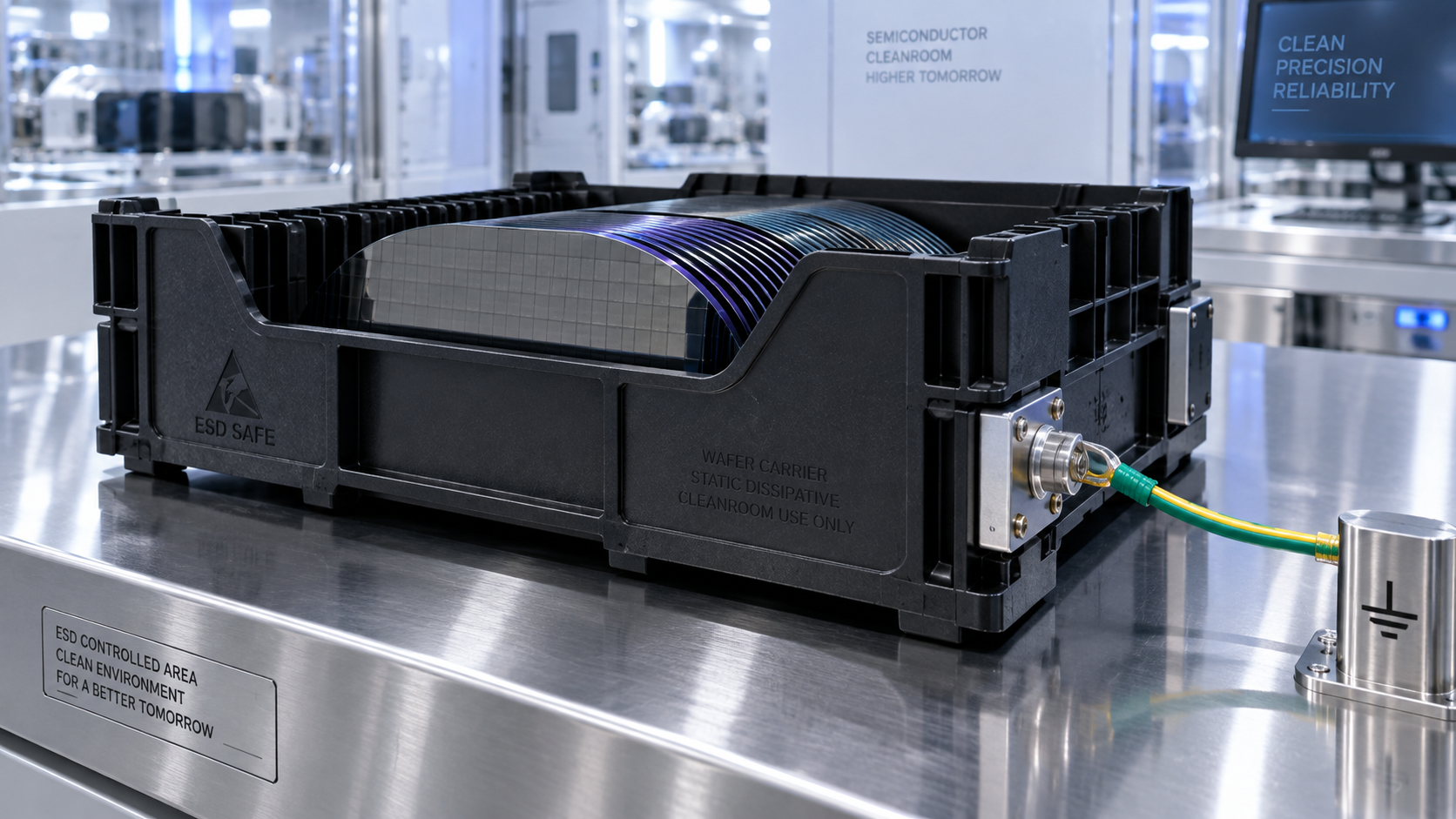
A conductive or dissipative molded component is not automatically grounded. It needs a deliberate electrical path from the working surface to a verified ground reference.
Grounding may depend on metal inserts, conductive fasteners, grounding straps, coated interfaces, spring contacts, conductive frames, or bonded equipment structures.
Designers should avoid assuming that painted surfaces, anodized aluminum, isolated fasteners, lubricated contacts, or removable panels will provide reliable electrical continuity.
Resistance-to-ground should be measured after assembly, not only on loose molded samples. Installation details often determine the actual performance seen by operators and equipment.
Mechanical changes can also break grounding continuity. Wear, cleaning, corrosion, retorquing, replacement parts, and vibration may change contact pressure and electrical resistance.
Where a molded component must isolate one circuit while dissipating charge elsewhere, the design should clearly separate conductive paths from electrically protected areas.
Technical evaluators should request assembly drawings that identify grounding locations, bonding hardware, expected resistance ranges, inspection access, and maintenance responsibilities.
ESD controls should align with the facility’s broader grounding architecture, including conductive flooring, workstations, personnel grounding, equipment bonding, and monitored grounding points.
A Practical Qualification Framework for Technical Evaluators
Effective qualification begins by translating process risk into measurable acceptance criteria. This prevents a supplier’s standard resin specification from becoming the only decision basis.
First, define the component’s exposure. Consider direct device contact, automated handling, operator contact, airflow exposure, chemical cleaning, thermal cycling, and expected service life.
Second, select material candidates using electrical, mechanical, chemical, contamination, and cost criteria. Review both virgin resin documentation and compound formulation controls.
Third, require trial molding using production-intent tooling and process conditions. Prototype samples made from different tooling may not represent final filler orientation or surface behavior.
Fourth, test electrical performance after conditioning at the actual cleanroom humidity and temperature range. Standard laboratory conditions may hide low-humidity failure modes.
Fifth, test after cleaning, abrasion, aging, thermal exposure, and repeated handling. Initial performance is less valuable when a component degrades after several maintenance cycles.
Sixth, verify particle generation and cleanability using the facility’s contamination-control methods. A suitable electrical result cannot offset unacceptable particle performance.
Finally, establish incoming inspection, lot traceability, process-change notification, and periodic requalification. ESD performance should remain controlled after initial product release.
Common Procurement Errors and How to Avoid Them
A common error is specifying only “ESD plastic” without a numerical range, a test method, environmental conditioning, or a requirement for assembled resistance-to-ground.
Another mistake is approving a resin based on supplier literature while ignoring actual component geometry. Thin walls and weld lines can behave differently from standard test plaques.
Some teams focus entirely on surface resistance and overlook charge generation. A material may meet resistance targets while still accumulating problematic charge during frictional use.
Cleanroom teams may also overlook maintenance chemistry. Repeated disinfection or solvent wiping can alter the surface, remove coatings, or expose filler-rich regions.
Cost-driven resin substitution is a major risk. Similar-looking compounds can differ in filler chemistry, loading, moisture sensitivity, extractables, and long-term electrical stability.
Change control should cover resin supplier, compound grade, colorant, additive package, regrind ratio, tooling, gate configuration, and key molding parameters.
Supplier quality agreements should define notification requirements before changes occur. Retesting after an unannounced formulation change is often costly and operationally disruptive.
Technical evaluators should also confirm whether the supplier understands cleanroom packaging, handling, traceability, and contamination expectations beyond conventional injection molding quality controls.
Conclusion: Select the Molded System, Not Just the Polymer
Plastic injection molding can support effective ESD protection in cleanrooms, but only when electrical performance, cleanability, process consistency, and grounding are engineered as one system.
The strongest selection decisions use defined electrical limits, production-intent samples, environmental conditioning, contamination testing, and documented grounding verification after final assembly.
For high-value semiconductor, pharmaceutical, quantum, and precision-electronics operations, nominal resin conductivity is not enough evidence to justify deployment in controlled environments.
Technical evaluators should prioritize repeatable, verified behavior over broad material labels. That approach reduces latent ESD risk, particle attraction, qualification delays, and premature component replacement.
When plastic injection molding is specified with these controls, molded components can provide durable, cleanable, scalable ESD performance while supporting ISO 14644-aligned cleanroom operations.
Get weekly intelligence in your inbox.
No noise. No sponsored content. Pure intelligence.
 Sep 17, 2026How plastic injection molding affects ESD protection in cleanroomsPlastic injection molding affects ESD protection in cleanrooms. Learn how resin choice, molding consistency, grounding, and particle control support reliable compliance.
 Sep 16, 2026What to verify before choosing an industrial air quality monitoring supplierIndustrial air quality monitoring supplier checklist: verify measurement accuracy, calibration traceability, data integration, compliance support, and lifecycle service before you buy.
 Sep 15, 2026Smart HVAC investment insights for North American heat recovery projectsSmart HVAC investment insights North America: evaluate heat recovery, lifecycle costs, controls, and performance for resilient project decisions.
 Sep 14, 2026How SEMI standards shape water treatment design for semiconductor fabsSemiconductor water treatment SEMI guidance shapes resilient UPW design, contamination control, monitoring, reclaim strategy, and fab-ready validation.
 Sep 13, 2026What drives Biosafety Containment Systems cost in BSL-3 projects?Biosafety Containment Systems cost in BSL-3 projects depends on HVAC, layout, decontamination, controls, and commissioning. Discover how to build a credible budget.
 Sep 12, 2026How to qualify a fine chemical process solutions supplier for purity controlFine Chemical Process Solutions supplier qualification guide: evaluate purity control, traceability, contamination prevention, and safety for reliable high-purity production.
 Sep 11, 2026What drives cleanroom certification cost for ISO Class 1–9 projects?Cleanroom certification cost depends on ISO Class 1–9 requirements, test scope, HVAC readiness, documentation, and retesting. Explore practical budgeting insights to control project risk.
 Sep 10, 2026When should Procurement Directors prioritize heat recovery payback?Procurement Directors: learn when heat recovery delivers reliable payback, lower lifecycle costs, and safe performance in controlled industrial environments.
 Sep 09, 2026How to select an environmental monitoring system for cleanroomsEnvironmental monitoring system selection for cleanrooms: compare sensors, alarms, data integrity, integration, and installation to ensure reliable control.
 Sep 08, 2026How temperature stability affects semiconductor manufacturing yieldSemiconductor manufacturing temperature stability directly affects yield, overlay, metrology, and process control. Explore practical HVAC, monitoring, and zoning strategies.
 Sep 07, 2026How to prepare for a Regulatory Frameworks audit of cleanroom controlsRegulatory Frameworks audit readiness for cleanroom controls: build traceable evidence, verify alarms and monitoring, and close compliance gaps with confidence.
 Sep 07, 2026How to choose reverse osmosis systems with the right recovery rateReverse osmosis systems: learn how to select the right recovery rate for reliable water quality, lower scaling risk, efficient concentrate control, and stable long-term performance.
 Sep 05, 2026How does a negative pressure room work to contain airborne contaminants?How does a negative pressure room work? Discover how inward airflow, controlled exhaust, monitoring, and room design help contain airborne contaminants safely.
 Sep 04, 2026How Should Semiconductor Facilities Select Vibration Isolation Systems?Vibration isolation semiconductor guide: learn how to match tool limits, site vibration, utilities, and cleanroom needs for stable, high-yield fab performance.
 Sep 04, 2026What TOC Limits Should Be Set and Monitored for a UPW Loop?What are our TOC limits for the UPW loop? Learn how to set defensible TOC thresholds, monitor trends, protect critical processes, and improve water-quality control.
 Sep 04, 2026What Are the Best Retrofit Options for Upgrading Existing Pharmaceutical Cleanrooms?What are the best retrofit options to upgrade existing pharma cleanrooms? Explore FFUs, HVAC modernization, pressure cascades, monitoring, and sealed finishes for compliant performance.
 Sep 04, 2026How Does a Negative Air Pressure Room Protect Adjacent Areas?What is a negative air pressure room? Learn how controlled airflow contains airborne hazards, protects adjacent spaces, and supports safer facility operations.
 Sep 04, 2026What Is ISO Class 1 Cleanroom Classification, and Where Is It Used?What is ISO Class 1? Explore its ultra-low particle limits, critical cleanroom design factors, verification methods, and uses in semiconductor, optics, and quantum manufacturing.
 Sep 04, 2026How Long After a UPW Deviation Does Yield Impact Typically Appear?What is the typical time lag from UPW deviation to yield impact? Learn how contamination, process sensitivity, exposure windows, and testing stages shape detection timing.
 Sep 04, 2026What Testing Data Should Engineers Review Before Approving a UPW Material?What testing data should be reviewed before approving a UPW material? Explore extractables, TOC, particle release, ionic leaching, corrosion, and reliability data for confident approval.
 Sep 04, 2026How Should Pharmaceutical Cleanrooms Choose Climate Control Systems?Which climate control systems are recommended for pharmaceutical cleanroom environments? Explore HVAC, humidity, pressure, HEPA filtration, and GMP-ready monitoring strategies.
 Sep 04, 2026Airtight Door Problems in Medical Spaces and How Buyers Prevent ThemA problem-solving guide for airtight door procurement, covering sealing performance, sensors, wall coordination, cleaning, maintenance, and acceptance risk.
 Sep 04, 2026What drives cleanroom design cost for ISO Class 7 projects?Cleanroom design cost for ISO Class 7 projects depends on HVAC, filtration, utilities, validation, and lifecycle strategy. Learn how to control budgets without compromising compliance or performance.
 Sep 03, 2026When do heat pipe heat exchangers suit pharmaceutical cleanrooms?Heat Pipe Heat Exchangers for pharmaceutical plants: discover when they support cleanroom energy recovery, airflow separation, humidity control, and GMP-ready HVAC design.
 Sep 02, 2026What determines biosafety cabinets price across different modelsBiosafety cabinets price varies by class, airflow design, filtration, size, certification, and installation. Compare models confidently to choose safe, cost-effective containment.
 Sep 01, 2026When does thermal energy storage cut peak-demand costs in plants?Thermal energy storage for industrial plants can cut peak-demand costs when tariffs, load profiles, and controls align. Explore practical savings, resilience, and integration factors.
 Aug 31, 2026How a digital environmental monitoring system supports audit-ready cleanroomsDigital environmental monitoring system strategies for audit-ready cleanrooms: improve traceability, alarm response, data integrity, and compliance confidence.