How Should Pharmaceutical Cleanrooms Choose Climate Control Systems?
How Should Pharmaceutical Cleanrooms Choose Climate Control Systems?
Selecting climate control for pharmaceutical cleanrooms requires more than maintaining a comfortable room temperature. The HVAC system is part of the contamination-control strategy, the pressure-control strategy, and often the evidence package used to demonstrate that a facility remains in a validated state. For teams asking, “which climate control systems are recommended for pharmaceutical cleanroom environments?”, there is no single equipment answer. The appropriate architecture depends on the product, process, room classification, containment obligations, heat and moisture loads, local climate, utility resilience, and the site’s ability to maintain and qualify the system over time.
A cleanroom may pass an initial particle test yet still be operationally fragile. Unstable humidity can affect powders, capsules, coatings, and packaging. Poor air balancing can reverse a pressure cascade when doors cycle. An undersized cooling coil can make summer dehumidification impossible without compromising supply-air temperature. These are not isolated mechanical issues; they can become production, quality, and investigation issues.
The practical goal is therefore not to purchase the most sophisticated HVAC plant. It is to build a controllable, cleanable, maintainable environmental system whose performance can be measured, challenged, documented, and restored after disturbance.
Start With the Manufacturing Risk, Not the Air-Handling Unit
The first decision should be whether the room primarily protects the product, protects the operator and surrounding environment, or must do both. A non-sterile oral solid dose suite, an aseptic filling area, a potent-compound handling room, and a microbiology laboratory may all be called “cleanrooms,” but their air-management logic is fundamentally different.
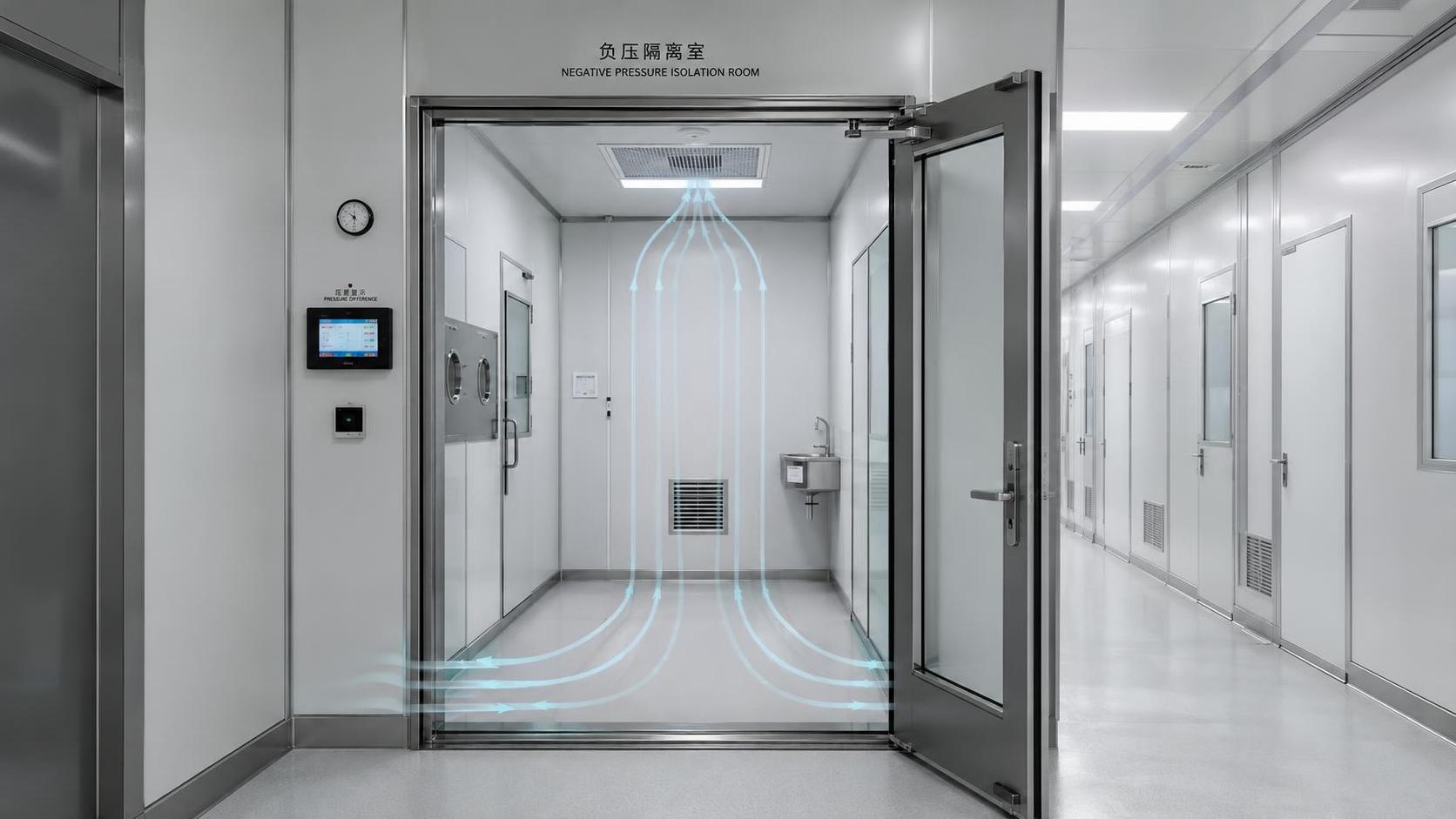
For product protection, facilities generally establish cleaner air in critical areas and maintain directional airflow from cleaner to less-clean spaces. For containment, the pressure relationship may need to favor inward airflow toward the hazardous process. Where both sterility assurance and containment are involved, the design becomes more demanding: the pressure cascade, exhaust arrangement, room segregation, transfer routes, and recovery behavior after a door opening need to be assessed together.
This is why a room-by-room user requirement specification is more useful than beginning with a preferred chiller brand or fan type. It should define the intended operation, occupancy pattern, equipment heat release, process exhaust, cleaning cycles, material movement, pressure relationships, environmental limits, alarm response, and required availability. The HVAC concept follows from those requirements.
The Recommended Baseline: Dedicated, Zoned, and Qualified Air Treatment
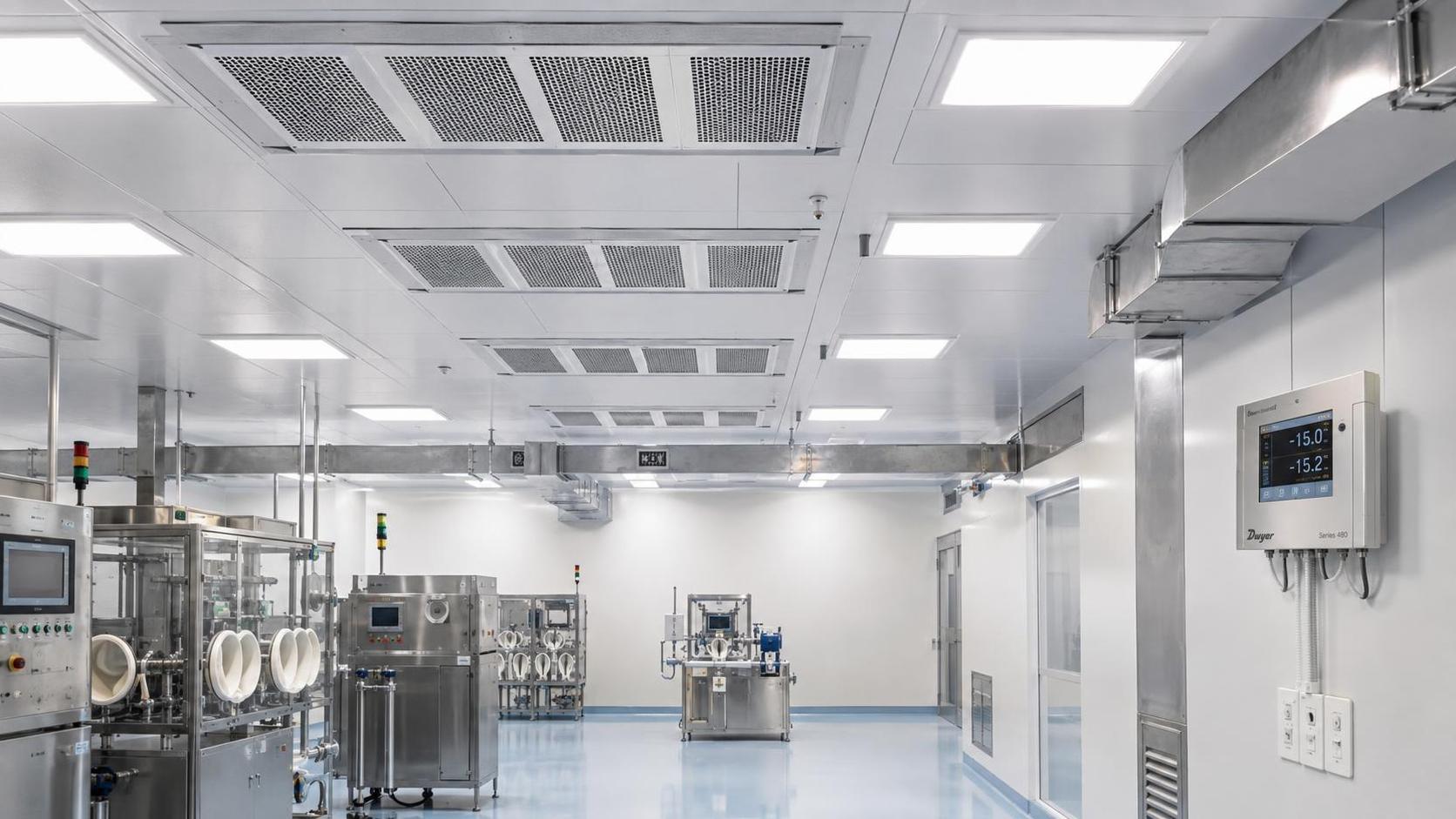
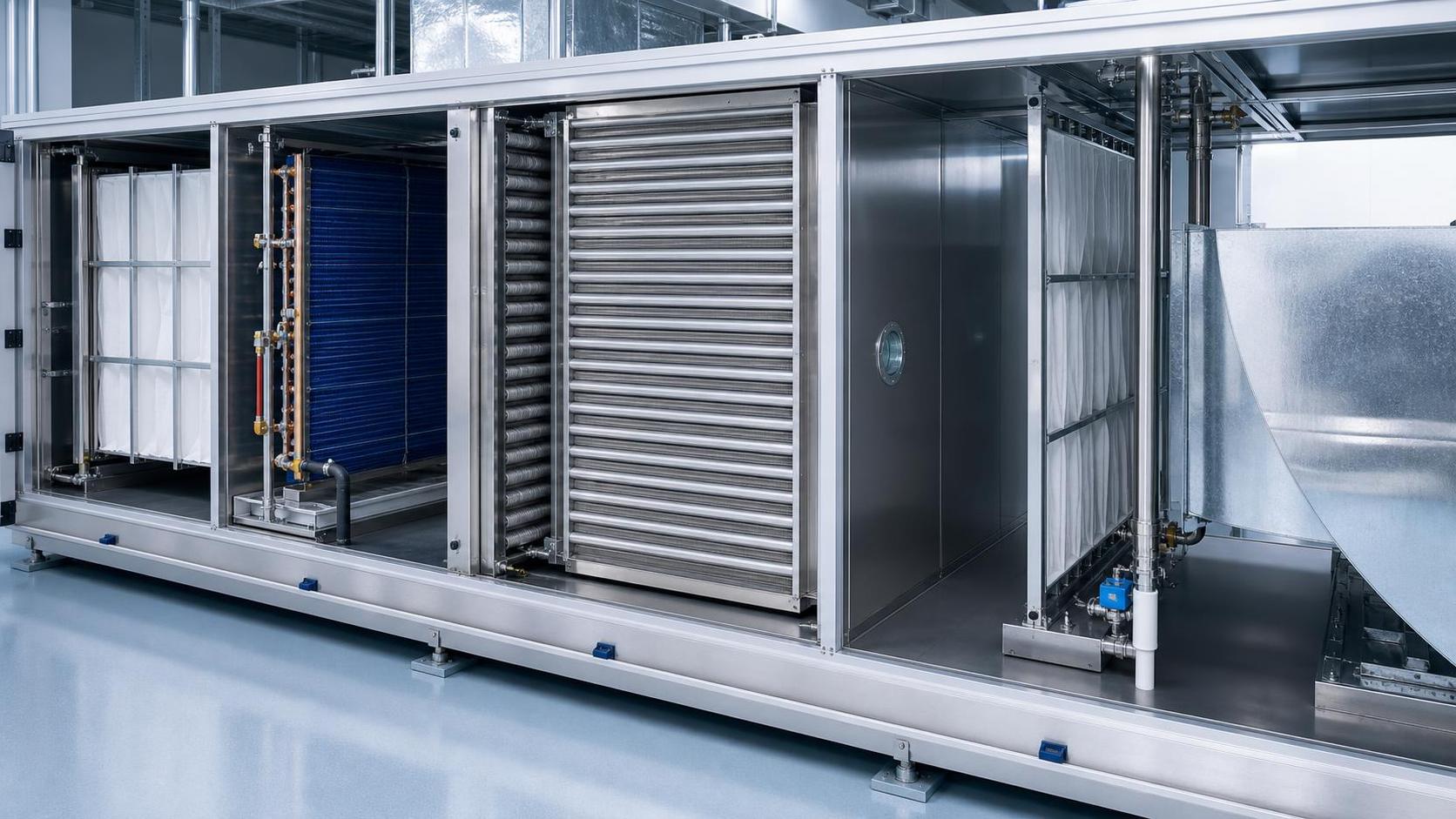
For most pharmaceutical production environments, the most defensible starting point is a dedicated or carefully segregated central air-handling system serving defined cleanroom zones. It typically combines outdoor-air treatment, recirculated air, staged filtration, cooling and heating capacity, humidity control, supply and return or exhaust paths, and a building automation system capable of trend recording and alarm management.
Dedicated air-handling units are often preferred where process criticality, cross-contamination risk, or differing humidity conditions make shared systems difficult to justify. Shared infrastructure may be technically viable in some lower-risk support areas, but it demands a clear segregation rationale. Return-air paths, maintenance access, duct leakage, filter replacement procedures, and failure modes should be reviewed before treating shared service as a cost-saving default.
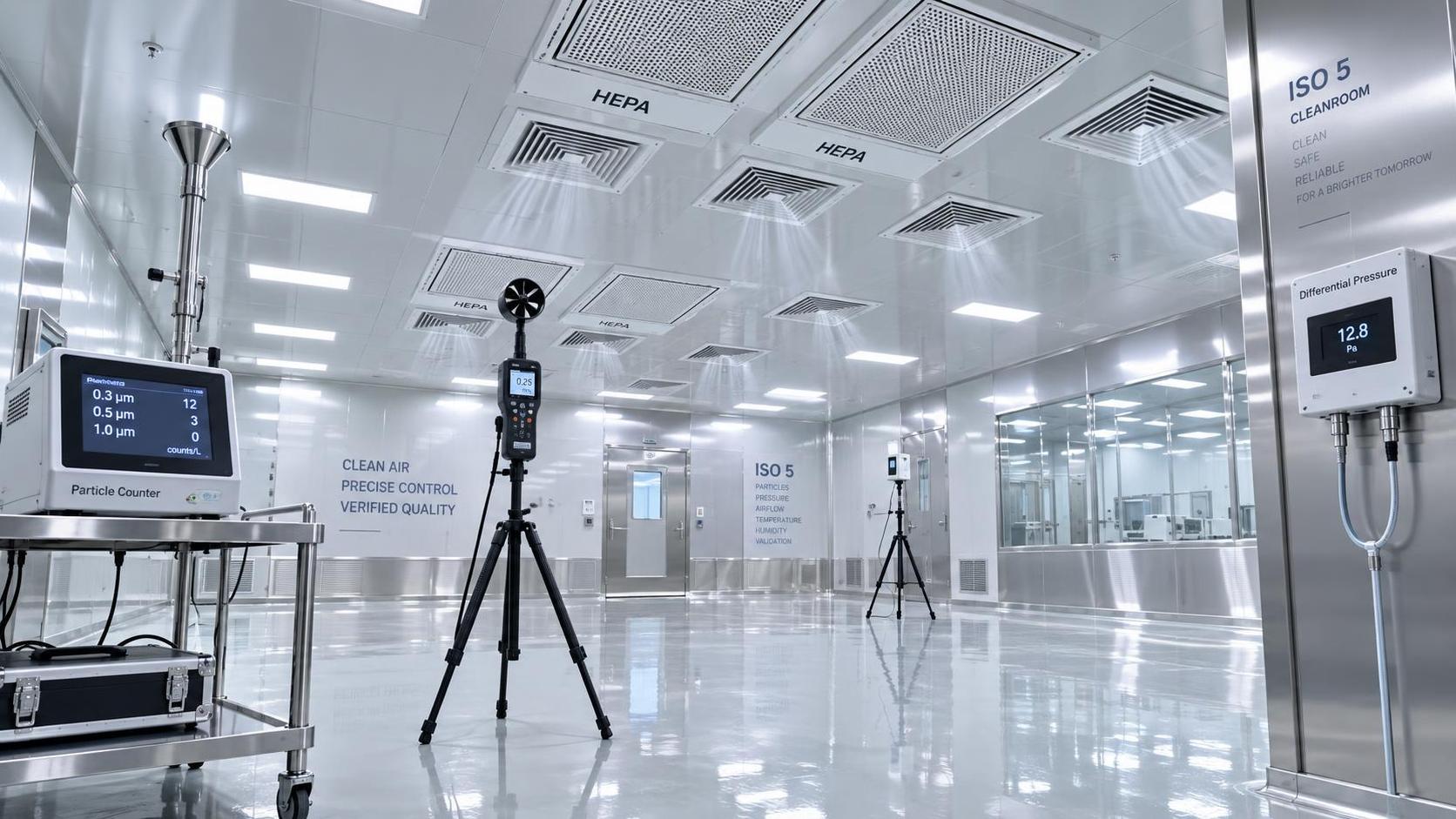
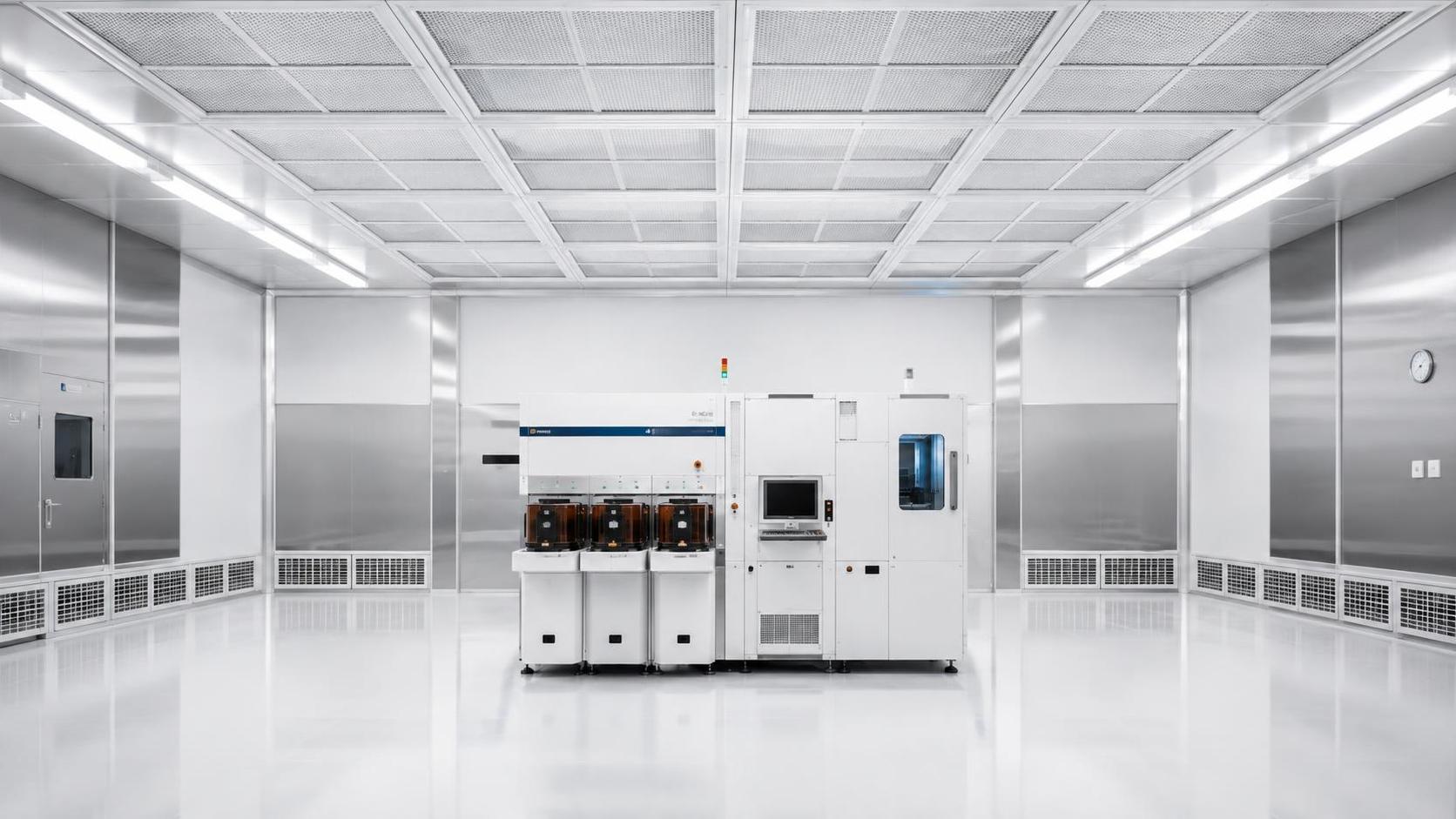
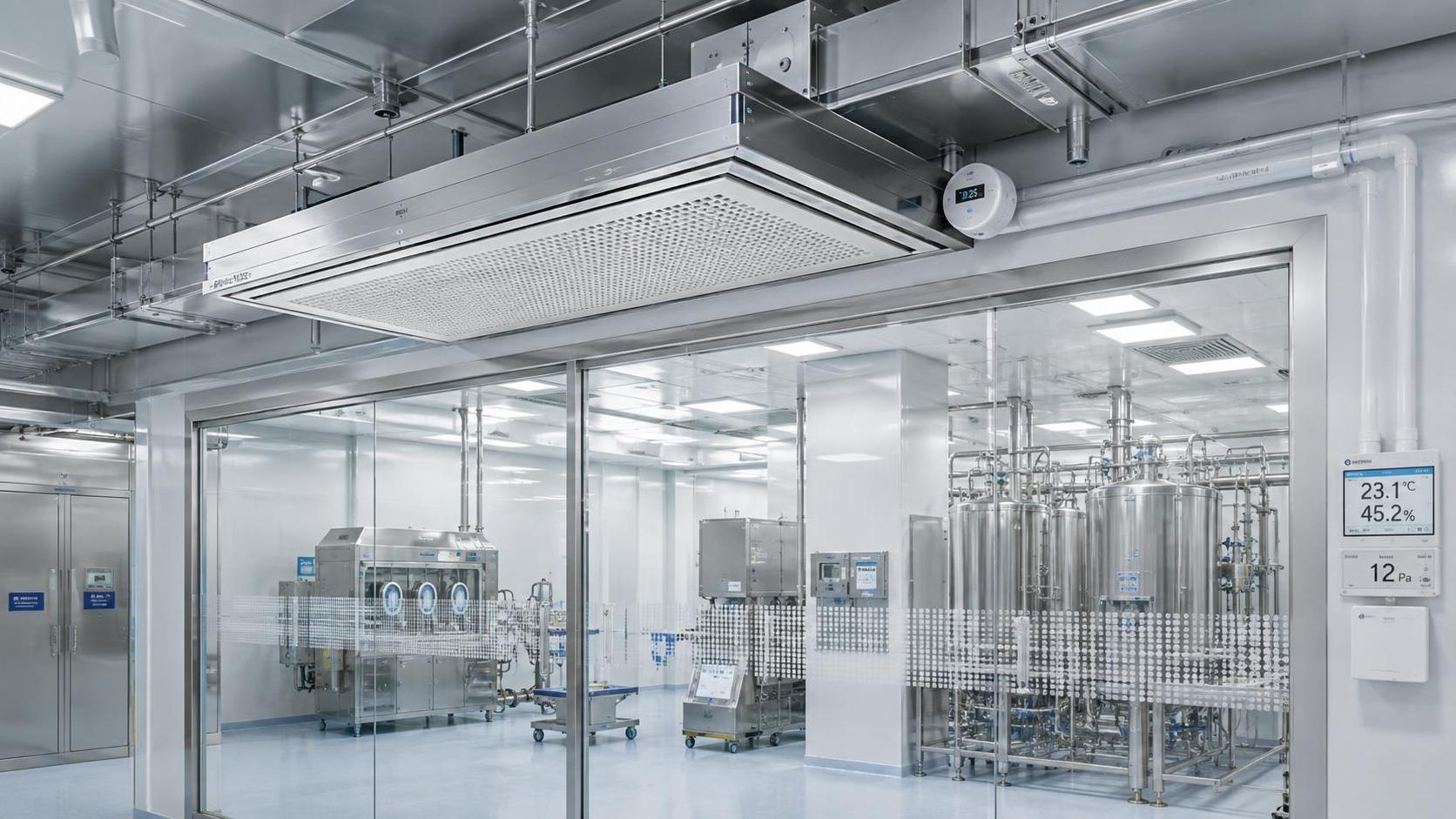
At terminal level, HEPA-filtered supply air is common in controlled pharmaceutical spaces, while the exact final filtration arrangement should be aligned with the room’s classification and process risk. Critical aseptic zones may use unidirectional airflow devices or localized protection rather than relying on a general room supply pattern alone. Fan filter units can provide useful modularity in selected applications, especially where ceiling-plenum constraints or future layout changes matter, but they increase the number of assets requiring monitoring, maintenance, and coordinated control.
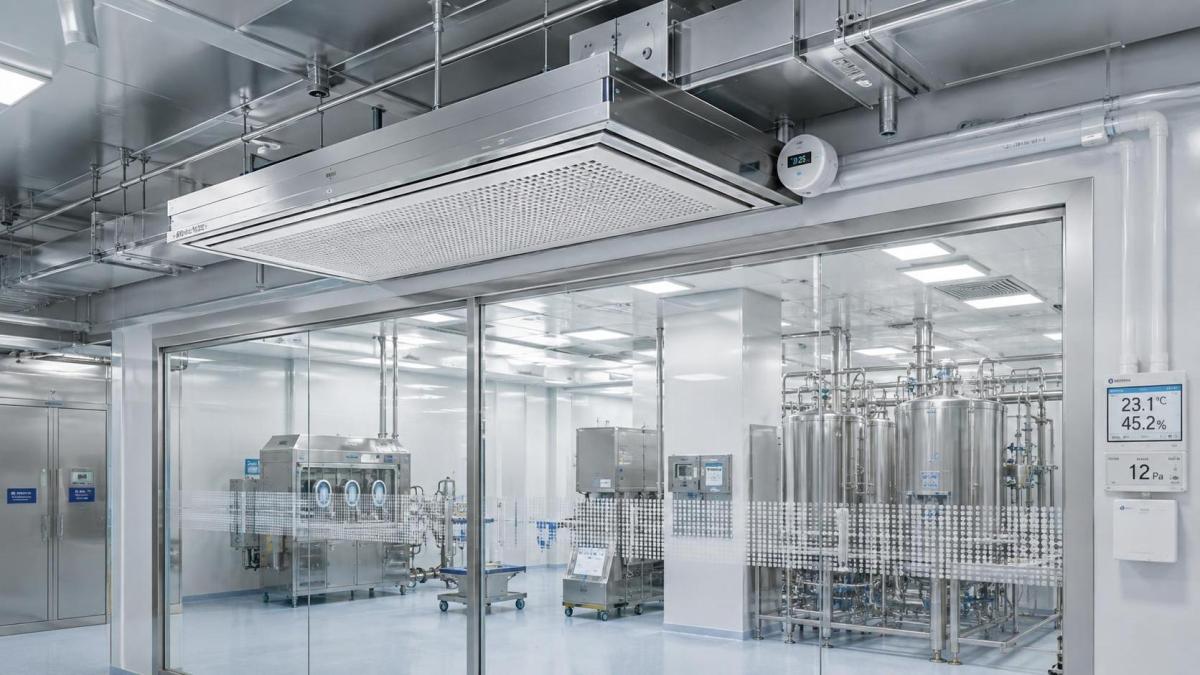
The recommended system is therefore usually a hierarchy: stable central conditioning for temperature and moisture removal; appropriately filtered and balanced room air distribution; localized airflow protection where the process requires it; and independent sensing to verify that the environmental outcome matches the design intent.
Humidity Control Is Often the Deciding Engineering Constraint
Temperature receives the most attention in early discussions because it is visible to occupants. Humidity is frequently harder to control and more consequential to the process. Hygroscopic powders, gelatin-based materials, film coatings, balance rooms, packaging operations, and certain analytical activities can all be sensitive to moisture conditions. Meanwhile, excess humidity can support microbial concerns in poorly managed areas or create condensation risks around cold surfaces and poorly insulated ductwork.
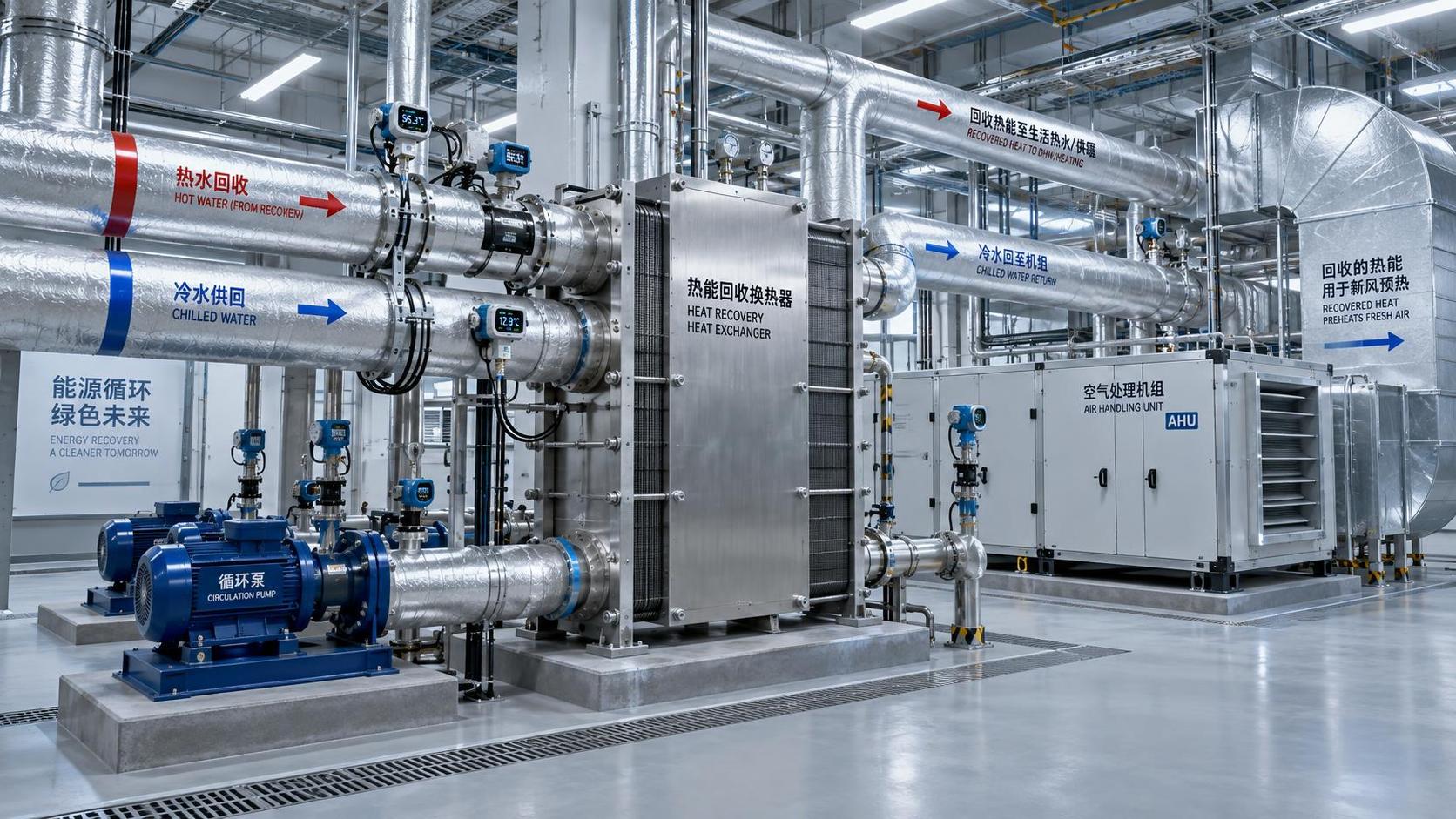
A cooling coil dehumidifies only when its surface condition is sufficiently below the air dew point. That basic fact creates a common design problem: a system can meet sensible cooling demand while lacking enough latent capacity for humid weather, high outside-air volumes, washdown-related moisture, or changing occupancy. Reheat may then be required to deliver dry supply air without overcooling the room. Whether that reheat is electric, hot-water, heat-recovery based, or generated through another approach should be evaluated against local energy rules, utility reliability, and operating philosophy.
For facilities with demanding dry-room requirements, conventional comfort-oriented HVAC may not be enough. Desiccant dehumidification, often integrated with sensible cooling and heat recovery, can be considered where low moisture levels must be held reliably through seasonal variation. It should not be selected simply because low relative humidity sounds desirable. Very dry conditions can affect materials, personnel comfort, electrostatic behavior, and energy use. The requirement must come from process and quality risk assessment.
Airflow and Pressure Cascades Must Remain Stable During Real Operation
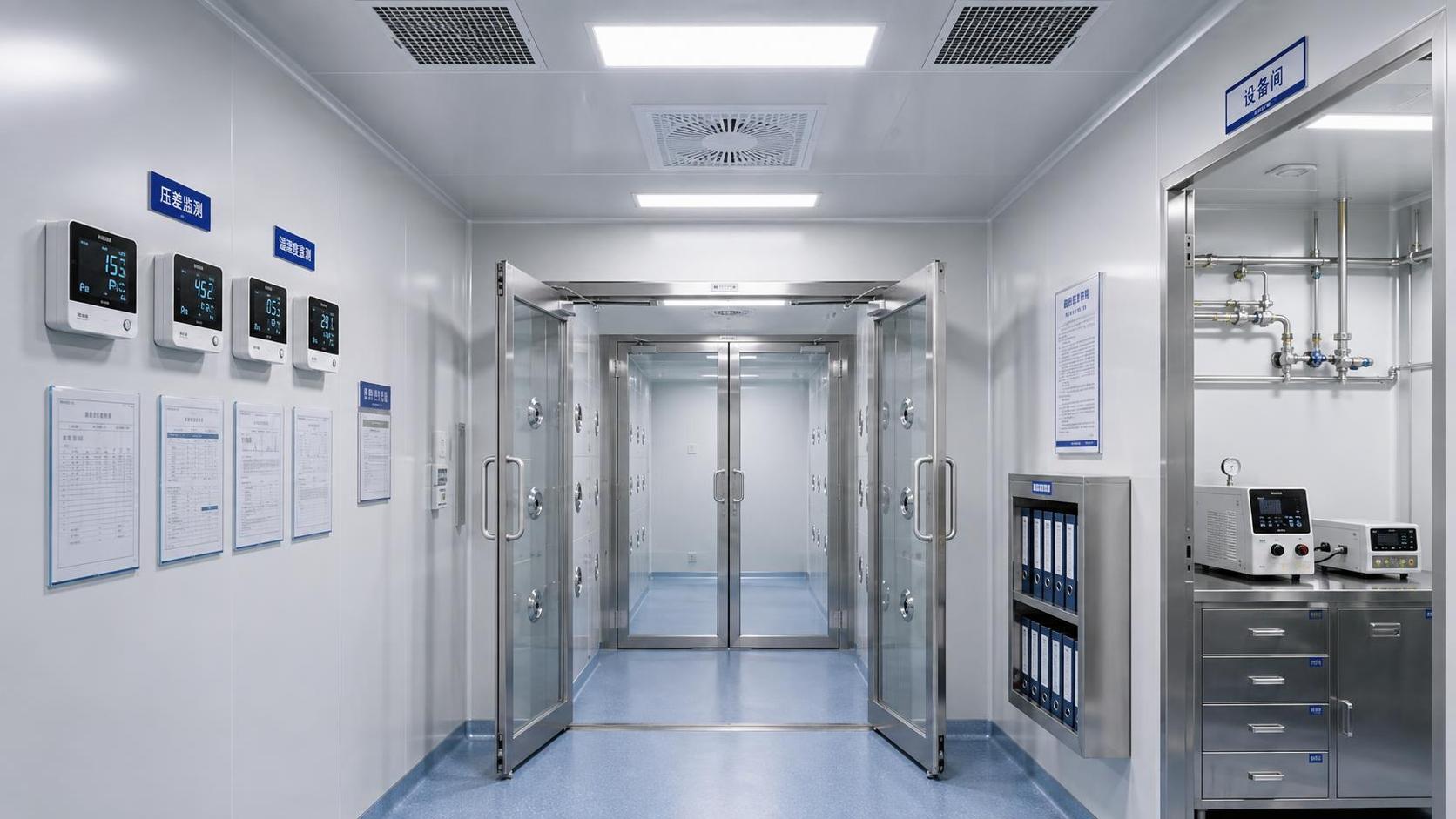
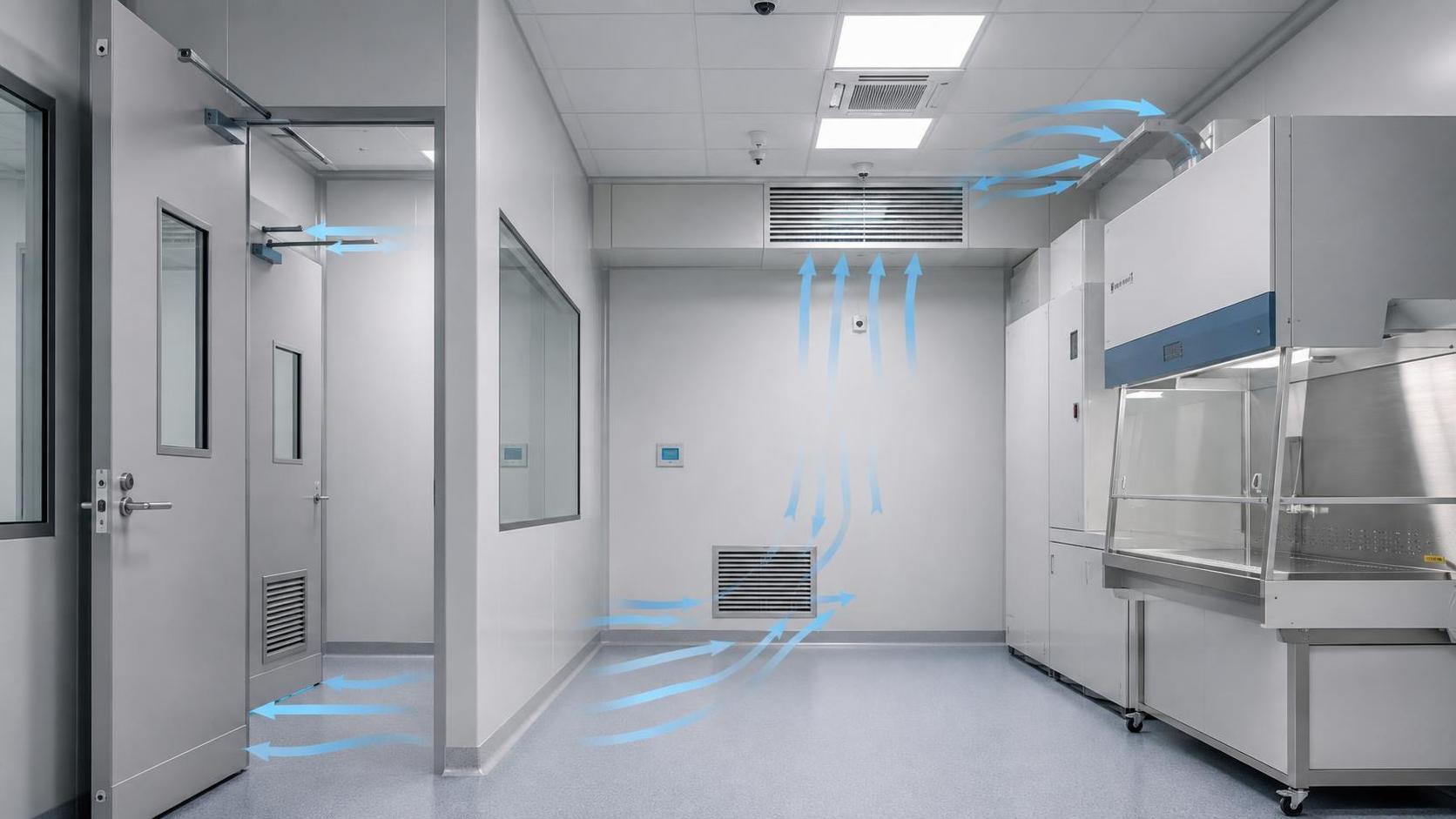
A pressure cascade is not a drawing annotation. It is a dynamic operating condition influenced by supply volume, return and exhaust volume, door openings, filter loading, damper position, adjacent-room behavior, and building pressure. Technical evaluators should ask not merely whether differential pressure transmitters are installed, but what happens when a door opens, a fan changes speed, a terminal filter approaches replacement condition, or one air-handling unit is unavailable.
Room pressure control is commonly achieved with a combination of airflow tracking, controlled return or exhaust dampers, variable-speed fans, and pressure sensors. The control sequence needs careful commissioning. A highly responsive loop may hunt and create instability; a slow loop may fail to recover promptly after disturbances. Sensor location also matters. A transmitter placed where turbulence, door drafts, or poorly sealed penetrations influence the reading can provide misleading reassurance.
Air changes per hour are sometimes used as a shortcut for comparing options, but they are not a universal measure of cleanliness or containment. Airflow pattern, supply diffuser location, return placement, equipment obstruction, personnel movement, and recovery performance can matter just as much. ISO 14644 provides a recognized framework for cleanroom classification and testing, yet its use should be connected to the specific pharmaceutical contamination-control strategy rather than reduced to a single airflow number.
Compare System Architectures by Their Operational Consequences
The table is not a prescriptive map. It is a reminder that every architecture shifts risk somewhere: toward energy consumption, maintenance complexity, commissioning effort, control-system dependence, or recovery time after failure.
Controls, Monitoring, and Data Integrity Cannot Be Added at the End
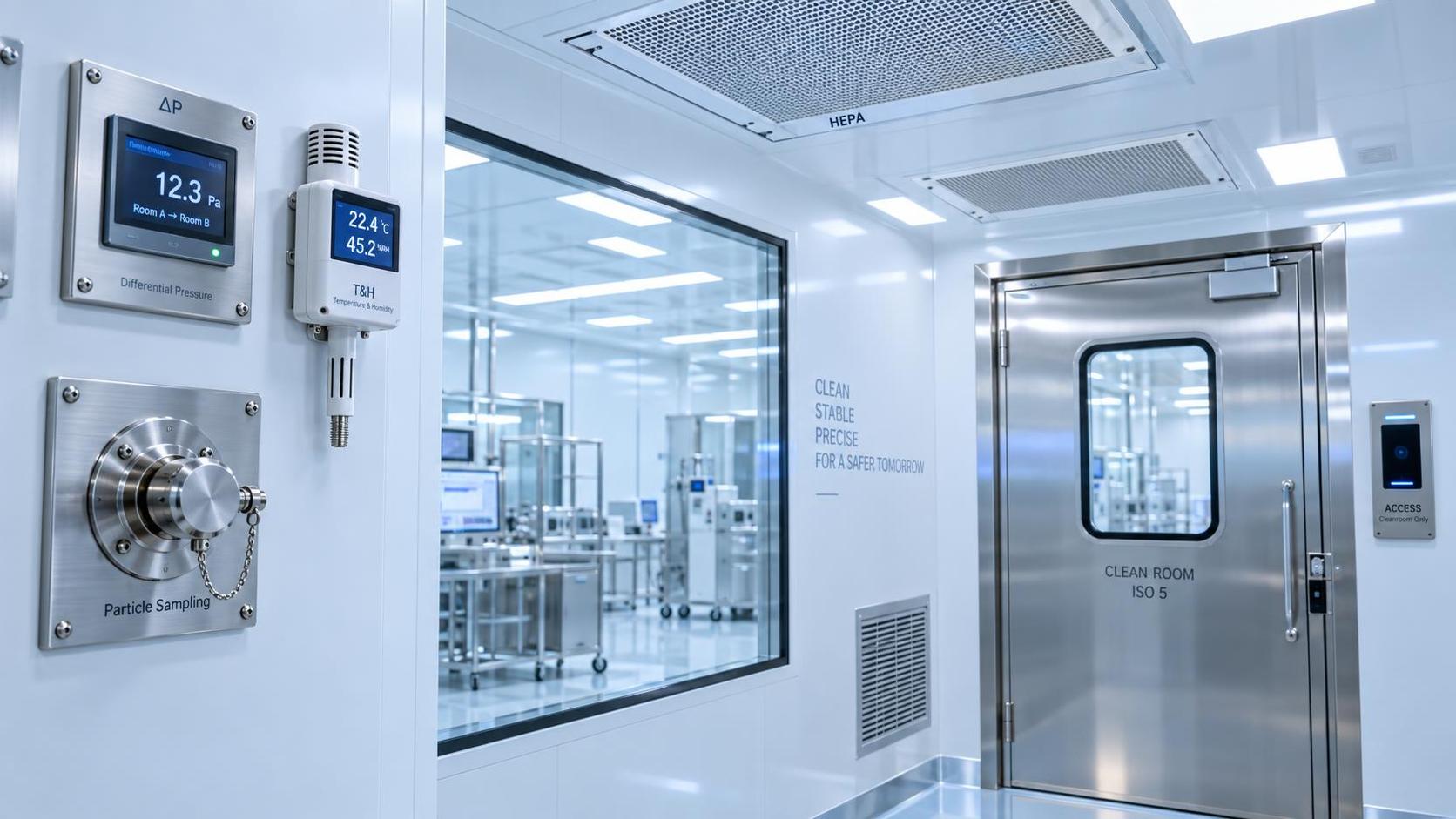
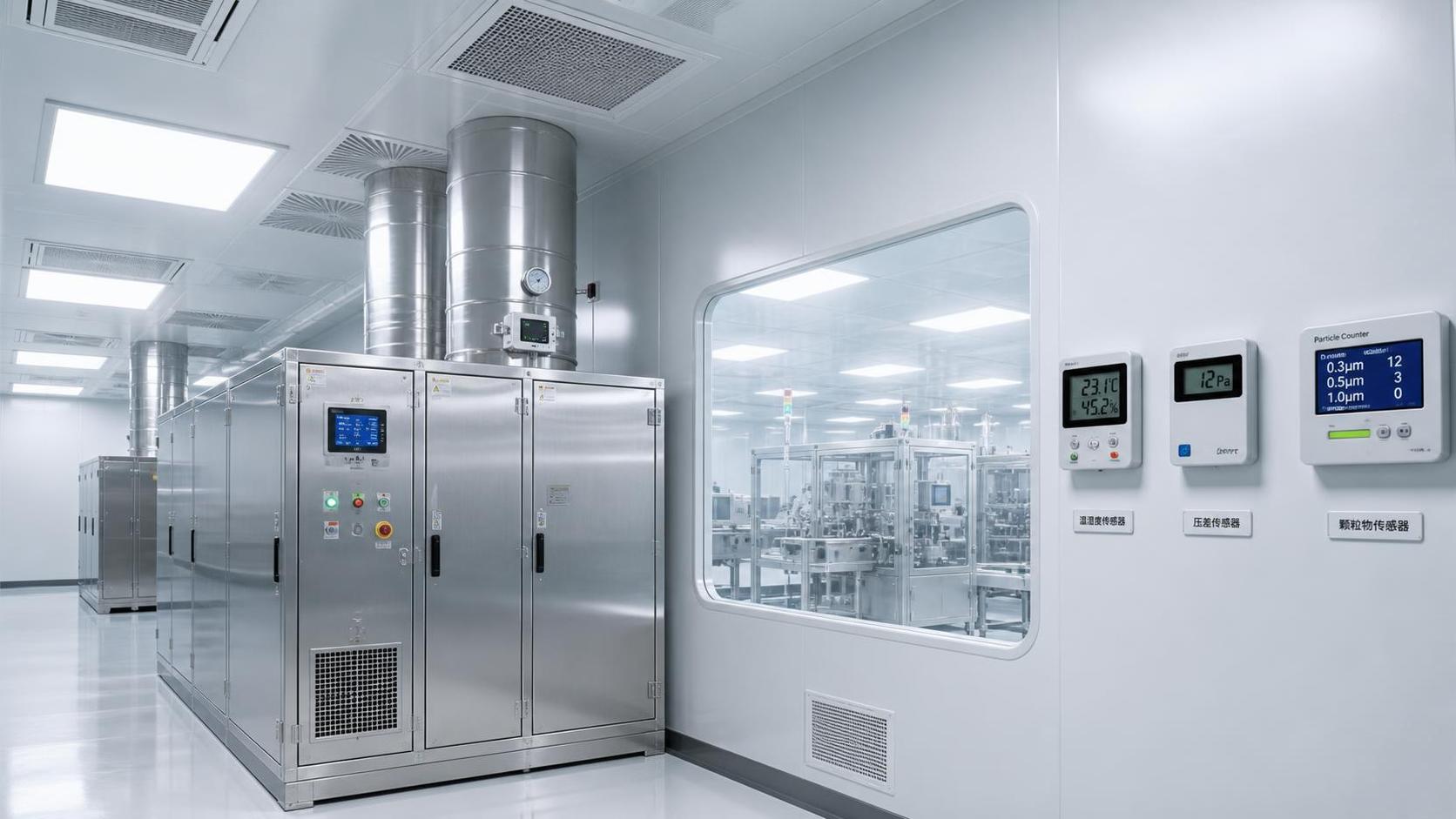
Pharmaceutical climate control should be designed as a monitored system, not a collection of mechanical components. Temperature, relative humidity, differential pressure, airflow status, filter differential pressure, fan condition, damper position, and utility alarms may all be relevant, depending on the process. The critical question is which variables directly support product quality, contamination control, or safe containment—and whether the sensor accuracy, calibration regime, alarm limits, and historian records are suitable for that purpose.
A building management system may handle supervisory control, while environmental monitoring systems and validated data platforms may have separate responsibilities. Integrating them can improve visibility, but integration should not blur ownership or data expectations. Alarm rationalization is especially important. If operators receive frequent nuisance alarms, the truly significant alarm may not receive the response it deserves.
Digital-twin methods can be useful for examining airflow, thermal behavior, equipment loading, and operational scenarios before major modifications. Their value lies in testing assumptions against a structured model, not in replacing commissioning or qualification. G-ICE approaches this intersection through its precision industrial HVAC, contamination-control, and smart environmental monitoring pillars, benchmarking hardware and control concepts against frameworks such as ISO 14644 and relevant ASHRAE guidance. For pharmaceutical projects, that multidisciplinary view is valuable because a cleanroom’s environmental performance is never purely a mechanical question.
Design for Qualification, Maintenance, and Failure Recovery
Systems that are difficult to test or maintain often become difficult to defend during audits and investigations. Filter housings should allow safe integrity testing and replacement. Coils, drain pans, humidification sections, and ducts need inspection and cleaning access. Control dampers and sensors should be reachable without unnecessary disruption to classified areas. Condensate management deserves attention because standing water inside an air-handling system is an avoidable hygiene risk.
Redundancy also needs a precise definition. A standby fan, dual chilled-water pumps, backup controls, or N+1 cooling capacity may improve availability, but only if the downstream distribution and control logic can continue to deliver acceptable room conditions. A redundant chiller does not protect a process from a single poorly designed control panel, a common electrical feeder, or a non-redundant exhaust fan. Failure-mode review should identify which events require production stoppage, which permit controlled continuation, and how room conditions will be documented during recovery.
Commissioning should test normal operation and credible upset conditions: fan restart, power transfer where applicable, door cycling, filter loading assumptions, loss of a sensor, seasonal humidity extremes, and the response to abnormal pressure. Installation qualification, operational qualification, and performance qualification activities should be planned early enough that the mechanical design includes the test points and records they require.
A Better Decision Sequence
The most reliable selection process moves from process risk to environmental requirements, then to HVAC architecture and individual equipment. Before approving a proposal, technical evaluators should confirm that it clearly states design conditions for each room; explains the pressure and airflow logic; separates sensible and latent load assumptions; identifies filtration stages and test access; defines monitoring points and alarm behavior; and shows how maintenance can be performed without creating unnecessary contamination or containment exposure.
It is equally important to challenge exclusions. Does the proposal assume unrealistically low process heat? Does it account for outside-air humidity in the local climate? Are future equipment additions included? Is process exhaust treated as a fixed quantity when it will actually vary? Are cleanroom partitions, door seals, and ceiling integrity within the HVAC contractor’s assumptions? Many later disputes begin in these gaps.
Pharmaceutical cleanrooms should choose climate control systems that make the required state repeatable, visible, and recoverable—not merely systems that achieve target readings on a favorable day. A disciplined review of process conditions, airflow behavior, moisture control, monitoring architecture, and maintainability will usually reveal whether a proposed solution is genuinely fit for GMP-oriented operation or simply a conventional HVAC design with HEPA filters added at the end.
- Contamination Control
- Precision Industrial HVAC
- Smart Environmental Monitoring
- Fan Filter Units
- Pharmaceutical Cleanroom
- Environmental Monitoring Systems
- Airflow Visualization
- HEPA filtration
- Humidity control
- Environmental monitoring
- Industrial HVAC
- Pharmaceutical cleanrooms
- HEPA Filters
- ISO 14644
- Cleanroom Classification
Get weekly intelligence in your inbox.
No noise. No sponsored content. Pure intelligence.
 Sep 15, 2026Smart HVAC investment insights for North American heat recovery projectsSmart HVAC investment insights North America: evaluate heat recovery, lifecycle costs, controls, and performance for resilient project decisions.
 Sep 14, 2026How SEMI standards shape water treatment design for semiconductor fabsSemiconductor water treatment SEMI guidance shapes resilient UPW design, contamination control, monitoring, reclaim strategy, and fab-ready validation.
 Sep 13, 2026What drives Biosafety Containment Systems cost in BSL-3 projects?Biosafety Containment Systems cost in BSL-3 projects depends on HVAC, layout, decontamination, controls, and commissioning. Discover how to build a credible budget.
 Sep 12, 2026How to qualify a fine chemical process solutions supplier for purity controlFine Chemical Process Solutions supplier qualification guide: evaluate purity control, traceability, contamination prevention, and safety for reliable high-purity production.
 Sep 11, 2026What drives cleanroom certification cost for ISO Class 1–9 projects?Cleanroom certification cost depends on ISO Class 1–9 requirements, test scope, HVAC readiness, documentation, and retesting. Explore practical budgeting insights to control project risk.
 Sep 10, 2026When should Procurement Directors prioritize heat recovery payback?Procurement Directors: learn when heat recovery delivers reliable payback, lower lifecycle costs, and safe performance in controlled industrial environments.
 Sep 09, 2026How to select an environmental monitoring system for cleanroomsEnvironmental monitoring system selection for cleanrooms: compare sensors, alarms, data integrity, integration, and installation to ensure reliable control.
 Sep 08, 2026How temperature stability affects semiconductor manufacturing yieldSemiconductor manufacturing temperature stability directly affects yield, overlay, metrology, and process control. Explore practical HVAC, monitoring, and zoning strategies.
 Sep 07, 2026How to prepare for a Regulatory Frameworks audit of cleanroom controlsRegulatory Frameworks audit readiness for cleanroom controls: build traceable evidence, verify alarms and monitoring, and close compliance gaps with confidence.
 Sep 07, 2026How to choose reverse osmosis systems with the right recovery rateReverse osmosis systems: learn how to select the right recovery rate for reliable water quality, lower scaling risk, efficient concentrate control, and stable long-term performance.
 Sep 05, 2026How does a negative pressure room work to contain airborne contaminants?How does a negative pressure room work? Discover how inward airflow, controlled exhaust, monitoring, and room design help contain airborne contaminants safely.
 Sep 04, 2026What TOC Limits Should Be Set and Monitored for a UPW Loop?What are our TOC limits for the UPW loop? Learn how to set defensible TOC thresholds, monitor trends, protect critical processes, and improve water-quality control.
 Sep 04, 2026What Are the Best Retrofit Options for Upgrading Existing Pharmaceutical Cleanrooms?What are the best retrofit options to upgrade existing pharma cleanrooms? Explore FFUs, HVAC modernization, pressure cascades, monitoring, and sealed finishes for compliant performance.
 Sep 04, 2026How Does a Negative Air Pressure Room Protect Adjacent Areas?What is a negative air pressure room? Learn how controlled airflow contains airborne hazards, protects adjacent spaces, and supports safer facility operations.
 Sep 04, 2026What Is ISO Class 1 Cleanroom Classification, and Where Is It Used?What is ISO Class 1? Explore its ultra-low particle limits, critical cleanroom design factors, verification methods, and uses in semiconductor, optics, and quantum manufacturing.
 Sep 04, 2026How Long After a UPW Deviation Does Yield Impact Typically Appear?What is the typical time lag from UPW deviation to yield impact? Learn how contamination, process sensitivity, exposure windows, and testing stages shape detection timing.
 Sep 04, 2026What Testing Data Should Engineers Review Before Approving a UPW Material?What testing data should be reviewed before approving a UPW material? Explore extractables, TOC, particle release, ionic leaching, corrosion, and reliability data for confident approval.
 Sep 04, 2026How Should Pharmaceutical Cleanrooms Choose Climate Control Systems?Which climate control systems are recommended for pharmaceutical cleanroom environments? Explore HVAC, humidity, pressure, HEPA filtration, and GMP-ready monitoring strategies.
 Sep 04, 2026Airtight Door Problems in Medical Spaces and How Buyers Prevent ThemA problem-solving guide for airtight door procurement, covering sealing performance, sensors, wall coordination, cleaning, maintenance, and acceptance risk.
 Sep 04, 2026What drives cleanroom design cost for ISO Class 7 projects?Cleanroom design cost for ISO Class 7 projects depends on HVAC, filtration, utilities, validation, and lifecycle strategy. Learn how to control budgets without compromising compliance or performance.
 Sep 03, 2026When do heat pipe heat exchangers suit pharmaceutical cleanrooms?Heat Pipe Heat Exchangers for pharmaceutical plants: discover when they support cleanroom energy recovery, airflow separation, humidity control, and GMP-ready HVAC design.
 Sep 02, 2026What determines biosafety cabinets price across different modelsBiosafety cabinets price varies by class, airflow design, filtration, size, certification, and installation. Compare models confidently to choose safe, cost-effective containment.
 Sep 01, 2026When does thermal energy storage cut peak-demand costs in plants?Thermal energy storage for industrial plants can cut peak-demand costs when tariffs, load profiles, and controls align. Explore practical savings, resilience, and integration factors.
 Aug 31, 2026How a digital environmental monitoring system supports audit-ready cleanroomsDigital environmental monitoring system strategies for audit-ready cleanrooms: improve traceability, alarm response, data integrity, and compliance confidence.
 Aug 30, 2026When does next-gen thermal management closed loop reduce chiller energy use?Next-gen thermal management closed loop systems can cut chiller energy by reducing lift, optimizing flows, enabling heat recovery, and improving controls. Discover when savings are real.
 Aug 29, 2026How chilled water piping layout affects pump energy useChilled water piping layout directly affects pump energy, control stability, and lifecycle costs. Explore practical design insights for efficient, reliable systems.
 Aug 28, 2026When thermal energy storage systems cut peak cooling costs in pharma plantsThermal Energy Storage Systems for pharmaceutical plants cut peak cooling costs, support compliance, and strengthen resilience. Explore the business case.