What determines biosafety cabinets price across different models
Budgeting for a biosafety cabinet often starts with a simple question: why do quotations for equipment that appears similar differ so widely? The short answer is that a cabinet is priced according to the protection it must deliver, prove, and sustain. Its outer dimensions may be comparable, but its containment purpose, airflow architecture, filtration arrangement, controls, test requirements, and installation needs may be materially different.
For procurement teams, the useful comparison is therefore not “which biosafety cabinet has the lowest purchase price?” It is “which cabinet provides the required protection for the work, in the room where it will operate, with an operating cost and service model the laboratory can support?” A lower-priced unit can be the sound choice for routine, low-risk procedures. It becomes an expensive mistake when it cannot protect the material, the operator, or the surrounding environment at the required level.
Protection class is the first price boundary
The cabinet class usually explains the largest share of price variation because each class addresses a different containment problem.
Class I cabinets protect personnel and the laboratory environment by drawing room air inward through the front opening and filtering exhaust air before it leaves the cabinet. They do not provide product protection because unfiltered room air passes over the work zone. Their simpler air path and construction can make them less costly than more complex alternatives, provided that this protection profile matches the work being performed.
Class II cabinets protect personnel, the product, and the environment. They use a carefully balanced combination of inward airflow and HEPA-filtered vertical airflow across the work area. Maintaining these air streams without turbulence, reverse flow, or contamination leakage requires a more sophisticated plenum design, fan system, filter configuration, sash geometry, and control logic. This is why Class II systems commonly span a broad pricing range even within the same nominal width.
Class III cabinets provide the highest level of physical isolation. Work is conducted through attached gloves in a gas-tight enclosure, with air entering and exiting through controlled filtration arrangements. Transfer ports, leak-tight construction, pressure control, and decontamination provisions add engineering complexity. A Class III cabinet should be evaluated as a containment installation rather than as a standard bench-top purchase, and its cost extends well beyond the cabinet itself.
Price should never drive a laboratory to select a lower containment class than its risk assessment requires. Conversely, purchasing a more restrictive cabinet than the procedure demands can create avoidable capital, operating, and workflow costs. The right starting document is the laboratory’s agent and procedure risk assessment, supported by the applicable institutional biosafety and facility requirements.
Airflow and filtration design separate basic and high-specification models
Two Class II cabinets can carry similar labels while offering different performance characteristics and different biosafety cabinets price levels. The distinction often lies in the air-handling system.
A cabinet must maintain a stable inflow barrier at the front opening while supplying clean, filtered air to the work zone. It must also retain contaminants within the cabinet and direct them through the intended exhaust route. Achieving that balance depends on fan capacity, pressure management, filter loading tolerance, plenum layout, diffuser design, sash position sensing, and the quality of factory adjustment.
More advanced models may include electronically commutated fans, automatic airflow compensation, digital pressure sensing, and controls that respond when sash position or filter resistance changes. These features add cost, but they can reduce the chance that a gradual change in operating conditions goes unnoticed. Their value is greatest where procedures are sensitive to disruption, users work across long shifts, or the cabinet is part of a controlled laboratory environment with formal documentation requirements.
Filter configuration also matters. Many cabinets use HEPA filters to remove particulate contaminants from supply and exhaust air. The number, size, accessibility, sealing method, and expected replacement process all affect both purchase price and future maintenance exposure. A model with a difficult filter-change procedure may be cheaper to buy but more expensive to service, particularly when cabinet downtime, certification labor, decontamination, or controlled waste handling are included.
Exhaust arrangements can create another major divide. Some cabinets recirculate filtered air into the room, while others are intended to connect to an exhaust system or use a canopy connection. The appropriate arrangement depends on the biological work, any associated chemicals or volatile materials, local facility design, and governing safety requirements. Procurement should not treat an exhaust connection as a minor accessory: it can affect the cabinet selection, building HVAC capacity, installation scope, and commissioning plan.
Size affects more than the cabinet footprint
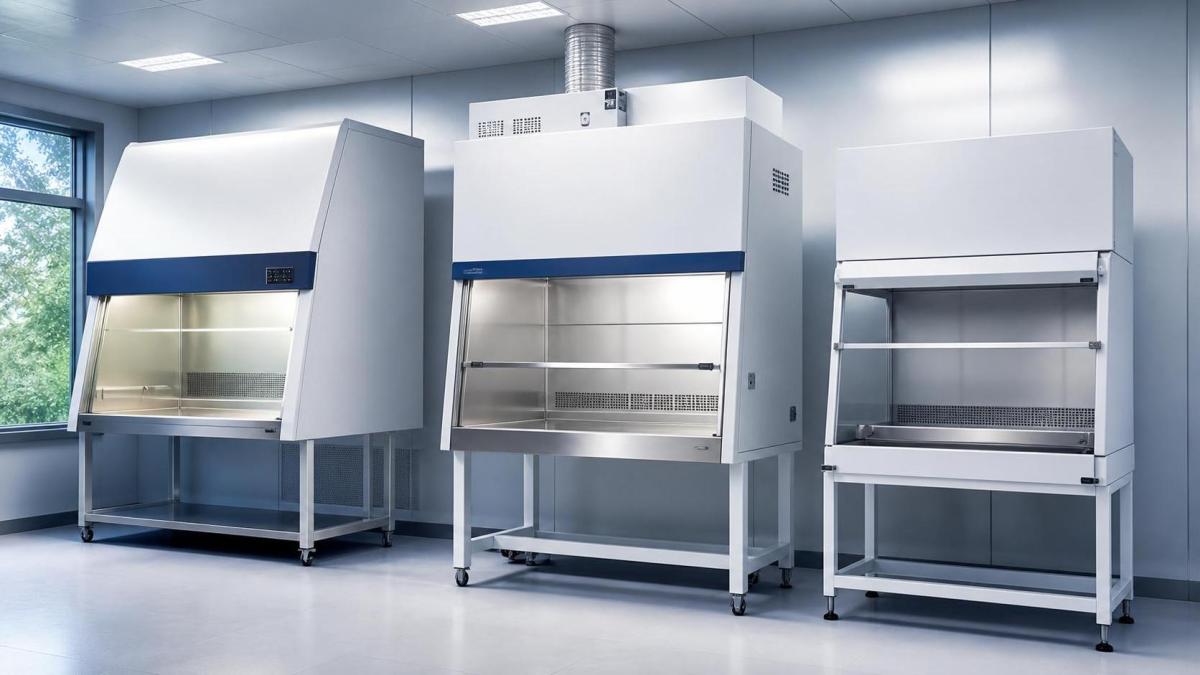
Wider work surfaces generally cost more because they require larger filters, larger fans, more cabinet structure, and more electrical capacity. Yet width alone is not a reliable basis for comparison. A compact cabinet with a premium monitoring package and demanding certification configuration may cost more than a larger basic model.
The practical issue is whether the working aperture and interior depth support the procedure without encouraging unsafe habits. If two operators need to work simultaneously, if large vessels must be moved through the sash opening, or if instruments will remain inside the cabinet, an undersized cabinet can compromise workflow and airflow discipline. Overcrowding obstructs grilles, disrupts the intended air pattern, and increases the time required for cleaning and setup.
Procurement specifications should define the usable internal workspace, not only the external width. They should also account for doorways, elevator capacity, floor loading, service clearances, ceiling constraints, and the route from delivery point to final location. A cabinet that reaches the laboratory only after disassembly, special rigging, or late facility modifications can quickly erase an apparent quotation advantage.
Certification, validation, and documentation are part of the delivered product
Containment performance cannot be judged by appearance or by a control-panel display alone. The cabinet must be tested and certified after installation, and it must be recertified according to the laboratory’s requirements and applicable standards. This distinction is important when comparing offers: a factory-tested cabinet, a delivered cabinet, and an installed, certified cabinet are not necessarily the same commercial scope.
Higher-priced models may reflect construction and testing intended to meet recognized performance standards, as well as more extensive documentation for qualification, traceability, and maintenance. In regulated pharmaceutical, clinical, research, or high-containment settings, documentation can be as important as the hardware. Buyers may need records covering factory testing, filter information, electrical safety, airflow settings, materials, operating instructions, and service history.
Certification should be separated clearly into the purchasing scope:
- Factory testing and documentation supplied with the cabinet.
- Delivery, positioning, and assembly at the final location.
- Site installation, including exhaust or facility connections where required.
- Initial field certification and any required remedial adjustments.
- Scheduled recertification, filter replacement, and emergency service support.
A quotation that excludes these items may still be commercially valid, but it should not be compared directly with a fully installed and certified offer. The same principle applies to accessories. Stands, ergonomic supports, UV-related options, work-surface configurations, electrical outlets, gas or vacuum penetrations, data connectivity, and exhaust transition components can change the final project cost substantially.
Controls and monitoring should match the consequences of failure
Basic cabinets may use simple indicators and manual controls. Higher-specification equipment can offer continuous airflow monitoring, audible and visual alarms, sash-height interlocks, event logging, remote status outputs, and building-management integration. These functions contribute to price because they require sensors, software, calibration provisions, and more complex commissioning.
The purchase decision should focus on what the laboratory will do with the information. An alarm has limited value if there is no defined response when it occurs. Remote monitoring has limited value if nobody owns the alert, the cabinet cannot be accessed promptly, or the laboratory has no maintenance escalation process. When these controls are connected to a documented operating procedure, they can strengthen oversight and reduce dependence on informal visual checks.
For laboratories with many cabinets across multiple rooms or sites, standardized control interfaces and service access can be worth paying for. They simplify user training, spare-parts planning, periodic testing, and records management. For an isolated unit used in a straightforward workflow, a simpler configuration may be more appropriate.
The installed cost can exceed the cabinet quotation
A credible budget should treat the cabinet as one element of a room-level system. The electrical supply, ventilation balance, exhaust path, room pressure relationship, temperature load, noise requirements, and surrounding bench layout all influence whether the cabinet can perform as intended.
For example, placing a cabinet near a doorway, supply diffuser, high-traffic route, or competing air movement can undermine the front air barrier. Resolving the issue after delivery may require relocation or HVAC adjustments. Similarly, a ducted configuration may require coordination with facility engineers before an order is placed, not after the cabinet arrives.
Operating cost also deserves attention. Fan energy consumption, replacement filters, certification visits, decontamination support, downtime, and local service availability can outweigh small differences in initial purchase price over the cabinet’s useful life. Procurement teams should request enough information to estimate these items, rather than assuming that all models have comparable service needs.
How to compare quotations without reducing the decision to a number
A practical bid comparison starts by locking the non-negotiable requirements: cabinet class, protection objective, intended procedures, usable work area, room constraints, exhaust configuration, required standards, and site certification scope. Only then is it reasonable to compare equipment options on price.
Ask each supplier to identify what is included, excluded, and assumed. A useful comparison sheet will show the precise model and configuration, filter arrangement, airflow and alarm functions, electrical requirements, stand and accessories, delivery terms, installation responsibilities, certification scope, warranty coverage, recommended service intervals, expected consumables, and lead-time assumptions. Ambiguous wording such as “complete system” should be translated into named deliverables.
The lowest bid can be appropriate when it meets the defined containment requirement, fits the facility, includes a workable service path, and does not shift essential costs into excluded items. The highest bid is not automatically the safer selection either. Additional automation, integration, or containment capability should be tied to a real procedural, compliance, or operational need.
The price of a biosafety cabinet ultimately reflects the cost of controlling air, proving containment, and keeping that performance reliable over time. Buyers who evaluate those elements together can distinguish a genuinely economical purchase from a low initial figure that leaves critical work, validation, or lifecycle obligations outside the order.
Get weekly intelligence in your inbox.
No noise. No sponsored content. Pure intelligence.
 Oct 21, 2026How often is cleanroom certification required under ISO 14644-2?Cleanroom Certification is generally recommended annually under ISO 14644-2. Learn when risk-based extensions apply and which changes trigger earlier testing to plan with confidence.
 Oct 21, 2026FASEB Comments on NIH Draft Policy for Research Involving BiohazardsFASEB comments on NIH’s draft biohazard research policy call for risk-based biosafety oversight. Explore potential implications for laboratories, suppliers, and compliance teams.
 Oct 20, 2026How to disinfect ultrasound machines without damaging surfacesLearn how to disinfect ultrasoundmachines without surface damage. Explore compatible products, wet contact times, and probe care to protect patients and equipment.
 Oct 20, 2026Ultrapure Water in Semiconductor Manufacturing: Reuse and Quality Control InsightsExplore ultrapure water reuse in semiconductor manufacturing, key UPW quality benchmarks and analytical insights to help evaluate suppliers and protect process purity.
 Oct 19, 2026How cooling affects warpage in injection-molded consumer electronics housingsOptimize plastic injection molding for consumer electronics with cooling strategies to reduce housing warpage and improve assembly fit. Discover practical checks for stable, efficient production.
 Oct 18, 2026Can air leaks prevent a dehumidifier from holding its target dew point?Why can't our dehumidifier maintain the target dew point? Discover how air leaks increase moisture loads, spot hidden faults, and find practical fixes to restore reliable dew-point control.
 Oct 17, 2026How semiconductor process water treatment removes trace organicsSee how semiconductor process water treatment removes trace organics with RO, UV oxidation, and polishing. Learn how TOC monitoring helps verify purity and pinpoint contamination.
 Oct 16, 2026How to choose ultra pure water piping materials to limit leachingChoose ultra pure water piping with confidence. Compare PVDF, PFA, and stainless steel, assess leaching risks, and learn how to qualify your system for reliable purity.
 Oct 15, 2026How to size a skid-mounted deionized water system for peak demandCompare deionized water systems skid configurations for peak demand. Learn how to balance production, storage, and pump capacity to prevent shortages and avoid costly oversizing.
 Oct 14, 2026When is collaborative laboratory robotics suitable for sample sorting?Explore when collaborative laboratory robotics suits sample sorting. Discover key checks for safety, traceability, container compatibility, and throughput before choosing your solution.
 Oct 13, 2026How sandwich panel joints affect airtightness in cleanroom systemsCleanroom Systems sandwich panels need reliable joints for airtightness. Discover how gaskets, sealants, and testing help reduce leakage and protect cleanroom pressure control.
 Oct 12, 2026How to verify USP compliance for ultra pure water systemsUltra Pure Water Systems USP compliance: learn how to verify water quality, sampling, sanitization, trends, and validation controls at every point of use.
 Oct 11, 2026How tight temperature control prevents cleanroom process driftCleanroom process temperature control systems prevent costly drift by stabilizing critical conditions, improving repeatability, and protecting sensitive production workflows.
 Oct 10, 2026When does organic contaminant removal require TOC treatment?Organic contaminant removal requires TOC treatment when dissolved organics threaten product quality, equipment reliability, or process control. Learn how to assess risks and choose the right solution.
 Oct 08, 2026What affects lead times for sheet metal bending services in Canada?Sheet metal bending services Canada: discover how material supply, tooling, tolerances, finishing, documentation, and freight affect lead times for reliable project delivery.
 Oct 07, 2026How HVAC design for semiconductor fabs prevents airborne contaminationHVAC design for semiconductor fabs prevents airborne contamination through advanced filtration, pressure cascades, airflow control, and real-time monitoring. Explore key strategies for cleaner, more reliable wafer production.
 Oct 06, 2026How photovoltaic modules waterproof technology prevents moisture damagephotovoltaic modules waterproof technology prevents moisture damage with durable seals, drainage, and junction-box protection. Explore practical selection and testing insights.
 Oct 05, 2026How ISO 14644 Europe requirements affect cleanroom qualificationISO 14644 Europe requirements shape cleanroom qualification, from particle classification and recovery testing to monitoring, GMP alignment, and change control.
 Oct 04, 2026How to assess a pharmaceutical cleanroom solutions supplier’s ISO capabilityPharmaceutical Cleanroom Solutions supplier assessment guide: evaluate ISO 14644 capability, validation evidence, airflow design, documentation, and long-term GMP readiness.
 Oct 03, 2026What EU standards govern the design of BSL-3 laboratories in Europe?BSL-3 laboratories Europe: explore EU directives, EN standards, HVAC containment, commissioning, and practical design strategies for compliant, resilient high-containment facilities.
 Oct 02, 2026How EN 1822 defines HEPA filtration efficiency for cleanroomsHEPA filtration EN 1822 explained: learn how MPPS testing, local leakage limits, and filter classes support reliable cleanroom decisions.
 Oct 01, 2026How pharmaceutical process water systems control microbial riskProcess water systems pharmaceutical teams rely on can control microbial risk through hygienic design, monitoring, and validated sanitization. Explore practical compliance strategies.
 Sep 30, 2026When does a negative pressure laboratory need BSL-3 containment?Negative pressure laboratory or BSL-3? Discover the risk factors, engineering controls, and containment requirements needed for safe, compliant laboratory planning.
 Sep 29, 2026How to evaluate a TOC-zero water treatment supplier for UPW systemsChoose a TOC-zero water treatment supplier with confidence. Compare UPW performance, monitoring, validation, materials, service capability, and lifecycle cost.
 Sep 28, 2026What drives sustainable cooling cost in high-precision facilities?Sustainable cooling cost in high-precision facilities depends on thermal stability, energy, water, controls, and resilience. Explore smarter lifecycle strategies.
 Sep 27, 2026How to compare freight forwarding services for time-critical shipmentsCompare freight forwarding services for time-critical shipments with practical insights on routing, customs, visibility, specialized handling, and contingency planning.
 Sep 26, 2026How environmental integrity in laboratories supports reliable test resultsEnvironmental Integrity in laboratories safeguards samples, instruments, and staff. Discover practical controls for contamination, monitoring, and reliable test results.