Energy Usage Intensity (EUI): Benchmarking HVAC Upgrades
Energy usage intensity (EUI) is one of the clearest metrics for evaluating whether HVAC upgrades truly improve building performance. For researchers comparing retrofit strategies across industrial and institutional facilities, EUI connects energy data with operational demands, compliance goals, and long-term cost control—making it a practical benchmark for smarter, evidence-based decision-making.
Why energy usage intensity (EUI) is becoming the preferred HVAC benchmark
Across industries, HVAC performance is no longer judged by equipment efficiency alone. Facilities now need proof that upgrades reduce total building energy use.
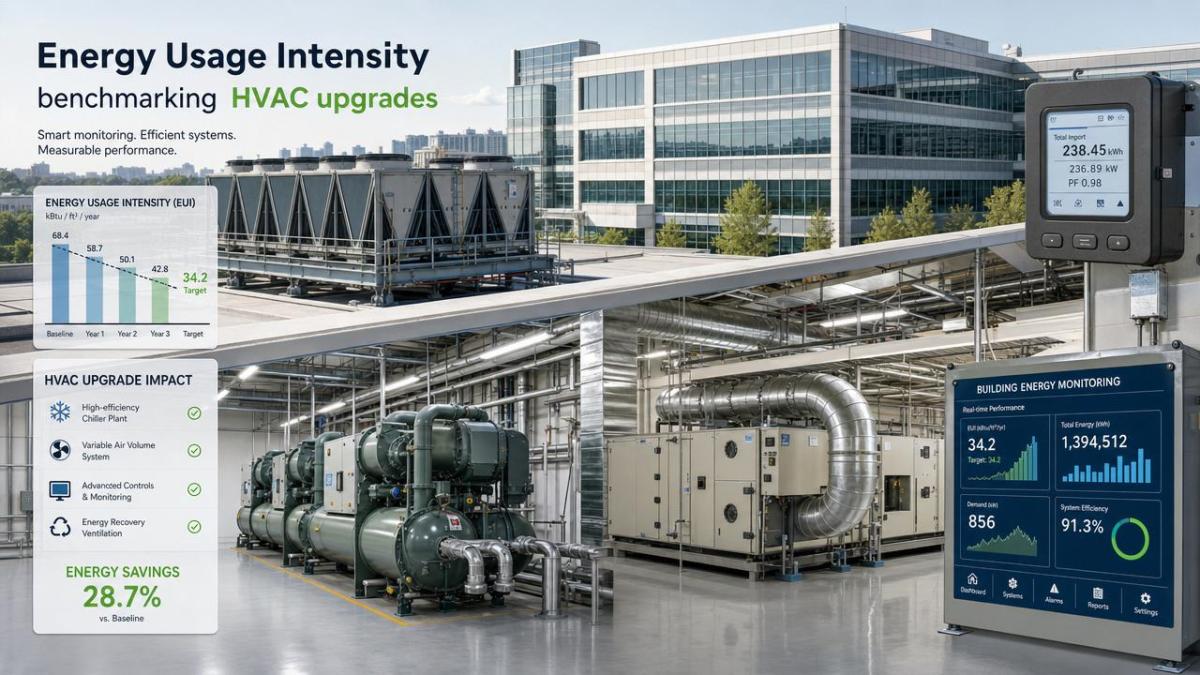
That shift makes energy usage intensity (EUI) especially valuable. It translates complex utility data into a normalized metric, usually energy consumed per floor area annually.
For offices, laboratories, cleanrooms, hospitals, and mixed-use campuses, EUI helps compare buildings with very different technical demands. It creates a common language for benchmarking HVAC upgrades.
This matters in high-control environments. Semiconductor support spaces, biopharma facilities, and precision manufacturing sites often operate under strict temperature, humidity, and contamination limits.
In such settings, a low equipment kW rating may look attractive, yet actual site performance may disappoint. EUI reveals whether system-wide outcomes improved after retrofit work.
The current shift: HVAC upgrades are now measured by operational outcomes
Several trend signals explain why energy usage intensity (EUI) is rising in strategic importance. Capital planning is moving from component replacement toward measurable operational performance.
Energy volatility is one signal. Another is tighter carbon reporting. A third is the expansion of digital monitoring across critical environments.
These changes are especially visible in comprehensive facilities portfolios. Operators must compare aging assets, prioritize retrofit timing, and justify spending using defensible data.
In this context, energy usage intensity (EUI) supports apples-to-apples evaluation better than isolated equipment metrics. It also aligns with ESG reporting and internal energy governance.
Trend signals now shaping HVAC benchmarking
- Retrofits are increasingly judged by annual building performance, not only design-point efficiency.
- Industrial and institutional sites face stronger disclosure pressure on energy and carbon intensity.
- Smart metering and BAS analytics make EUI tracking easier and more reliable.
- Facilities with mission-critical conditions need metrics that reflect both resilience and energy use.
- Benchmarking against standards and peer portfolios is becoming standard practice.
What is driving wider use of energy usage intensity (EUI)
The expansion of energy usage intensity (EUI) is not accidental. It reflects a convergence of technical, financial, and regulatory pressures across the built environment.
For technical facilities, this is crucial. A high-performing HVAC system must protect process integrity while managing fan power, chilled water demand, ventilation loads, and control stability.
Energy usage intensity (EUI) captures that broader impact. It shows whether upgrades improved actual facility behavior, not just equipment specifications on paper.
How EUI changes decisions across building types and business functions
The influence of energy usage intensity (EUI) extends beyond engineering reviews. It affects budgeting, retrofit sequencing, compliance planning, and asset performance strategies.
In office buildings, EUI often highlights waste from outdated air handling schedules and poor control logic. In laboratories, it can reveal ventilation intensity that exceeds real risk profiles.
In clean manufacturing, EUI benchmarking helps balance contamination control with fan energy and thermal stability. In healthcare, it supports evaluation of isolation, filtration, and occupancy-driven loads.
Typical impact areas influenced by EUI analysis
- Retrofit prioritization between chillers, air handlers, controls, heat recovery, and envelope measures.
- Verification of whether ventilation upgrades increased resilience without creating unnecessary energy burdens.
- Assessment of building scheduling, zoning, and occupancy alignment.
- Support for capital requests through measurable baseline-to-post-upgrade comparison.
- Cross-site benchmarking within regional or global facility portfolios.
This broader use is why energy usage intensity (EUI) is now central to many upgrade studies. It supports both local optimization and enterprise-level planning.
Where EUI can mislead if benchmarking methods are weak
Despite its value, energy usage intensity (EUI) is not automatically fair or complete. Weak benchmarking methods can distort results and lead to poor HVAC investment choices.
A major issue is operational context. Two facilities with equal floor area may have very different air change rates, process heat loads, or uptime requirements.
Weather normalization also matters. Comparing annual EUI without climate adjustment can overstate improvement or mask underperformance after an HVAC upgrade.
Another challenge is scope definition. Some studies include plug loads, process loads, and reheat energy, while others isolate building services only.
Key points to watch before trusting EUI results
- Confirm whether the EUI baseline includes comparable occupancy and production conditions.
- Separate process-driven loads from HVAC-driven changes where possible.
- Use weather-adjusted data for pre- and post-upgrade comparison.
- Document control sequence changes, not just hardware replacements.
- Review comfort, contamination, biosafety, and temperature stability outcomes alongside EUI.
When used carefully, energy usage intensity (EUI) remains powerful. The key is disciplined interpretation rather than blind target chasing.
A practical framework for benchmarking HVAC upgrades with EUI
A useful energy usage intensity (EUI) framework should move from baseline definition to verified post-retrofit performance. That structure improves both transparency and decision quality.
- Define the building type, conditioned area, operating hours, and critical environmental constraints.
- Establish a consistent EUI baseline using at least twelve months of measured energy data.
- Normalize for climate, occupancy shifts, and major process changes.
- Map planned HVAC upgrades to expected load reductions and control improvements.
- Verify post-upgrade EUI and compare it with operational KPIs such as humidity control and uptime.
- Benchmark results against internal peers, published references, and applicable standards.
This method is especially effective for facilities with precision thermal management, cleanroom air systems, advanced filtration, or strict environmental compliance requirements.
What to prioritize next as EUI becomes a strategic metric
The growing use of energy usage intensity (EUI) signals a more mature approach to HVAC modernization. Performance must now be verifiable, contextual, and tied to business outcomes.
The next step is to pair EUI with deeper environmental intelligence. Metering, BAS data, digital twins, and compliance records should inform one performance narrative.
That approach is especially relevant in advanced industrial and institutional facilities, where energy reductions cannot come at the expense of safety, cleanliness, or thermal precision.
Start by auditing current energy usage intensity (EUI), validating the baseline, and identifying HVAC upgrades with measurable impact potential. Then verify results through ongoing benchmarking rather than one-time assumptions.
When energy usage intensity (EUI) is used this way, it becomes more than a metric. It becomes a disciplined foundation for smarter retrofit choices, stronger compliance alignment, and durable operational efficiency.
Get weekly intelligence in your inbox.
No noise. No sponsored content. Pure intelligence.
 Oct 21, 2026How often is cleanroom certification required under ISO 14644-2?Cleanroom Certification is generally recommended annually under ISO 14644-2. Learn when risk-based extensions apply and which changes trigger earlier testing to plan with confidence.
 Oct 21, 2026FASEB Comments on NIH Draft Policy for Research Involving BiohazardsFASEB comments on NIH’s draft biohazard research policy call for risk-based biosafety oversight. Explore potential implications for laboratories, suppliers, and compliance teams.
 Oct 20, 2026How to disinfect ultrasound machines without damaging surfacesLearn how to disinfect ultrasoundmachines without surface damage. Explore compatible products, wet contact times, and probe care to protect patients and equipment.
 Oct 20, 2026Ultrapure Water in Semiconductor Manufacturing: Reuse and Quality Control InsightsExplore ultrapure water reuse in semiconductor manufacturing, key UPW quality benchmarks and analytical insights to help evaluate suppliers and protect process purity.
 Oct 19, 2026How cooling affects warpage in injection-molded consumer electronics housingsOptimize plastic injection molding for consumer electronics with cooling strategies to reduce housing warpage and improve assembly fit. Discover practical checks for stable, efficient production.
 Oct 18, 2026Can air leaks prevent a dehumidifier from holding its target dew point?Why can't our dehumidifier maintain the target dew point? Discover how air leaks increase moisture loads, spot hidden faults, and find practical fixes to restore reliable dew-point control.
 Oct 17, 2026How semiconductor process water treatment removes trace organicsSee how semiconductor process water treatment removes trace organics with RO, UV oxidation, and polishing. Learn how TOC monitoring helps verify purity and pinpoint contamination.
 Oct 16, 2026How to choose ultra pure water piping materials to limit leachingChoose ultra pure water piping with confidence. Compare PVDF, PFA, and stainless steel, assess leaching risks, and learn how to qualify your system for reliable purity.
 Oct 15, 2026How to size a skid-mounted deionized water system for peak demandCompare deionized water systems skid configurations for peak demand. Learn how to balance production, storage, and pump capacity to prevent shortages and avoid costly oversizing.
 Oct 14, 2026When is collaborative laboratory robotics suitable for sample sorting?Explore when collaborative laboratory robotics suits sample sorting. Discover key checks for safety, traceability, container compatibility, and throughput before choosing your solution.
 Oct 13, 2026How sandwich panel joints affect airtightness in cleanroom systemsCleanroom Systems sandwich panels need reliable joints for airtightness. Discover how gaskets, sealants, and testing help reduce leakage and protect cleanroom pressure control.
 Oct 12, 2026How to verify USP compliance for ultra pure water systemsUltra Pure Water Systems USP compliance: learn how to verify water quality, sampling, sanitization, trends, and validation controls at every point of use.
 Oct 11, 2026How tight temperature control prevents cleanroom process driftCleanroom process temperature control systems prevent costly drift by stabilizing critical conditions, improving repeatability, and protecting sensitive production workflows.
 Oct 10, 2026When does organic contaminant removal require TOC treatment?Organic contaminant removal requires TOC treatment when dissolved organics threaten product quality, equipment reliability, or process control. Learn how to assess risks and choose the right solution.
 Oct 08, 2026What affects lead times for sheet metal bending services in Canada?Sheet metal bending services Canada: discover how material supply, tooling, tolerances, finishing, documentation, and freight affect lead times for reliable project delivery.
 Oct 07, 2026How HVAC design for semiconductor fabs prevents airborne contaminationHVAC design for semiconductor fabs prevents airborne contamination through advanced filtration, pressure cascades, airflow control, and real-time monitoring. Explore key strategies for cleaner, more reliable wafer production.
 Oct 06, 2026How photovoltaic modules waterproof technology prevents moisture damagephotovoltaic modules waterproof technology prevents moisture damage with durable seals, drainage, and junction-box protection. Explore practical selection and testing insights.
 Oct 05, 2026How ISO 14644 Europe requirements affect cleanroom qualificationISO 14644 Europe requirements shape cleanroom qualification, from particle classification and recovery testing to monitoring, GMP alignment, and change control.
 Oct 04, 2026How to assess a pharmaceutical cleanroom solutions supplier’s ISO capabilityPharmaceutical Cleanroom Solutions supplier assessment guide: evaluate ISO 14644 capability, validation evidence, airflow design, documentation, and long-term GMP readiness.
 Oct 03, 2026What EU standards govern the design of BSL-3 laboratories in Europe?BSL-3 laboratories Europe: explore EU directives, EN standards, HVAC containment, commissioning, and practical design strategies for compliant, resilient high-containment facilities.
 Oct 02, 2026How EN 1822 defines HEPA filtration efficiency for cleanroomsHEPA filtration EN 1822 explained: learn how MPPS testing, local leakage limits, and filter classes support reliable cleanroom decisions.
 Oct 01, 2026How pharmaceutical process water systems control microbial riskProcess water systems pharmaceutical teams rely on can control microbial risk through hygienic design, monitoring, and validated sanitization. Explore practical compliance strategies.
 Sep 30, 2026When does a negative pressure laboratory need BSL-3 containment?Negative pressure laboratory or BSL-3? Discover the risk factors, engineering controls, and containment requirements needed for safe, compliant laboratory planning.
 Sep 29, 2026How to evaluate a TOC-zero water treatment supplier for UPW systemsChoose a TOC-zero water treatment supplier with confidence. Compare UPW performance, monitoring, validation, materials, service capability, and lifecycle cost.
 Sep 28, 2026What drives sustainable cooling cost in high-precision facilities?Sustainable cooling cost in high-precision facilities depends on thermal stability, energy, water, controls, and resilience. Explore smarter lifecycle strategies.
 Sep 27, 2026How to compare freight forwarding services for time-critical shipmentsCompare freight forwarding services for time-critical shipments with practical insights on routing, customs, visibility, specialized handling, and contingency planning.
 Sep 26, 2026How environmental integrity in laboratories supports reliable test resultsEnvironmental Integrity in laboratories safeguards samples, instruments, and staff. Discover practical controls for contamination, monitoring, and reliable test results.