ISO 14644 Compliance Mistakes That Delay Cleanroom Approval
ISO 14644 Compliance failures often surface late—when design assumptions, airflow balancing, particle testing, or documentation no longer support a smooth cleanroom sign-off. For project managers and engineering leads, these mistakes can trigger costly rework, approval delays, and operational risk. This article highlights the most common compliance gaps and how to prevent them before they compromise schedule, certification, and facility performance.
Why do ISO 14644 compliance mistakes usually appear at the end of a project?
Many teams assume ISO 14644 Compliance is mainly a final testing event, but that is one of the most expensive misconceptions in cleanroom delivery. In reality, compliance is built across the full project lifecycle: concept design, airflow strategy, material selection, installation quality, commissioning, performance verification, and operational documentation. When any of these elements are handled in isolation, the cleanroom may look complete yet still fail to satisfy approval criteria.
For project managers, the biggest risk is that hidden assumptions remain unchallenged until particle counts, recovery tests, pressure cascades, or room classification results reveal a mismatch. At that point, every correction affects schedule, contractors, and budget simultaneously. A missing seal detail can force ceiling rework. Poor HVAC balancing can delay validation. Incomplete documentation can prevent sign-off even when the room technically performs well.
This is why high-performing organizations treat ISO 14644 Compliance as a coordination discipline rather than a narrow testing task. G-ICE often sees delays caused not by one major engineering failure, but by several smaller disconnects between cleanroom design intent, environmental control systems, and validation evidence.
What are the most common design-stage mistakes that undermine ISO 14644 Compliance?
The earliest mistakes are often the most damaging because they shape everything that follows. One frequent issue is defining room classification targets without aligning them to actual process risk, occupancy, equipment heat load, and maintenance access. Teams may select an aggressive cleanliness class for prestige or caution, then discover the resulting airflow volume, energy demand, and balancing sensitivity are far greater than expected.
Another common gap is poor integration between architecture and HVAC. Ceiling grids, return air paths, door leakage, pass-through details, and equipment penetrations all influence particulate control. If the cleanroom envelope is designed without enough coordination, the mechanical system may struggle to maintain pressure differentials and consistent air patterns. This becomes especially problematic in facilities with advanced contamination control, biosafety support spaces, or precision thermal management requirements.
A third mistake is underestimating thermal stability and airflow interaction. ISO 14644 Compliance is not only about particle counts at one moment in time. In many advanced manufacturing and pharmaceutical environments, temperature, humidity, turbulence, and operator movement affect whether a space can sustain compliant conditions during realistic operations. Designing only for nominal airflow rates without modeling process variability often leads to unstable performance during commissioning.
Project leaders should ask early whether the design basis clearly links cleanliness targets, pressure cascade logic, filtration stages, air change strategy, recovery expectations, and operational states such as at-rest and operational conditions. If that chain is unclear, compliance risk is already embedded in the project.
Which commissioning and testing errors delay cleanroom approval the most?
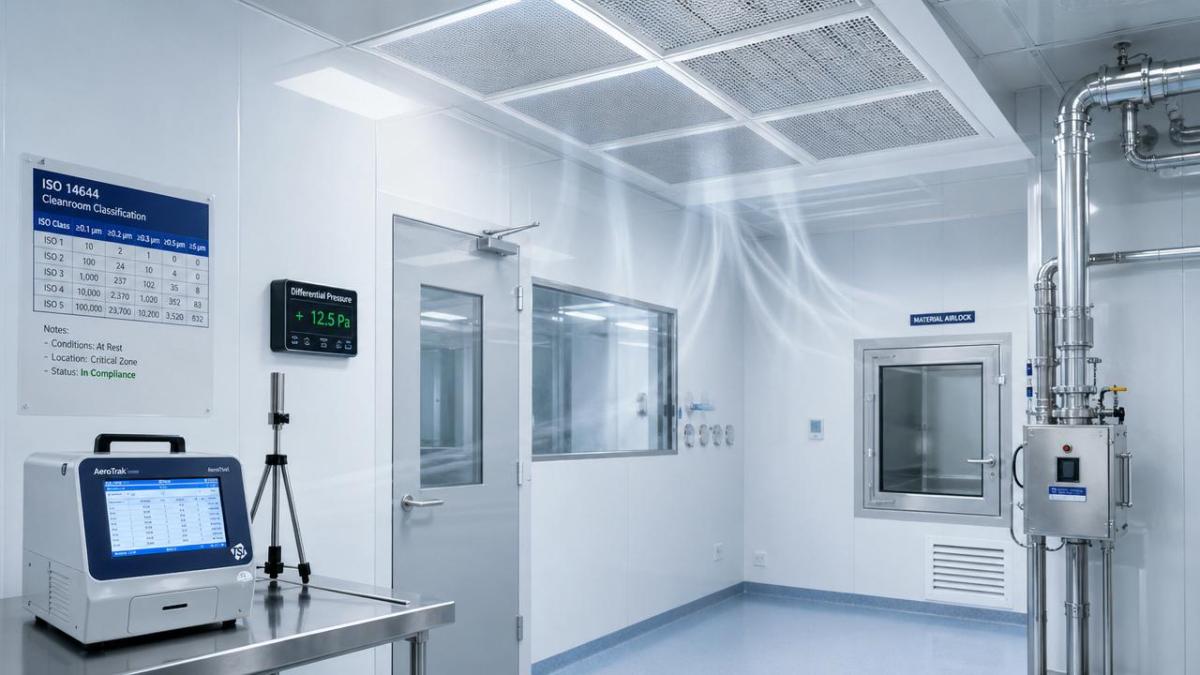
Commissioning is where many ISO 14644 Compliance plans become vulnerable. A classic mistake is rushing from installation to formal testing without adequate pre-commissioning. Filters may be installed correctly, but airflow may not be balanced, sensors may not be calibrated, and room states may not be stabilized before particle measurements begin. This leads to inconsistent results and retesting cycles.
Another major issue is using test methods that do not match the facility’s intended operating condition. Some teams perform classification testing in an unrealistically empty or inactive room, then discover later that real production conditions generate turbulence, local particle release, or pressure instability. Approval authorities and internal quality teams increasingly expect evidence that the cleanroom performs under defined, credible conditions.
Sensor placement and measurement planning also matter. If pressure, temperature, humidity, and particle monitoring points are selected for convenience rather than risk relevance, the data may fail to support robust cleanroom validation. For example, a room may pass average readings while still having dead zones, poor recovery near equipment, or unstable pressure at critical doorways.
The practical lesson is simple: commissioning should not be treated as a compressed final phase. It should be a staged verification process that confirms installation quality, control logic, balancing stability, filtration integrity, and operating readiness before formal classification testing begins.
How does documentation failure affect ISO 14644 Compliance even when the room seems to perform well?
A surprisingly large number of delays happen because the cleanroom works, but the evidence package does not. ISO 14644 Compliance depends on traceability. Approval teams need to see how design criteria were defined, how systems were installed, how deviations were addressed, and how test results connect to room classification and intended use.
Missing or inconsistent records create doubt. If airflow drawings do not match installed conditions, if HEPA integrity reports are incomplete, if calibration certificates are outdated, or if balancing reports cannot be tied to final room tags, the entire compliance review slows down. This is particularly serious in regulated sectors where cleanroom qualification is linked to production release, quality audits, or biosafety governance.
For engineering project leads, documentation control should start long before handover. Establish a structured turnover file that includes design basis documents, equipment submittals, installation records, nonconformance logs, commissioning procedures, environmental monitoring strategies, and final acceptance criteria. The goal is not paperwork for its own sake. The goal is to make compliance understandable, auditable, and defensible.
What warning signs show a project is drifting toward ISO 14644 compliance trouble?
Project managers can usually spot trouble before formal failure if they know where to look. One warning sign is repeated balancing adjustments with no stable baseline. If airflow, pressure, or temperature values keep shifting after each intervention, the issue may be deeper than controls tuning. It could reflect leakage, poor zoning logic, or an unrealistic design basis.
Another sign is unresolved interface conflicts between trades. Ceiling access, utility penetrations, process equipment footprints, and cleanroom panels are not minor details. They directly affect contamination control and airflow integrity. If these conflicts remain open late in the project, ISO 14644 Compliance risk rises sharply.
A third signal is unclear ownership of validation scope. If no one can answer who is responsible for classification test planning, recovery test criteria, document compilation, or deviation closure, approval delays are highly likely. Cleanroom projects fail when technical tasks are completed but not integrated into one accountable compliance path.
How can project teams prevent rework and protect schedule?
The best way to protect ISO 14644 Compliance is to manage it as a cross-functional deliverable with clear gates. Start by defining acceptance criteria early, not just room classes but also test conditions, operating assumptions, documentation requirements, and deviation procedures. This gives every stakeholder a common target.
Next, create formal design reviews focused on contamination control, airflow path integrity, pressure zoning, thermal behavior, and maintainability. In advanced facilities, combining cleanroom expertise with precision HVAC, environmental monitoring, and digital control review can reveal hidden risks well before installation. This multidisciplinary view is central to reducing late-stage surprises.
Teams should also use staged commissioning milestones. Verify envelope readiness before balancing. Verify balancing stability before classification testing. Verify instruments and records before final approval. This sequence prevents the common trap of performing expensive validation work on an unstable system.
Finally, assign one owner for compliance integration. This person does not replace contractors or validators, but ensures design intent, as-built conditions, test evidence, and approval requirements remain connected. On large industrial projects, that coordination role often determines whether the facility enters operation on time.
What should managers confirm before approving the final cleanroom validation package?
Before sign-off, project managers and engineering leads should ask a focused set of questions. Do the final room classifications match intended process use? Were tests performed under defined at-rest or operational conditions? Are airflow, pressure, temperature, and humidity data consistent across reports? Do drawings reflect the installed configuration? Have deviations been closed with documented rationale? Are ongoing monitoring and maintenance responsibilities clearly transferred to operations?
They should also confirm whether the facility can remain compliant in real use, not just on test day. That means reviewing change control, cleaning procedures, filter replacement access, alarm logic, and environmental monitoring strategy. Sustainable ISO 14644 Compliance depends on operational discipline as much as on initial construction quality.
In sectors where contamination, temperature stability, and process repeatability are mission-critical, this final review should be evidence-based and uncompromising. A cleanroom that barely passes once is not the same as a cleanroom that will support reliable manufacturing, audit resilience, and long-term environmental control.
What are the most practical next steps if your team wants faster approval and fewer compliance surprises?
If your project is still in design, prioritize a gap review between room classification goals, airflow strategy, envelope details, and commissioning assumptions. If construction is underway, verify that as-built changes are being captured immediately and that testing prerequisites are not slipping. If validation is near, review the full evidence package before formal submission rather than after the first rejection.
For organizations managing high-spec industrial environments, the most effective approach is early coordination between cleanroom architecture, HVAC and thermal control, monitoring systems, and compliance documentation. That alignment is where ISO 14644 Compliance becomes predictable instead of reactive.
If you need to confirm a specific cleanroom strategy, project timeline, test scope, retrofit path, or performance benchmark, start by discussing room classification targets, process sensitivity, occupancy pattern, utility loads, acceptance criteria, and documentation ownership. Those questions usually reveal whether the path to approval is truly under control.
Get weekly intelligence in your inbox.
No noise. No sponsored content. Pure intelligence.
 May 27, 2026Impact of CBAM on Chillers: Cost Risks and Compliance GapsImpact of CBAM on chillers: uncover hidden cost risks, supplier data gaps, and compliance pitfalls. Learn how to protect budgets, timelines, and import decisions.
 May 27, 2026Global HVAC Decarbonization: What Changes First in 2026Global HVAC decarbonization enters a decision year in 2026. Discover what changes first in refrigerants, controls, cooling plants, and compliance planning to cut risk and boost resilience.
 May 27, 2026Future of Low-GWP Cooling: 2026 Technology Shifts to WatchFuture of low-gwp cooling in 2026: discover key technology shifts in refrigerants, oil-free systems, smart controls, and compliance-driven design for critical facilities.
 May 27, 2026How to Lower Energy Usage Intensity in Controlled FacilitiesEnergy usage intensity (EUI) in controlled facilities can be reduced through smarter airflow, cooling, humidity control, and monitoring. Learn practical strategies to cut energy waste without risking compliance or stability.
 May 27, 2026Industrial Dehumidification: When Tighter Humidity Control Pays OffIndustrial dehumidification pays off when humidity affects yield, compliance, and uptime. See where tighter control cuts defects, protects assets, and improves operational performance.
 May 26, 2026Smart Building Management BMS Upgrade GuideSmart building management (BMS) upgrade guide covering checklists, risk control, compliance, HVAC optimization, and scalable execution to improve efficiency and long-term facility performance.
 May 26, 2026HVAC Digital Twin Use Cases in 2026HVAC digital twin use cases in 2026: discover how cleanrooms, labs, pharma, and industrial sites cut risk, improve uptime, and optimize energy with smarter data-driven control.
 May 26, 2026ASHRAE Standards Compliance Risk ChecklistASHRAE standards compliance risk checklist for manufacturing, labs, and commercial facilities—spot hidden HVAC gaps early, reduce audit risk, and protect safety, quality, and uptime.
 May 26, 2026When HVAC System Redundancy Pays OffHVAC system redundancy pays off when downtime, compliance risk, and asset loss cost more than backup capacity. Learn where N+1 or 2N delivers real ROI.
 May 26, 2026Air Flow Visualization for Cleaner HVAC TuningAir flow visualization helps reveal hidden turbulence, leakage, and pressure drift for cleaner HVAC tuning. Learn how to improve control, compliance, and efficiency.
 May 26, 2026EU Launches SMR Strategy: Mobile Decon Systems and Modular BSL-3/4 Infrastructure Prioritized for Joint ProcurementEU prioritizes mobile decon systems & modular BSL-3/4 infrastructure for SMR joint procurement—key opportunity for certified global suppliers.
 May 26, 2026IEA Warns on Persistent Methane Emissions: Stricter Carbon Footprint Verification for BSL-3/4 Infrastructure ExportsIEA's methane warning triggers stricter carbon footprint verification for BSL-3/4 infrastructure exports—get CBAM Phase II compliance insights now.
 May 25, 2026When Thermodynamic Hardware Maintenance Cuts DowntimeHigh-Performance Thermodynamic Hardware maintenance helps cut downtime, improve thermal stability, and support compliance—discover how disciplined service protects uptime and long-term asset value.
 May 25, 2026High-Tech Industrial Complex Design Cost PrioritiesHigh-Tech Industrial Complex design cost priorities explained: learn how to balance compliance, uptime, energy efficiency, and lifecycle value for smarter approvals.
 May 25, 2026Industrial Climate Control Standards: What Fails First?Industrial Climate Control standards fail first in airflow, thermal precision, filtration, and controls. Discover early warning signs, reduce compliance risk, and plan smarter upgrades.
 May 25, 2026How to Measure Sub-Micron Contamination AccuratelySub-Micron Contamination measurement made practical: learn accurate methods, key parameters, and smart workflow tips to improve cleanroom control, compliance, and product quality.
 May 25, 20262026 Guide to 18.2MΩ·cm UPW Certification RisksUltra-Pure Water Treatment certification risks in 2026: learn how 18.2MΩ·cm compliance can fail after approval, and how to protect audits, uptime, yield, and validation confidence.
![]() May 25, 2026UKCA Transition Ends for FFU and Lab Automation DevicesUKCA transition ends 23 May 2026 for FFU and lab automation devices — ensure full UKCA, RoHS & EMC compliance now to avoid UK market access delays.
May 25, 2026UKCA Transition Ends for FFU and Lab Automation DevicesUKCA transition ends 23 May 2026 for FFU and lab automation devices — ensure full UKCA, RoHS & EMC compliance now to avoid UK market access delays.![]() May 25, 2026Hormuz Strait Traffic Drops Below 10%: Cleanroom Equipment Shipments Delayed, Freight Up 35%Cleanroom equipment shipments delayed as Hormuz Strait traffic drops below 10%—freight up 35%. Critical FFUs, UPW skids & BSL-3 units impacted. Act now.
May 25, 2026Hormuz Strait Traffic Drops Below 10%: Cleanroom Equipment Shipments Delayed, Freight Up 35%Cleanroom equipment shipments delayed as Hormuz Strait traffic drops below 10%—freight up 35%. Critical FFUs, UPW skids & BSL-3 units impacted. Act now.![]() May 25, 2026China Customs Launches Clean Tech Export Compliance PlatformClean tech export compliance made simple: China Customs’ new platform helps global buyers verify certifications for UPW systems, BSL-3/4 labs, ESD solutions & FFUs—fast, free, and official.
May 25, 2026China Customs Launches Clean Tech Export Compliance PlatformClean tech export compliance made simple: China Customs’ new platform helps global buyers verify certifications for UPW systems, BSL-3/4 labs, ESD solutions & FFUs—fast, free, and official.![]() May 25, 2026EU CBAM Fully Enforced: FFUs and Maglev Chillers Require Carbon Footprint ReportsEU CBAM now fully enforces carbon footprint reports for FFUs and Maglev Chillers—key for exporters, suppliers & HVAC manufacturers. Act now to avoid delays & penalties.
May 25, 2026EU CBAM Fully Enforced: FFUs and Maglev Chillers Require Carbon Footprint ReportsEU CBAM now fully enforces carbon footprint reports for FFUs and Maglev Chillers—key for exporters, suppliers & HVAC manufacturers. Act now to avoid delays & penalties.![]() May 25, 2026DIN EN ISO 14644-3:2026 Introduces Digital Twin Lab ValidationDIN EN ISO 14644-3:2026 mandates Digital Twin Lab validation for cleanrooms—transforming compliance in pharma, biotech & semiconductors. Act now!
May 25, 2026DIN EN ISO 14644-3:2026 Introduces Digital Twin Lab ValidationDIN EN ISO 14644-3:2026 mandates Digital Twin Lab validation for cleanrooms—transforming compliance in pharma, biotech & semiconductors. Act now!![]() May 25, 2026FDA Updates Purified Water Guidance: TOC ≤100 ppb in 18.2 MΩ·cm UPWFDA updates UPW guidance: TOC ≤100 ppb now required for 18.2 MΩ·cm ultrapure water — critical for pharma suppliers, TOC analyzers & validation services.
May 25, 2026FDA Updates Purified Water Guidance: TOC ≤100 ppb in 18.2 MΩ·cm UPWFDA updates UPW guidance: TOC ≤100 ppb now required for 18.2 MΩ·cm ultrapure water — critical for pharma suppliers, TOC analyzers & validation services. May 24, 2026Cleanroom Architecture for Quantum Computing: What Fails First?Cleanroom Architecture for quantum computing: discover what fails first—from vibration and thermal drift to airflow and contamination—and how to prevent costly downtime.
 May 24, 2026Smart Environmental Monitoring for Data Centers in 2026Smart Environmental Monitoring for data center success in 2026 starts with real-time visibility, smarter risk control, and scenario-based insights that improve uptime, efficiency, and compliance.
 May 24, 2026Precision Temperature Control for Semiconductor: Cost vs StabilityPrecision Temperature Control for semiconductor affects yield, uptime, and energy costs. Compare cost vs stability across fab scenarios to choose smarter, lower-risk thermal control.
 May 24, 2026BSL-3/4 Containment Risks in High-Risk Lab PlanningBiosafety Containment for high-risk lab planning: uncover BSL-3/4 failure points, pressure risks, and control gaps to build safer, resilient, high-performance facilities.