Wireless EV Charging: Efficiency Losses Explained
For technical evaluators, wireless EV charging is not just a convenience feature—it is an energy-transfer system where coil alignment, air-gap distance, power electronics, thermal behavior, and grid-side controls directly shape real-world efficiency.
While inductive charging can simplify fleet operations and reduce connector wear, every conversion stage introduces measurable losses that affect operating cost, infrastructure sizing, and sustainability claims.
This article explains where those efficiency losses occur, how they compare with plug-in charging, and what design or deployment factors matter most when assessing wireless EV charging for industrial, commercial, or high-utilization environments.
Where Efficiency Losses Start in Wireless EV Charging
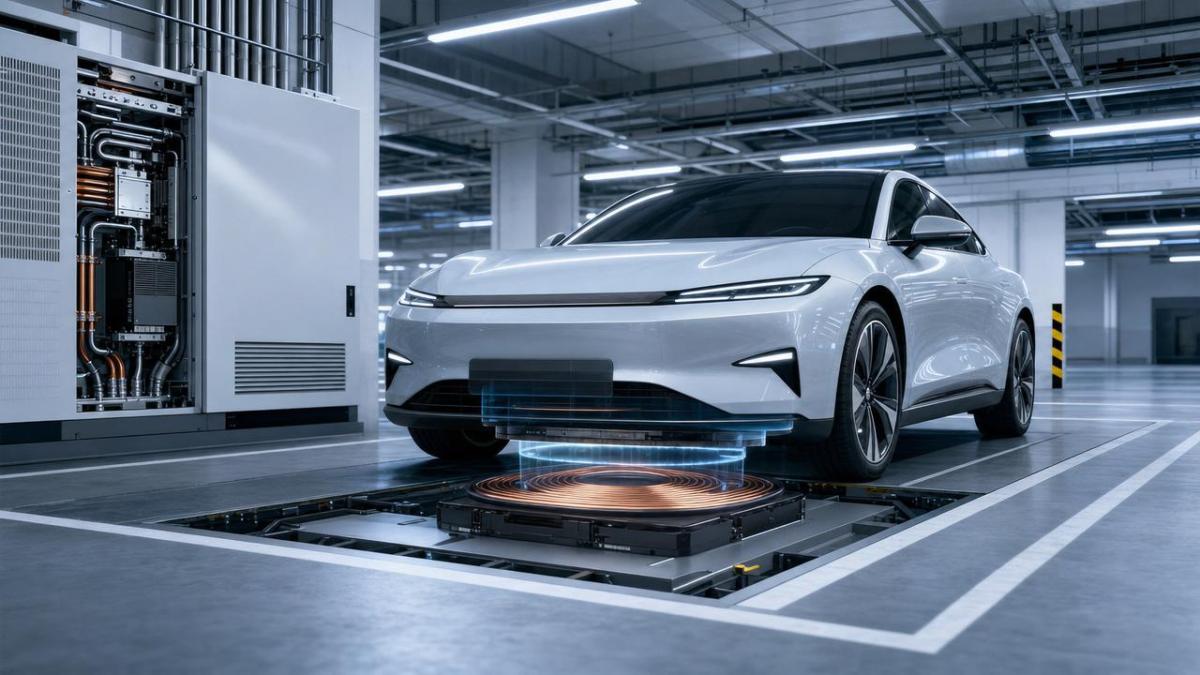
Wireless EV charging transfers energy through magnetic coupling between a ground assembly and a vehicle receiver. That transfer is efficient only when geometry, control, and temperature remain within design limits.
For evaluators, the key question is not whether the technology works. It is whether the complete system delivers predictable energy performance across daily parking behavior, duty cycles, and site constraints.
Main Loss Points to Measure
- Grid-to-pad conversion losses occur in rectifiers, inverters, filters, metering devices, and control electronics before magnetic transfer begins.
- Coupling losses increase when lateral misalignment, vertical air-gap variation, or angular parking error reduces magnetic field utilization.
- Vehicle-side conversion losses appear in receiver electronics, battery charging controls, thermal management, and auxiliary power demand.
- Environmental losses can rise when water, metallic debris, temperature extremes, or enclosure ventilation limits change operating behavior.
In controlled conditions, modern wireless EV charging can approach plug-in performance. In field use, however, small installation and behavioral deviations often create the efficiency gap that procurement teams must quantify.
How Wireless EV Charging Compares with Plug-In Charging
Plug-in systems usually have fewer energy-transfer stages, but they also depend on connectors, cable handling, operator compliance, and maintenance discipline. The comparison should include energy loss and operational friction.
The following table helps technical evaluators compare wireless EV charging with conventional conductive charging in commercial and industrial settings where uptime, safety, and repeatability matter.
The right decision is rarely based on peak efficiency alone. A slightly lower transfer efficiency may be acceptable if wireless EV charging increases charging events and reduces missed connections.
Key Technical Parameters That Affect Real-World Efficiency
Efficiency claims should be reviewed at system level, not component level. A pad, inverter, or receiver may perform well individually but underperform after civil installation and vehicle integration.
For industrial campuses, laboratories, data centers, and controlled environments, G-ICE encourages evaluators to examine wireless EV charging alongside electrical infrastructure, thermal loads, and monitoring architecture.
Parameters to Confirm Before Procurement
The table below summarizes practical parameters that influence energy loss, installation risk, and long-term maintainability when evaluating wireless EV charging for high-utilization fleets.
This parameter review prevents a common mistake: comparing only nameplate efficiency. Wireless EV charging performance must be tested under the same parking, weather, and load assumptions used for financial modeling.
Which Applications Justify Wireless EV Charging Despite Losses?
Wireless EV charging is most compelling when automated energy access changes the operating model. If vehicles frequently stop, wait, or stage, convenience can become measurable utilization value.
In comprehensive industrial environments, charging must coexist with clean operations, controlled logistics, electrical resilience, and ESG reporting. Efficiency losses should be viewed through that broader operational lens.
High-Value Deployment Scenarios
- Autonomous industrial vehicles that cannot rely on manual cable handling during frequent route-based charging events.
- Commercial fleets where drivers often forget to plug in, creating dispatch risk and battery reserve uncertainty.
- Controlled campuses where exposed cables may interfere with pedestrian safety, sanitation routines, or vehicle circulation.
- High-throughput parking bays where opportunity charging during short dwell times improves battery availability.
For low-use passenger parking, the business case may be weaker. For automated logistics, laboratory support fleets, and controlled-site mobility, wireless EV charging can solve problems beyond energy transfer.
Procurement Checklist for Technical Evaluators
Technical evaluators often face incomplete vendor data, aggressive timelines, and uncertain vehicle compatibility. A disciplined checklist reduces procurement risk and avoids retrofits after installation.
What to Ask Vendors Before Shortlisting
- Request complete AC-grid-to-battery efficiency data, not only pad-to-receiver transfer figures measured under ideal alignment.
- Ask for efficiency maps showing lateral offset, air-gap variation, operating temperature, and partial-load behavior.
- Confirm foreign-object detection, living-object protection, electromagnetic compatibility, and fault-response behavior.
- Evaluate how the system integrates with site energy management, demand-response logic, and digital monitoring platforms.
- Review civil works, drainage, pad protection, snow or washdown exposure, and maintenance access before final layout approval.
A wireless EV charging proposal should include more than hardware pricing. It should define measured assumptions, commissioning procedures, verification methods, and operational limits.
Cost, Sustainability, and Infrastructure Sizing Implications
Efficiency losses affect more than electricity cost. They can change transformer sizing, heat rejection, cable routing, ventilation needs, and the credibility of carbon-reduction reporting.
The higher the annual throughput, the more important each percentage point becomes. Technical evaluators should calculate both direct energy cost and indirect infrastructure consequences.
Practical Cost Drivers
The following cost view supports early budgeting for wireless EV charging projects before detailed engineering, utility coordination, and fleet integration are finalized.
A realistic cost model may show that wireless EV charging has higher installed cost but lower operational interruption. The value depends on labor avoidance, uptime, and charging compliance.
Standards, Safety, and Compliance Considerations
Wireless EV charging should be evaluated against relevant electrical safety, electromagnetic compatibility, interoperability, and site-specific occupational safety requirements. Compliance expectations differ by region and vehicle category.
Technical evaluators should avoid treating efficiency and compliance as separate topics. Protective functions, communication protocols, and thermal limits can all influence delivered energy.
Compliance Topics to Review
- Electromagnetic field exposure limits for workers, pedestrians, and sensitive equipment near charging locations.
- Foreign-object and living-object detection performance under realistic pad contamination and parking conditions.
- Electrical isolation, grounding, water ingress protection, and fault clearing during abnormal operation.
- Interoperability alignment with evolving wireless power transfer standards and vehicle manufacturer requirements.
G-ICE’s multidisciplinary view is useful here. Controlled environments already depend on rigorous benchmarking, from HVAC stability to cleanroom contamination control and digital monitoring.
That same discipline should apply to wireless EV charging: define acceptance criteria, document commissioning results, and connect operational data to site-wide infrastructure governance.
Common Misconceptions and FAQ
Many wireless EV charging decisions fail because teams focus on marketing claims rather than field conditions. The following questions reflect common technical and procurement concerns.
Is wireless EV charging always less efficient than plug-in charging?
Not always in a way that matters operationally. Plug-in charging may show lower transfer loss, but missed plug-ins, cable damage, and manual delays can reduce real fleet energy availability.
What efficiency number should buyers request?
Ask for AC-input-to-battery-delivered efficiency across expected alignment offsets, air gaps, ambient temperatures, and load levels. A single peak figure is not sufficient for technical procurement.
Does misalignment create safety problems or only efficiency loss?
Misalignment primarily reduces coupling efficiency, but it may also increase heat or trigger protective derating. Good systems use positioning guidance and detection logic to manage risk.
When is wireless EV charging a poor fit?
It may be unsuitable when vehicles park unpredictably, annual charging throughput is low, civil works are constrained, or interoperability with existing fleet platforms is uncertain.
Why Choose G-ICE for Wireless EV Charging Evaluation?
G-ICE supports technical evaluators who must connect energy-transfer performance with infrastructure reliability, environmental control, safety governance, and long-term operational data.
Our strength is not limited to charging hardware review. We assess wireless EV charging within complex industrial environments where thermal management, clean operations, monitoring, and compliance interact.
Consulting Scope Available for Project Teams
- Parameter confirmation, including power level, air-gap tolerance, alignment requirements, and efficiency verification methods.
- Vendor comparison support covering technical data requests, commissioning criteria, service obligations, and lifecycle cost assumptions.
- Infrastructure review for electrical capacity, HVAC impact, monitoring integration, maintenance access, and site safety controls.
- Compliance discussion covering applicable standards, electromagnetic safety, documentation needs, and acceptance testing plans.
- Quotation and delivery-cycle communication support for organizations preparing pilots, phased deployments, or customized fleet charging layouts.
If your team is assessing wireless EV charging for an industrial campus, commercial fleet, laboratory support operation, or high-utilization controlled site, start with measured assumptions.
Contact G-ICE to discuss parameters, product selection, certification expectations, delivery constraints, sample or pilot support, and a defensible evaluation framework before procurement commitments are made.
Get weekly intelligence in your inbox.
No noise. No sponsored content. Pure intelligence.
 Oct 21, 2026How often is cleanroom certification required under ISO 14644-2?Cleanroom Certification is generally recommended annually under ISO 14644-2. Learn when risk-based extensions apply and which changes trigger earlier testing to plan with confidence.
 Oct 21, 2026FASEB Comments on NIH Draft Policy for Research Involving BiohazardsFASEB comments on NIH’s draft biohazard research policy call for risk-based biosafety oversight. Explore potential implications for laboratories, suppliers, and compliance teams.
 Oct 20, 2026How to disinfect ultrasound machines without damaging surfacesLearn how to disinfect ultrasoundmachines without surface damage. Explore compatible products, wet contact times, and probe care to protect patients and equipment.
 Oct 20, 2026Ultrapure Water in Semiconductor Manufacturing: Reuse and Quality Control InsightsExplore ultrapure water reuse in semiconductor manufacturing, key UPW quality benchmarks and analytical insights to help evaluate suppliers and protect process purity.
 Oct 19, 2026How cooling affects warpage in injection-molded consumer electronics housingsOptimize plastic injection molding for consumer electronics with cooling strategies to reduce housing warpage and improve assembly fit. Discover practical checks for stable, efficient production.
 Oct 18, 2026Can air leaks prevent a dehumidifier from holding its target dew point?Why can't our dehumidifier maintain the target dew point? Discover how air leaks increase moisture loads, spot hidden faults, and find practical fixes to restore reliable dew-point control.
 Oct 17, 2026How semiconductor process water treatment removes trace organicsSee how semiconductor process water treatment removes trace organics with RO, UV oxidation, and polishing. Learn how TOC monitoring helps verify purity and pinpoint contamination.
 Oct 16, 2026How to choose ultra pure water piping materials to limit leachingChoose ultra pure water piping with confidence. Compare PVDF, PFA, and stainless steel, assess leaching risks, and learn how to qualify your system for reliable purity.
 Oct 15, 2026How to size a skid-mounted deionized water system for peak demandCompare deionized water systems skid configurations for peak demand. Learn how to balance production, storage, and pump capacity to prevent shortages and avoid costly oversizing.
 Oct 14, 2026When is collaborative laboratory robotics suitable for sample sorting?Explore when collaborative laboratory robotics suits sample sorting. Discover key checks for safety, traceability, container compatibility, and throughput before choosing your solution.
 Oct 13, 2026How sandwich panel joints affect airtightness in cleanroom systemsCleanroom Systems sandwich panels need reliable joints for airtightness. Discover how gaskets, sealants, and testing help reduce leakage and protect cleanroom pressure control.
 Oct 12, 2026How to verify USP compliance for ultra pure water systemsUltra Pure Water Systems USP compliance: learn how to verify water quality, sampling, sanitization, trends, and validation controls at every point of use.
 Oct 11, 2026How tight temperature control prevents cleanroom process driftCleanroom process temperature control systems prevent costly drift by stabilizing critical conditions, improving repeatability, and protecting sensitive production workflows.
 Oct 10, 2026When does organic contaminant removal require TOC treatment?Organic contaminant removal requires TOC treatment when dissolved organics threaten product quality, equipment reliability, or process control. Learn how to assess risks and choose the right solution.
 Oct 08, 2026What affects lead times for sheet metal bending services in Canada?Sheet metal bending services Canada: discover how material supply, tooling, tolerances, finishing, documentation, and freight affect lead times for reliable project delivery.
 Oct 07, 2026How HVAC design for semiconductor fabs prevents airborne contaminationHVAC design for semiconductor fabs prevents airborne contamination through advanced filtration, pressure cascades, airflow control, and real-time monitoring. Explore key strategies for cleaner, more reliable wafer production.
 Oct 06, 2026How photovoltaic modules waterproof technology prevents moisture damagephotovoltaic modules waterproof technology prevents moisture damage with durable seals, drainage, and junction-box protection. Explore practical selection and testing insights.
 Oct 05, 2026How ISO 14644 Europe requirements affect cleanroom qualificationISO 14644 Europe requirements shape cleanroom qualification, from particle classification and recovery testing to monitoring, GMP alignment, and change control.
 Oct 04, 2026How to assess a pharmaceutical cleanroom solutions supplier’s ISO capabilityPharmaceutical Cleanroom Solutions supplier assessment guide: evaluate ISO 14644 capability, validation evidence, airflow design, documentation, and long-term GMP readiness.
 Oct 03, 2026What EU standards govern the design of BSL-3 laboratories in Europe?BSL-3 laboratories Europe: explore EU directives, EN standards, HVAC containment, commissioning, and practical design strategies for compliant, resilient high-containment facilities.
 Oct 02, 2026How EN 1822 defines HEPA filtration efficiency for cleanroomsHEPA filtration EN 1822 explained: learn how MPPS testing, local leakage limits, and filter classes support reliable cleanroom decisions.
 Oct 01, 2026How pharmaceutical process water systems control microbial riskProcess water systems pharmaceutical teams rely on can control microbial risk through hygienic design, monitoring, and validated sanitization. Explore practical compliance strategies.
 Sep 30, 2026When does a negative pressure laboratory need BSL-3 containment?Negative pressure laboratory or BSL-3? Discover the risk factors, engineering controls, and containment requirements needed for safe, compliant laboratory planning.
 Sep 29, 2026How to evaluate a TOC-zero water treatment supplier for UPW systemsChoose a TOC-zero water treatment supplier with confidence. Compare UPW performance, monitoring, validation, materials, service capability, and lifecycle cost.
 Sep 28, 2026What drives sustainable cooling cost in high-precision facilities?Sustainable cooling cost in high-precision facilities depends on thermal stability, energy, water, controls, and resilience. Explore smarter lifecycle strategies.
 Sep 27, 2026How to compare freight forwarding services for time-critical shipmentsCompare freight forwarding services for time-critical shipments with practical insights on routing, customs, visibility, specialized handling, and contingency planning.
 Sep 26, 2026How environmental integrity in laboratories supports reliable test resultsEnvironmental Integrity in laboratories safeguards samples, instruments, and staff. Discover practical controls for contamination, monitoring, and reliable test results.