District Cooling Infrastructure: What Makes a Project Bankable
For business evaluators, bankability in district cooling infrastructure goes far beyond engineering performance. Investors and stakeholders need clear demand visibility, resilient revenue models, regulatory alignment, and lifecycle efficiency before capital is committed. This article examines the financial, technical, and governance factors that determine whether a district cooling project can move from concept to a credible, investment-ready asset.
Why bankability in district cooling infrastructure is being reassessed now
The investment lens on district cooling infrastructure has changed materially over the past few years. What was once evaluated mainly as a utility engineering proposition is now judged as a long-duration infrastructure asset exposed to energy volatility, carbon regulation, urban planning risk, and customer concentration. For business evaluators, the central question is no longer whether district cooling works technically. It is whether the project can sustain predictable cash flow under changing market conditions.
Several market signals explain this shift. Cities are under pressure to decarbonize cooling demand, especially in dense commercial districts, mixed-use developments, airports, healthcare campuses, data-centered urban zones, and industrial parks. At the same time, tenants and operators want lower lifecycle cost and better thermal resilience. Lenders, however, have become more selective. They increasingly test assumptions around anchor loads, tariff structures, network expansion logic, and operator capability before supporting district cooling infrastructure.
This means bankability is moving from a narrow capital-availability issue to a broader quality-of-project issue. Strong projects combine energy efficiency, contractual discipline, phased growth realism, and governance transparency. Weak projects often fail not because cooling demand is absent, but because the commercial structure cannot convert demand into durable revenue.
The main trend signals shaping project viability
Business evaluators should watch how the market is redefining a “good” district cooling infrastructure opportunity. The trend is away from oversized, speculative networks and toward staged, evidence-based systems linked to committed demand and measurable sustainability outcomes.
These changes matter because district cooling infrastructure typically depends on long asset lives, relatively high upfront capital intensity, and a network effect that strengthens only when connection density rises. Investors therefore need proof that the project can survive early-stage underutilization, future energy price shifts, and customer renegotiation pressure.
What is driving the new definition of a bankable project
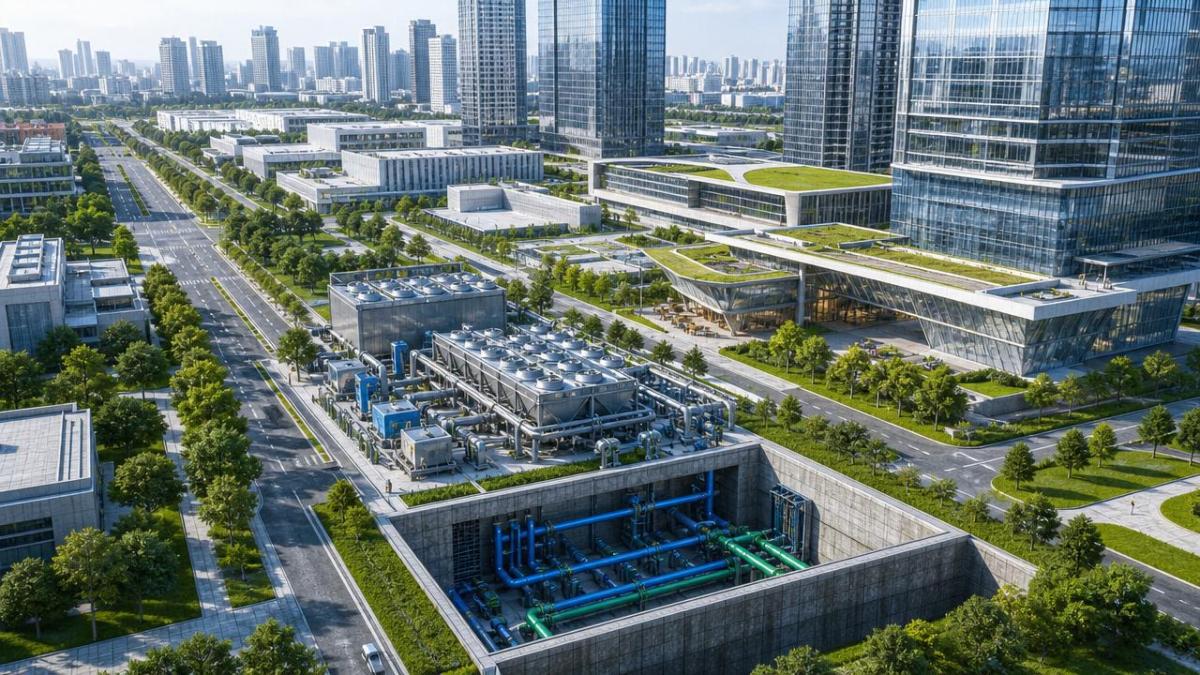
Four forces are driving the new bankability test for district cooling infrastructure. First is the rising strategic importance of cooling itself. In hot climates, dense cities, and high-spec environments, cooling is no longer a background utility. It is a business continuity requirement. This is especially relevant where precision thermal control supports advanced manufacturing, healthcare, laboratories, high-performance commercial assets, or digital infrastructure.
Second is regulatory and ESG pressure. Governments and city planners increasingly want lower emissions intensity, better peak load management, and more efficient water and energy use. District cooling infrastructure can answer these priorities, but only when performance claims are backed by credible design, operating data, and compliance pathways. If the policy case is strong but the commercial model is weak, bankability still suffers.
Third is the cost of capital environment. When capital becomes more selective, sponsors must show clearer downside protection. This pushes evaluators to examine off-take agreements, concession clarity, operator track record, and maintenance assumptions in more detail than before. A project with optimistic utilization but weak contracts may look attractive in a presentation and fragile in a financing committee.
Fourth is technology maturity. Modern chillers, controls, thermal energy storage, and monitoring systems have improved the operational case for district cooling infrastructure. Yet technology alone does not create bankability. It must translate into measurable efficiency, lower outage risk, and service reliability that customers are willing to pay for over time.
Where business evaluators should focus first
For a business evaluator, the most important shift is from asset description to risk mapping. A bankable district cooling infrastructure project usually performs well across five dimensions: demand security, commercial structure, technical robustness, regulatory support, and operator credibility.
1. Demand security is more important than total market size
A large planned development area is not the same as bankable demand. Evaluators should ask how much load is truly committed, who the anchor customers are, whether their occupancy timeline is realistic, and how exposed the project is to one or two major users. Mixed load profiles can strengthen district cooling infrastructure because commercial, hospitality, healthcare, and industrial users may produce better diversity factors than a single-use district.
2. Revenue quality matters more than tariff headline level
A high nominal tariff is less valuable than a contract structure that is enforceable and adaptable. Evaluators should review capacity charges, consumption charges, minimum take-or-pay terms, indexation formulas, termination rights, and fuel or electricity pass-through mechanics. The stronger the alignment between cost drivers and tariff design, the more resilient the revenue model becomes.
3. Technical design must support lifecycle economics
District cooling infrastructure should not be assessed only on nameplate efficiency. Questions around redundancy, modularity, part-load performance, water treatment, controls integration, and expansion compatibility are central to bankability. In high-performance environments, even small thermal deviations can affect tenant operations, so reliability is not just a maintenance issue; it is a revenue protection issue.
4. Regulatory alignment can materially de-risk the project
Projects located in jurisdictions with clear concession frameworks, utility coordination rules, building connection policies, or sustainability mandates often have better financing prospects. District cooling infrastructure becomes more bankable when it is embedded in urban planning logic rather than treated as an optional afterthought.
5. Execution capability remains a deciding factor
Even a well-structured project can fail if the sponsor, EPC team, or operator lacks experience in sequencing plant construction, network rollout, customer onboarding, and commissioning. Evaluators should examine who bears performance risk, how operational KPIs are monitored, and whether the organization can manage both infrastructure and service-delivery responsibilities.
How the impact differs across stakeholders
The current evolution in district cooling infrastructure does not affect all participants in the same way. Understanding these differences helps evaluators interpret where friction or advantage may emerge.
For sectors that depend on stable environmental control, such as advanced manufacturing and regulated laboratory environments, district cooling infrastructure may offer more value than simple energy savings. It can support thermal consistency, centralized performance management, and easier integration with digital oversight systems. That broader operational value can improve customer stickiness if captured correctly in the service model.
The red flags that commonly weaken bankability
Many proposed district cooling infrastructure projects appear compelling at concept stage but become difficult to finance when evaluators test assumptions. Common red flags include overestimated connection rates, dependence on unconfirmed future developments, weak tariff escalation logic, lack of contractual minimum demand, and unclear allocation of construction-delay risk.
Another major warning sign is a mismatch between technical ambition and operating discipline. A project may specify premium equipment but lack a realistic maintenance strategy, data architecture, or operator training plan. In practice, bankability improves when projects show how system performance will be measured, verified, and corrected over time.
Evaluators should also watch for governance gaps. If approval rights, tariff review mechanisms, or dispute resolution pathways are vague, revenue certainty declines. District cooling infrastructure works best when institutional responsibilities are defined early and remain stable through expansion phases.
What a stronger evaluation framework looks like in the next phase
Looking ahead, the strongest evaluation frameworks for district cooling infrastructure will likely be more integrated than in the past. Instead of reviewing technical, financial, and ESG dimensions separately, decision makers should assess whether they reinforce one another. A project that demonstrates lower peak electricity demand, better carbon performance, and stronger customer retention may deserve a different valuation outlook than one judged only on initial capex metrics.
This also means scenario analysis should become more practical. Evaluators should model slower occupancy, partial customer churn, higher power cost, delayed expansion, and performance degradation over time. A bankable project is not one with no risk. It is one whose risks are visible, allocated, and manageable under realistic conditions.
Digital monitoring, benchmarking against recognized standards, and lifecycle performance reporting will become increasingly important. In sophisticated environments, such as campuses, precision industrial zones, or high-spec commercial clusters, district cooling infrastructure can benefit from smart environmental monitoring and control logic that improve transparency for both operators and financiers.
Practical judgment questions before capital is committed
Before treating a district cooling infrastructure proposal as investment-ready, business evaluators should confirm several points. Is there enough contracted or highly credible anchor demand to support the first phase? Does the tariff structure protect both affordability and cost recovery? Is expansion modular, or does the project require premature overbuilding? Are service obligations measurable and enforceable? Is the regulatory environment stable enough to protect long-term revenue expectations?
They should also ask whether the operator can maintain performance in environments that require strict thermal consistency, resilience, and compliance. In many cases, bankability depends as much on disciplined execution and monitoring as on equipment quality.
Final takeaway for business evaluators
The market is moving toward a more demanding view of district cooling infrastructure. Efficiency claims alone are no longer enough. Projects are increasingly judged on whether they can prove demand durability, structure revenue intelligently, align with policy direction, and maintain reliable service over decades. That change is important because it separates technically feasible systems from truly financeable assets.
If your organization wants to judge how this trend affects a specific development, campus, industrial cluster, or urban utility plan, focus first on four issues: who will buy the cooling, on what terms, under which regulatory framework, and with what operating proof. Those answers will usually reveal whether district cooling infrastructure is merely attractive on paper or genuinely bankable in the market.
Get weekly intelligence in your inbox.
No noise. No sponsored content. Pure intelligence.
 Sep 19, 2026When does heat recovery make sustainable cooling worth the investment?Sustainable cooling technology heat recovery: learn when reliable heat demand, temperature matching, and lifecycle savings make recovery a smart investment.
 Sep 18, 2026How to set alarm limits for semiconductor cleanroom monitoringSemiconductor cleanroom monitoring: learn how to set risk-based alarm limits for particles, humidity, pressure, and airflow to protect yield and reduce nuisance alerts.
 Sep 17, 2026How plastic injection molding affects ESD protection in cleanroomsPlastic injection molding affects ESD protection in cleanrooms. Learn how resin choice, molding consistency, grounding, and particle control support reliable compliance.
 Sep 16, 2026What to verify before choosing an industrial air quality monitoring supplierIndustrial air quality monitoring supplier checklist: verify measurement accuracy, calibration traceability, data integration, compliance support, and lifecycle service before you buy.
 Sep 15, 2026Smart HVAC investment insights for North American heat recovery projectsSmart HVAC investment insights North America: evaluate heat recovery, lifecycle costs, controls, and performance for resilient project decisions.
 Sep 14, 2026How SEMI standards shape water treatment design for semiconductor fabsSemiconductor water treatment SEMI guidance shapes resilient UPW design, contamination control, monitoring, reclaim strategy, and fab-ready validation.
 Sep 13, 2026What drives Biosafety Containment Systems cost in BSL-3 projects?Biosafety Containment Systems cost in BSL-3 projects depends on HVAC, layout, decontamination, controls, and commissioning. Discover how to build a credible budget.
 Sep 12, 2026How to qualify a fine chemical process solutions supplier for purity controlFine Chemical Process Solutions supplier qualification guide: evaluate purity control, traceability, contamination prevention, and safety for reliable high-purity production.
 Sep 11, 2026What drives cleanroom certification cost for ISO Class 1–9 projects?Cleanroom certification cost depends on ISO Class 1–9 requirements, test scope, HVAC readiness, documentation, and retesting. Explore practical budgeting insights to control project risk.
 Sep 10, 2026When should Procurement Directors prioritize heat recovery payback?Procurement Directors: learn when heat recovery delivers reliable payback, lower lifecycle costs, and safe performance in controlled industrial environments.
 Sep 09, 2026How to select an environmental monitoring system for cleanroomsEnvironmental monitoring system selection for cleanrooms: compare sensors, alarms, data integrity, integration, and installation to ensure reliable control.
 Sep 08, 2026How temperature stability affects semiconductor manufacturing yieldSemiconductor manufacturing temperature stability directly affects yield, overlay, metrology, and process control. Explore practical HVAC, monitoring, and zoning strategies.
 Sep 07, 2026How to prepare for a Regulatory Frameworks audit of cleanroom controlsRegulatory Frameworks audit readiness for cleanroom controls: build traceable evidence, verify alarms and monitoring, and close compliance gaps with confidence.
 Sep 07, 2026How to choose reverse osmosis systems with the right recovery rateReverse osmosis systems: learn how to select the right recovery rate for reliable water quality, lower scaling risk, efficient concentrate control, and stable long-term performance.
 Sep 05, 2026How does a negative pressure room work to contain airborne contaminants?How does a negative pressure room work? Discover how inward airflow, controlled exhaust, monitoring, and room design help contain airborne contaminants safely.
 Sep 04, 2026How Should Semiconductor Facilities Select Vibration Isolation Systems?Vibration isolation semiconductor guide: learn how to match tool limits, site vibration, utilities, and cleanroom needs for stable, high-yield fab performance.
 Sep 04, 2026What TOC Limits Should Be Set and Monitored for a UPW Loop?What are our TOC limits for the UPW loop? Learn how to set defensible TOC thresholds, monitor trends, protect critical processes, and improve water-quality control.
 Sep 04, 2026What Are the Best Retrofit Options for Upgrading Existing Pharmaceutical Cleanrooms?What are the best retrofit options to upgrade existing pharma cleanrooms? Explore FFUs, HVAC modernization, pressure cascades, monitoring, and sealed finishes for compliant performance.
 Sep 04, 2026How Does a Negative Air Pressure Room Protect Adjacent Areas?What is a negative air pressure room? Learn how controlled airflow contains airborne hazards, protects adjacent spaces, and supports safer facility operations.
 Sep 04, 2026What Is ISO Class 1 Cleanroom Classification, and Where Is It Used?What is ISO Class 1? Explore its ultra-low particle limits, critical cleanroom design factors, verification methods, and uses in semiconductor, optics, and quantum manufacturing.
 Sep 04, 2026How Long After a UPW Deviation Does Yield Impact Typically Appear?What is the typical time lag from UPW deviation to yield impact? Learn how contamination, process sensitivity, exposure windows, and testing stages shape detection timing.
 Sep 04, 2026What Testing Data Should Engineers Review Before Approving a UPW Material?What testing data should be reviewed before approving a UPW material? Explore extractables, TOC, particle release, ionic leaching, corrosion, and reliability data for confident approval.
 Sep 04, 2026How Should Pharmaceutical Cleanrooms Choose Climate Control Systems?Which climate control systems are recommended for pharmaceutical cleanroom environments? Explore HVAC, humidity, pressure, HEPA filtration, and GMP-ready monitoring strategies.
 Sep 04, 2026Airtight Door Problems in Medical Spaces and How Buyers Prevent ThemA problem-solving guide for airtight door procurement, covering sealing performance, sensors, wall coordination, cleaning, maintenance, and acceptance risk.
 Sep 04, 2026What drives cleanroom design cost for ISO Class 7 projects?Cleanroom design cost for ISO Class 7 projects depends on HVAC, filtration, utilities, validation, and lifecycle strategy. Learn how to control budgets without compromising compliance or performance.
 Sep 03, 2026When do heat pipe heat exchangers suit pharmaceutical cleanrooms?Heat Pipe Heat Exchangers for pharmaceutical plants: discover when they support cleanroom energy recovery, airflow separation, humidity control, and GMP-ready HVAC design.
 Sep 02, 2026What determines biosafety cabinets price across different modelsBiosafety cabinets price varies by class, airflow design, filtration, size, certification, and installation. Compare models confidently to choose safe, cost-effective containment.