K-REACH Change Hits UPW Chemical Pre-Registration
On June 10, 2026, South Korea’s Ministry of Environment released a key amendment to the K-REACH enforcement rules that changes import conditions for certain chemicals used in ultra-pure water (UPW) systems. For suppliers tied to 18.2MΩ·cm UPW production lines, especially those supporting semiconductor projects, the update matters because it turns pre-registration and full toxicological data submission into an import-stage compliance issue that may affect sourcing, project timing, and delivery planning.
What the amendment clearly changes
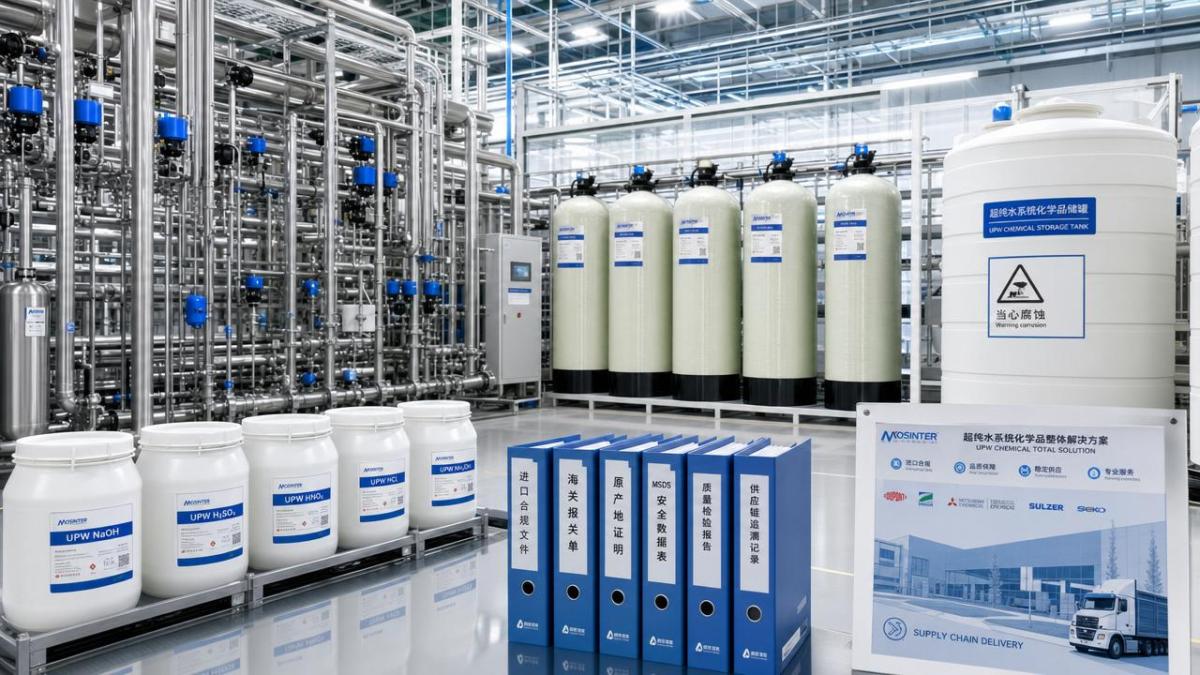
The confirmed change is that new chemical substances used in UPW preparation systems, including new additives, TOC removal agents, and ion-exchange regenerants, must complete K-REACH pre-registration before import into South Korea. The amendment was issued by South Korea’s Ministry of Environment on June 10, 2026, and it also requires the submission of complete toxicological data for those substances. The scope described in the provided information covers chemical suppliers serving 18.2MΩ·cm UPW production lines, and the stated business impact includes delivery timing and compliance costs for Chinese UPW equipment integrators supplying South Korean semiconductor plants.
Where the pressure is likely to appear first
Imported UPW chemical suppliers face a front-loaded compliance step
From an industry perspective, the most direct impact falls on suppliers of new UPW-related chemicals because the rule change moves compliance to the pre-import stage. That means the ability to ship is no longer only a commercial or logistics issue; it also depends on whether pre-registration has been completed and whether toxicological documentation is ready for review.
UPW system integrators may see delivery schedules tighten
Chinese UPW equipment integrators serving South Korean semiconductor customers are explicitly identified in the provided information as being affected. Analysis shows that even when the core equipment itself is ready, project delivery can still be delayed if the associated chemicals required for commissioning, operation, or system support cannot clear the new compliance gate in time.
Procurement and project teams need to reassess supporting materials
What deserves closer attention is the procurement side of UPW projects. Where a system package depends on specific additives, TOC removal agents, or ion-exchange regenerants, buyers and project teams may need to check whether supplier qualification materials, toxicology documentation, and import-readiness evidence are aligned before shipment and before contract milestones are locked in.
What companies should review now
Check whether any UPW-support chemicals fall into the new-substance category
Companies involved in export, integration, or sourcing should first identify whether the chemicals attached to their UPW projects are treated as new substances under the amended K-REACH framework. This is especially relevant for chemical packages linked to 18.2MΩ·cm UPW lines.
Review document readiness before shipment planning
Observably, document preparation becomes a practical risk point under this change. Businesses should pay closer attention to whether pre-registration status, toxicological materials, technical documents, and shipment-related compliance records are prepared early enough to support import timing.
Revisit procurement and delivery assumptions in project schedules
Analysis shows that the rule change is not only a regulatory matter but also a scheduling issue. Enterprises may need to recheck whether procurement lead times, supplier onboarding, and delivery commitments to South Korean customers still reflect the added compliance step.
Watch for execution language in customer and tender documents
Because the provided information does not include detailed implementation language beyond the amendment itself, companies should closely monitor how compliance expectations appear in customer specifications, tender documents, and commercial terms. It would be premature to treat all execution details as settled.
Why this looks like more than a routine wording update
Analysis shows that this development is better understood as an execution-level compliance signal rather than a purely formal policy notice. The reason is that the change directly links import eligibility for certain UPW system chemicals to pre-registration and toxicological documentation. At the same time, it is also more appropriate to understand this as a rule change that still requires follow-up observation, because the provided information does not include fuller detail on implementation practice, review pace, or market response.
How the market is likely to read it for now
For the UPW and semiconductor support supply chain, this update points to a tighter compliance threshold around chemical inputs rather than a general change to all project conditions. A balanced reading is that the amendment already matters for planning and supplier screening, but its full operational effect will depend on how consistently the new requirements are applied in trade, procurement, and project delivery workflows.
Basis of this article
This article is generated from the user-provided news title, event date, and event summary. For developments of this kind, relevant source types typically include official regulatory notices, publications from supervisory authorities, customs or trade-administration information, industry association updates, standard-setting documents, and reporting by authoritative trade media. A specific official source link was not provided in the input, so further verification remains necessary. What still needs continued observation includes detailed implementation language, compliance interpretation, tender-document changes, industry feedback, and how affected companies carry out the new requirements in practice.
Get weekly intelligence in your inbox.
No noise. No sponsored content. Pure intelligence.
 Sep 15, 2026Smart HVAC investment insights for North American heat recovery projectsSmart HVAC investment insights North America: evaluate heat recovery, lifecycle costs, controls, and performance for resilient project decisions.
 Sep 14, 2026How SEMI standards shape water treatment design for semiconductor fabsSemiconductor water treatment SEMI guidance shapes resilient UPW design, contamination control, monitoring, reclaim strategy, and fab-ready validation.
 Sep 13, 2026What drives Biosafety Containment Systems cost in BSL-3 projects?Biosafety Containment Systems cost in BSL-3 projects depends on HVAC, layout, decontamination, controls, and commissioning. Discover how to build a credible budget.
 Sep 12, 2026How to qualify a fine chemical process solutions supplier for purity controlFine Chemical Process Solutions supplier qualification guide: evaluate purity control, traceability, contamination prevention, and safety for reliable high-purity production.
 Sep 11, 2026What drives cleanroom certification cost for ISO Class 1–9 projects?Cleanroom certification cost depends on ISO Class 1–9 requirements, test scope, HVAC readiness, documentation, and retesting. Explore practical budgeting insights to control project risk.
 Sep 10, 2026When should Procurement Directors prioritize heat recovery payback?Procurement Directors: learn when heat recovery delivers reliable payback, lower lifecycle costs, and safe performance in controlled industrial environments.
 Sep 09, 2026How to select an environmental monitoring system for cleanroomsEnvironmental monitoring system selection for cleanrooms: compare sensors, alarms, data integrity, integration, and installation to ensure reliable control.
 Sep 08, 2026How temperature stability affects semiconductor manufacturing yieldSemiconductor manufacturing temperature stability directly affects yield, overlay, metrology, and process control. Explore practical HVAC, monitoring, and zoning strategies.
 Sep 07, 2026How to prepare for a Regulatory Frameworks audit of cleanroom controlsRegulatory Frameworks audit readiness for cleanroom controls: build traceable evidence, verify alarms and monitoring, and close compliance gaps with confidence.
 Sep 07, 2026How to choose reverse osmosis systems with the right recovery rateReverse osmosis systems: learn how to select the right recovery rate for reliable water quality, lower scaling risk, efficient concentrate control, and stable long-term performance.
 Sep 05, 2026How does a negative pressure room work to contain airborne contaminants?How does a negative pressure room work? Discover how inward airflow, controlled exhaust, monitoring, and room design help contain airborne contaminants safely.
 Sep 04, 2026What TOC Limits Should Be Set and Monitored for a UPW Loop?What are our TOC limits for the UPW loop? Learn how to set defensible TOC thresholds, monitor trends, protect critical processes, and improve water-quality control.
 Sep 04, 2026What Are the Best Retrofit Options for Upgrading Existing Pharmaceutical Cleanrooms?What are the best retrofit options to upgrade existing pharma cleanrooms? Explore FFUs, HVAC modernization, pressure cascades, monitoring, and sealed finishes for compliant performance.
 Sep 04, 2026How Does a Negative Air Pressure Room Protect Adjacent Areas?What is a negative air pressure room? Learn how controlled airflow contains airborne hazards, protects adjacent spaces, and supports safer facility operations.
 Sep 04, 2026What Is ISO Class 1 Cleanroom Classification, and Where Is It Used?What is ISO Class 1? Explore its ultra-low particle limits, critical cleanroom design factors, verification methods, and uses in semiconductor, optics, and quantum manufacturing.
 Sep 04, 2026How Long After a UPW Deviation Does Yield Impact Typically Appear?What is the typical time lag from UPW deviation to yield impact? Learn how contamination, process sensitivity, exposure windows, and testing stages shape detection timing.
 Sep 04, 2026What Testing Data Should Engineers Review Before Approving a UPW Material?What testing data should be reviewed before approving a UPW material? Explore extractables, TOC, particle release, ionic leaching, corrosion, and reliability data for confident approval.
 Sep 04, 2026How Should Pharmaceutical Cleanrooms Choose Climate Control Systems?Which climate control systems are recommended for pharmaceutical cleanroom environments? Explore HVAC, humidity, pressure, HEPA filtration, and GMP-ready monitoring strategies.
 Sep 04, 2026Airtight Door Problems in Medical Spaces and How Buyers Prevent ThemA problem-solving guide for airtight door procurement, covering sealing performance, sensors, wall coordination, cleaning, maintenance, and acceptance risk.
 Sep 04, 2026What drives cleanroom design cost for ISO Class 7 projects?Cleanroom design cost for ISO Class 7 projects depends on HVAC, filtration, utilities, validation, and lifecycle strategy. Learn how to control budgets without compromising compliance or performance.
 Sep 03, 2026When do heat pipe heat exchangers suit pharmaceutical cleanrooms?Heat Pipe Heat Exchangers for pharmaceutical plants: discover when they support cleanroom energy recovery, airflow separation, humidity control, and GMP-ready HVAC design.
 Sep 02, 2026What determines biosafety cabinets price across different modelsBiosafety cabinets price varies by class, airflow design, filtration, size, certification, and installation. Compare models confidently to choose safe, cost-effective containment.
 Sep 01, 2026When does thermal energy storage cut peak-demand costs in plants?Thermal energy storage for industrial plants can cut peak-demand costs when tariffs, load profiles, and controls align. Explore practical savings, resilience, and integration factors.
 Aug 31, 2026How a digital environmental monitoring system supports audit-ready cleanroomsDigital environmental monitoring system strategies for audit-ready cleanrooms: improve traceability, alarm response, data integrity, and compliance confidence.
 Aug 30, 2026When does next-gen thermal management closed loop reduce chiller energy use?Next-gen thermal management closed loop systems can cut chiller energy by reducing lift, optimizing flows, enabling heat recovery, and improving controls. Discover when savings are real.
 Aug 29, 2026How chilled water piping layout affects pump energy useChilled water piping layout directly affects pump energy, control stability, and lifecycle costs. Explore practical design insights for efficient, reliable systems.
 Aug 28, 2026When thermal energy storage systems cut peak cooling costs in pharma plantsThermal Energy Storage Systems for pharmaceutical plants cut peak cooling costs, support compliance, and strengthen resilience. Explore the business case.