Business Intelligence vs Dashboards: What Actually Improves Decisions?
Business Intelligence vs dashboards: why the distinction matters
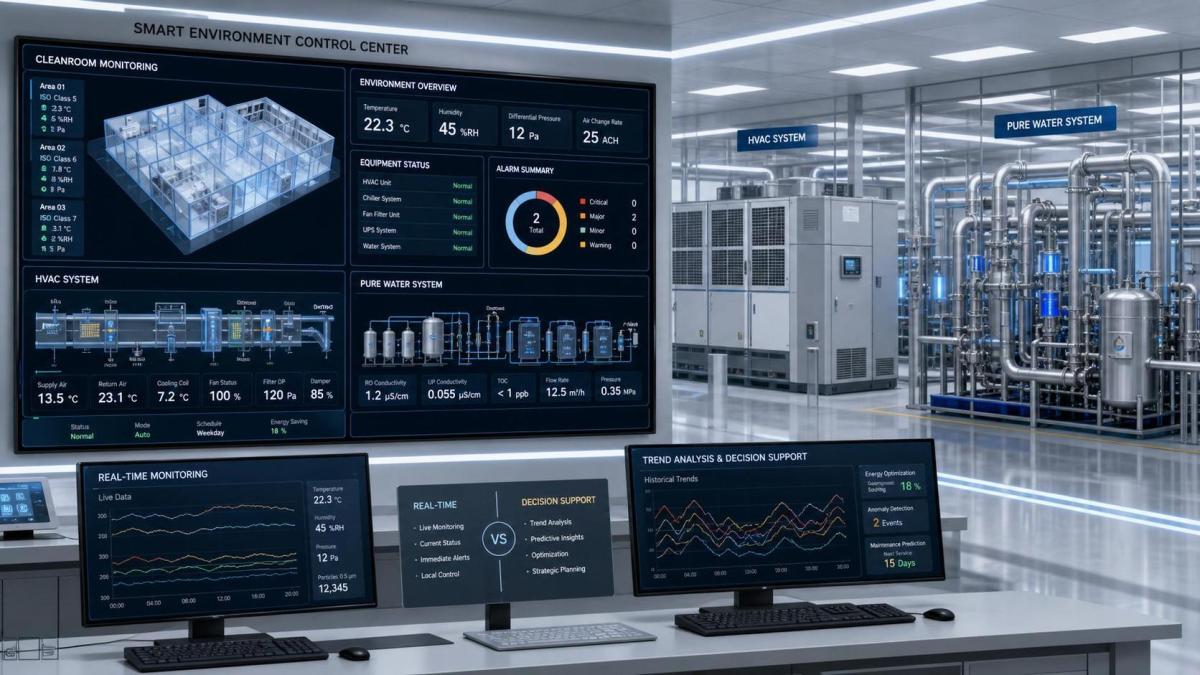
In complex operations, visibility is valuable, but visibility alone rarely improves a decision.
That is why Business Intelligence attracts attention far beyond reporting teams.
A dashboard can display current temperatures, alarm counts, water quality drift, or energy loads.
Business Intelligence goes further by connecting those signals to cause, risk, timing, and likely impact.
This difference becomes critical in environments shaped by contamination control, biosafety, and tight thermal tolerances.
In facilities aligned with standards such as ISO 14644, ASHRAE, and SEMI, a missed pattern can become a compliance event.
It can also become lost yield, unstable process quality, or avoidable downtime.
Seen through that lens, the real question is not whether dashboards are useful.
The better question is what actually helps people decide with confidence when operations become too interconnected for simple screens.
Are dashboards already enough for daily decisions?
Sometimes yes, but only for a narrow class of decisions.
Dashboards are strong when the goal is immediate awareness.
They help teams see whether a chiller is under stress, whether airborne particles are rising, or whether a lab zone crossed a threshold.
That is useful, especially in high-speed operating environments.
The limitation appears when the signal is not self-explanatory.
A red indicator shows deviation, but it does not automatically reveal source, sequence, probability, or business consequence.
For example, a rise in humidity may look minor on screen.
In practice, that shift may connect to filter performance, energy optimization logic, occupancy patterns, or process instability upstream.
Business Intelligence becomes valuable when decisions require relationships, not just readings.
It organizes operational data, maintenance history, compliance records, and performance benchmarks into decision-ready context.
In settings similar to the G-ICE framework, this context matters because environmental control systems rarely fail in isolation.
The more integrated the facility, the less reliable a single-screen interpretation becomes.
What does Business Intelligence add that a dashboard usually cannot?
The simplest answer is decision structure.
Business Intelligence turns raw visibility into a framework for action.
Instead of showing one operating condition, it can compare conditions across time, sites, process lines, and standards.
That makes a major difference when leaders need to prioritize investment, escalation, or corrective action.
In actual use, Business Intelligence often supports four practical questions:
- Is this event an isolated exception or part of a growing pattern?
- Which variables most strongly influence the outcome that matters?
- What financial, compliance, or yield risk is attached to delayed action?
- Which response creates the best trade-off between speed, cost, and resilience?
A dashboard might answer the first layer of awareness.
Business Intelligence is designed to answer the second and third layer, where strategy begins.
That is especially relevant for smart environmental monitoring and digital twin control.
When a facility captures thousands of variables, the problem is no longer access to data.
The problem is deciding which signals matter first and why.
A practical comparison at decision level
The table below helps separate display tools from decision tools.
This is why Business Intelligence often sits closer to enterprise decision-making than standard dashboarding.
Where is the gap most visible in industrial and controlled environments?
The gap becomes obvious where precision requirements are unforgiving.
Cleanrooms, high-risk laboratories, advanced HVAC systems, and ultra-pure water loops are good examples.
In those settings, one metric rarely tells the whole story.
Take contamination control as an example.
A dashboard may show particle counts within range for most hours.
Yet Business Intelligence may reveal that excursions cluster after maintenance windows or process changeovers.
That changes the decision from reactive cleaning to procedural redesign.
The same applies to thermal management.
Holding temperature within a narrow band is not enough if stability comes with unsustainable energy penalties or short equipment life.
Business Intelligence helps compare control quality, asset loading, maintenance frequency, and downstream process sensitivity together.
In benchmark-driven environments, such as those reflected in G-ICE, that broader view supports better trade-offs.
It helps organizations see not just whether systems comply, but whether they perform sustainably under real operating pressure.
If both exist, which one should guide investment decisions?
The answer depends on the maturity of the decision, not the popularity of the tool.
For front-line monitoring, dashboards remain essential.
For budgeting, standard-setting, risk prioritization, and multi-site alignment, Business Intelligence usually carries more weight.
A helpful way to judge the need is to look at the cost of being wrong.
If a mistaken decision only causes a short-lived visual inconvenience, a dashboard may be sufficient.
If the mistake can trigger process drift, audit exposure, product loss, or energy waste at scale, Business Intelligence deserves priority.
In practical planning, these signals often indicate a need for deeper intelligence:
- The same incident repeats, but root cause remains debated.
- Different sites report performance differently, making comparison unreliable.
- Compliance reviews require evidence beyond snapshots.
- Capital spending decisions rely on assumptions rather than linked operational data.
- Energy, resilience, and quality targets conflict without a shared decision model.
When those signs appear, adding more dashboards usually does not solve the real issue.
It often adds visual noise instead of clarity.
What mistakes do organizations make when they say they want Business Intelligence?
A common mistake is treating Business Intelligence as a prettier reporting layer.
That approach produces attractive screens without better judgment.
Another mistake is starting with software features instead of decision questions.
If the organization has not defined which decisions need improvement, data projects quickly become broad and unfocused.
There is also a data discipline issue.
Business Intelligence is only as useful as the consistency of naming, thresholds, timestamps, and source reliability.
This is especially important where digital monitoring touches HVAC, cleanroom systems, UPW treatment, and biosafety controls simultaneously.
If each domain measures success differently, the intelligence layer becomes fragmented.
A more reliable path is to define the business decisions first.
Then map which data, benchmarks, and comparison logic are required to support them.
That sequence sounds basic, but it often determines whether Business Intelligence becomes operationally useful or remains a reporting exercise.
A quick judgment checklist
Before expanding a reporting environment, it helps to test the need against a few practical questions.
- Do current screens explain causes, or only show symptoms?
- Can teams compare facilities using the same logic and thresholds?
- Are decisions tied to compliance, yield, uptime, and energy outcomes together?
- Is there enough historical depth to identify patterns before failures escalate?
- Can results support governance reviews, not just control-room awareness?
If the answer is mostly no, Business Intelligence is probably the missing layer.
So what actually improves decisions?
The short answer is not dashboards alone and not Business Intelligence in isolation.
Better decisions come from using each tool at the right level.
Dashboards support attention.
Business Intelligence supports interpretation, prioritization, and action.
In high-control environments, that layered approach is more realistic than choosing one over the other.
What matters most is whether the information system reflects operational reality.
If systems span contamination control, thermal stability, process fluids, containment, and digital monitoring, decision support must also cross those boundaries.
That is where Business Intelligence proves its value.
It helps translate technical performance into operational choices that can be defended, compared, and improved over time.
A sensible next step is to review three things together: which decisions carry the highest consequence, which data sources inform them today, and where explanation is still missing.
That exercise usually makes the role of dashboards and Business Intelligence much clearer.
Once that clarity exists, investment choices become less about software labels and more about decision quality.
Get weekly intelligence in your inbox.
No noise. No sponsored content. Pure intelligence.
 Sep 15, 2026Smart HVAC investment insights for North American heat recovery projectsSmart HVAC investment insights North America: evaluate heat recovery, lifecycle costs, controls, and performance for resilient project decisions.
 Sep 14, 2026How SEMI standards shape water treatment design for semiconductor fabsSemiconductor water treatment SEMI guidance shapes resilient UPW design, contamination control, monitoring, reclaim strategy, and fab-ready validation.
 Sep 13, 2026What drives Biosafety Containment Systems cost in BSL-3 projects?Biosafety Containment Systems cost in BSL-3 projects depends on HVAC, layout, decontamination, controls, and commissioning. Discover how to build a credible budget.
 Sep 12, 2026How to qualify a fine chemical process solutions supplier for purity controlFine Chemical Process Solutions supplier qualification guide: evaluate purity control, traceability, contamination prevention, and safety for reliable high-purity production.
 Sep 11, 2026What drives cleanroom certification cost for ISO Class 1–9 projects?Cleanroom certification cost depends on ISO Class 1–9 requirements, test scope, HVAC readiness, documentation, and retesting. Explore practical budgeting insights to control project risk.
 Sep 10, 2026When should Procurement Directors prioritize heat recovery payback?Procurement Directors: learn when heat recovery delivers reliable payback, lower lifecycle costs, and safe performance in controlled industrial environments.
 Sep 09, 2026How to select an environmental monitoring system for cleanroomsEnvironmental monitoring system selection for cleanrooms: compare sensors, alarms, data integrity, integration, and installation to ensure reliable control.
 Sep 08, 2026How temperature stability affects semiconductor manufacturing yieldSemiconductor manufacturing temperature stability directly affects yield, overlay, metrology, and process control. Explore practical HVAC, monitoring, and zoning strategies.
 Sep 07, 2026How to prepare for a Regulatory Frameworks audit of cleanroom controlsRegulatory Frameworks audit readiness for cleanroom controls: build traceable evidence, verify alarms and monitoring, and close compliance gaps with confidence.
 Sep 07, 2026How to choose reverse osmosis systems with the right recovery rateReverse osmosis systems: learn how to select the right recovery rate for reliable water quality, lower scaling risk, efficient concentrate control, and stable long-term performance.
 Sep 05, 2026How does a negative pressure room work to contain airborne contaminants?How does a negative pressure room work? Discover how inward airflow, controlled exhaust, monitoring, and room design help contain airborne contaminants safely.
 Sep 04, 2026What TOC Limits Should Be Set and Monitored for a UPW Loop?What are our TOC limits for the UPW loop? Learn how to set defensible TOC thresholds, monitor trends, protect critical processes, and improve water-quality control.
 Sep 04, 2026What Are the Best Retrofit Options for Upgrading Existing Pharmaceutical Cleanrooms?What are the best retrofit options to upgrade existing pharma cleanrooms? Explore FFUs, HVAC modernization, pressure cascades, monitoring, and sealed finishes for compliant performance.
 Sep 04, 2026How Does a Negative Air Pressure Room Protect Adjacent Areas?What is a negative air pressure room? Learn how controlled airflow contains airborne hazards, protects adjacent spaces, and supports safer facility operations.
 Sep 04, 2026What Is ISO Class 1 Cleanroom Classification, and Where Is It Used?What is ISO Class 1? Explore its ultra-low particle limits, critical cleanroom design factors, verification methods, and uses in semiconductor, optics, and quantum manufacturing.
 Sep 04, 2026How Long After a UPW Deviation Does Yield Impact Typically Appear?What is the typical time lag from UPW deviation to yield impact? Learn how contamination, process sensitivity, exposure windows, and testing stages shape detection timing.
 Sep 04, 2026What Testing Data Should Engineers Review Before Approving a UPW Material?What testing data should be reviewed before approving a UPW material? Explore extractables, TOC, particle release, ionic leaching, corrosion, and reliability data for confident approval.
 Sep 04, 2026How Should Pharmaceutical Cleanrooms Choose Climate Control Systems?Which climate control systems are recommended for pharmaceutical cleanroom environments? Explore HVAC, humidity, pressure, HEPA filtration, and GMP-ready monitoring strategies.
 Sep 04, 2026Airtight Door Problems in Medical Spaces and How Buyers Prevent ThemA problem-solving guide for airtight door procurement, covering sealing performance, sensors, wall coordination, cleaning, maintenance, and acceptance risk.
 Sep 04, 2026What drives cleanroom design cost for ISO Class 7 projects?Cleanroom design cost for ISO Class 7 projects depends on HVAC, filtration, utilities, validation, and lifecycle strategy. Learn how to control budgets without compromising compliance or performance.
 Sep 03, 2026When do heat pipe heat exchangers suit pharmaceutical cleanrooms?Heat Pipe Heat Exchangers for pharmaceutical plants: discover when they support cleanroom energy recovery, airflow separation, humidity control, and GMP-ready HVAC design.
 Sep 02, 2026What determines biosafety cabinets price across different modelsBiosafety cabinets price varies by class, airflow design, filtration, size, certification, and installation. Compare models confidently to choose safe, cost-effective containment.
 Sep 01, 2026When does thermal energy storage cut peak-demand costs in plants?Thermal energy storage for industrial plants can cut peak-demand costs when tariffs, load profiles, and controls align. Explore practical savings, resilience, and integration factors.
 Aug 31, 2026How a digital environmental monitoring system supports audit-ready cleanroomsDigital environmental monitoring system strategies for audit-ready cleanrooms: improve traceability, alarm response, data integrity, and compliance confidence.
 Aug 30, 2026When does next-gen thermal management closed loop reduce chiller energy use?Next-gen thermal management closed loop systems can cut chiller energy by reducing lift, optimizing flows, enabling heat recovery, and improving controls. Discover when savings are real.
 Aug 29, 2026How chilled water piping layout affects pump energy useChilled water piping layout directly affects pump energy, control stability, and lifecycle costs. Explore practical design insights for efficient, reliable systems.
 Aug 28, 2026When thermal energy storage systems cut peak cooling costs in pharma plantsThermal Energy Storage Systems for pharmaceutical plants cut peak cooling costs, support compliance, and strengthen resilience. Explore the business case.