Supply Chain Trends 2026: Cost, Risk, and Resilience Signals
Supply Chain Trends 2026 are changing the operating baseline
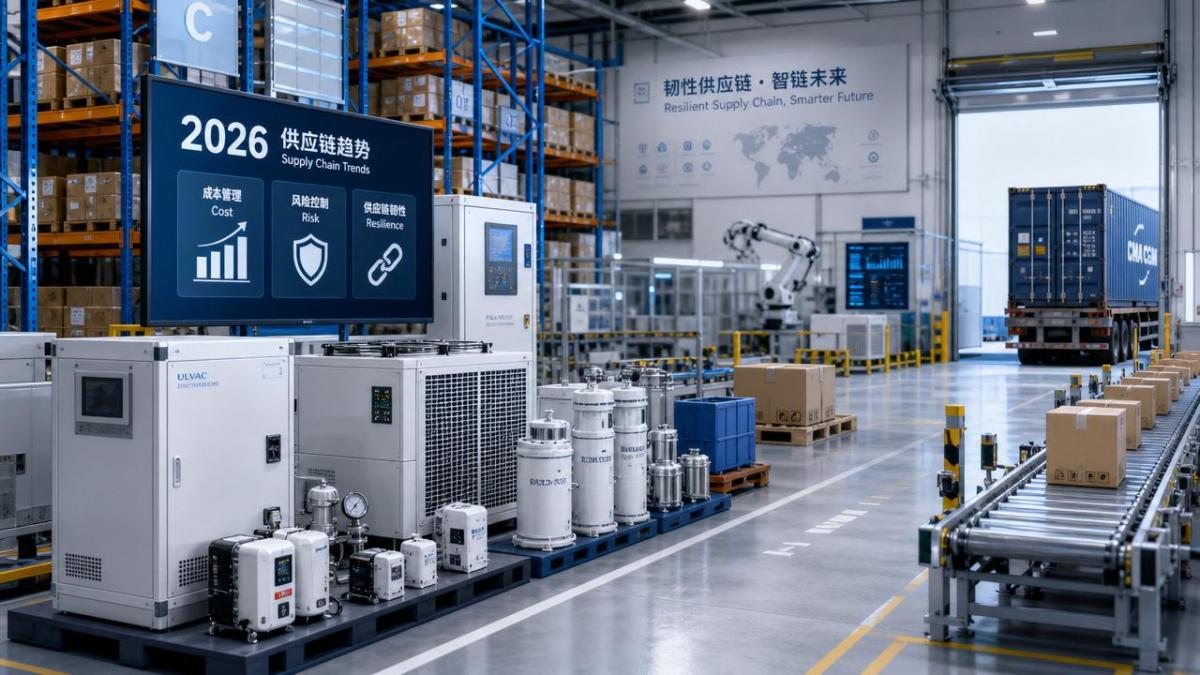
Supply Chain Trends in 2026 point to a harder reality for industrial planning.
Cost pressure, risk exposure, and resilience now move together, not in separate tracks.
That shift matters most where uptime, contamination control, thermal precision, and regulatory proof cannot fail.
In semiconductor, pharmaceutical, advanced laboratory, and data-intensive facilities, a delayed component is rarely just a delayed shipment.
It can interrupt validation cycles, stretch commissioning timelines, and raise compliance risk across interconnected systems.
Recent Supply Chain Trends also show that procurement decisions are becoming infrastructure decisions.
When fan filter units, precision chillers, UPW skids, sensors, controls, and containment assemblies arrive late or vary in quality, operational control weakens quickly.
This is why the 2026 outlook deserves close attention beyond logistics teams alone.
For organizations following the G-ICE view of high-performance environments, supply continuity is now tied directly to environmental integrity and capital efficiency.
The signal is no longer disruption alone, but persistent volatility
The more visible change is not one dramatic crisis.
It is the normalization of overlapping volatility across freight, energy, industrial metals, electronics, and regulatory clearance.
Supply Chain Trends now reflect a world where lead times may improve in one quarter and reverse in the next.
That pattern makes planning harder for projects requiring validated, tightly specified equipment.
High-performance HVAC modules, filtration media, cleanroom panels, process valves, and digital monitoring components depend on globally distributed inputs.
A small disruption upstream can trigger requalification, redesign, or delayed acceptance downstream.
More importantly, cost signals are no longer limited to purchase price.
Hidden costs now appear in storage, redesign labor, temporary substitutions, compliance paperwork, and startup delay.
Where the pressure is becoming most visible
- Critical components with narrow qualification windows are showing uneven availability.
- Cross-border shipments face more documentation reviews tied to origin, safety, and sustainability claims.
- Energy-intensive equipment carries pricing risk linked to utility markets and decarbonization compliance.
- Digital control layers depend on electronics categories still exposed to regional concentration.
These Supply Chain Trends suggest that volatility is becoming structural rather than temporary.
Why these Supply Chain Trends are strengthening in 2026
Several forces are reinforcing each other.
The result is a market where resilience investment increasingly competes with short-term cost reduction.
From a G-ICE perspective, this matters because invisible performance thresholds leave little room for substitution.
A part that looks equivalent on paper may fail a contamination, thermal stability, or biosafety requirement during operation.
That is why Supply Chain Trends in technical environments cannot be read through price charts alone.
The impact is spreading beyond procurement into facility performance
One important shift is that supply instability now affects multiple operational layers at once.
It touches design assumptions, construction schedules, qualification paths, maintenance cycles, and ESG reporting.
In cleanroom and controlled environments, this can become especially expensive.
If a specified airflow module changes, air balancing may change as well.
If a chiller platform changes, thermal response and energy models may need revision.
If sensor architecture changes, digital twin assumptions and alarm logic may need revalidation.
Practical areas where Supply Chain Trends are reshaping decisions
- Specification strategy now favors functionally approved alternatives before disruption appears.
- Inventory policy is moving toward criticality-based buffers, not broad stockpiling.
- Supplier review increasingly includes validation data, standards alignment, and service continuity.
- Capital planning is giving more weight to maintainability and replacement-path visibility.
More noticeably, resilience is becoming measurable.
Organizations want to know which assets are exposed, how quickly substitutes can be qualified, and where operational bottlenecks are hidden.
What deserves closer attention in controlled industrial environments
Not every category carries the same risk.
The strongest Supply Chain Trends appear around components where performance tolerance is narrow and documentation demands are high.
Examples include FFU systems, magnetic-levitation centrifugal chillers, containment hardware, filtration media, process instrumentation, and UPW treatment assemblies.
These categories matter because their role is not isolated.
They sit inside larger systems governed by ISO 14644, ASHRAE, SEMI, biosafety protocols, and internal environmental control benchmarks.
A delivery issue can become a validation issue, and then a revenue issue.
Signals worth monitoring during 2026
- Longer approval cycles for components with origin-sensitive materials or electronics.
- Wider bid spreads for energy-efficient equipment with strong lifecycle performance.
- Higher demand for suppliers able to provide traceability, validation support, and retrofit compatibility.
- Greater use of digital monitoring to connect spare-part planning with asset performance.
This is also where G-ICE-style benchmarking becomes useful.
It helps compare options by operational fit, standards alignment, and resilience value rather than by initial price alone.
A stronger response starts with better visibility, not bigger inventories
Many organizations have already learned that excess stock is a blunt instrument.
It ties up capital and does little to solve specification mismatch or service continuity issues.
The more effective response to current Supply Chain Trends is sharper visibility across technical and commercial risk.
That means mapping which components are mission-critical, which suppliers are difficult to replace, and which standards create requalification barriers.
Useful actions with immediate planning value
- Segment components by operational criticality, qualification burden, and lead-time sensitivity.
- Create preapproved alternates for selected high-risk categories before projects enter execution.
- Review contracts for service parts access, documentation support, and change-notice obligations.
- Link supply monitoring with facility data to identify assets most exposed to downtime.
- Use lifecycle cost models that include energy, maintenance, and compliance handling.
The key is to treat resilience as a design and governance issue.
When supply decisions align with environmental performance targets, cost control becomes more durable.
The next phase of Supply Chain Trends will reward disciplined flexibility
Looking ahead, the most credible Supply Chain Trends are not about a return to old stability.
They point toward a market where flexibility must be engineered without compromising technical control.
That balance is especially relevant in facilities where contamination, thermal drift, water purity, or biosafety failure has outsized consequences.
The practical question for 2026 is no longer whether disruption can happen.
It is whether systems, standards, and sourcing logic are prepared when it does.
A useful next step is to review supply exposure by critical asset class, compare current specifications against alternative pathways, and track standards-linked risk in upcoming projects.
That approach makes Supply Chain Trends actionable.
It also supports the broader goal behind resilient industrial infrastructure: stable performance, defensible compliance, and better capital decisions under uncertain conditions.
Get weekly intelligence in your inbox.
No noise. No sponsored content. Pure intelligence.
 Sep 15, 2026Smart HVAC investment insights for North American heat recovery projectsSmart HVAC investment insights North America: evaluate heat recovery, lifecycle costs, controls, and performance for resilient project decisions.
 Sep 14, 2026How SEMI standards shape water treatment design for semiconductor fabsSemiconductor water treatment SEMI guidance shapes resilient UPW design, contamination control, monitoring, reclaim strategy, and fab-ready validation.
 Sep 13, 2026What drives Biosafety Containment Systems cost in BSL-3 projects?Biosafety Containment Systems cost in BSL-3 projects depends on HVAC, layout, decontamination, controls, and commissioning. Discover how to build a credible budget.
 Sep 12, 2026How to qualify a fine chemical process solutions supplier for purity controlFine Chemical Process Solutions supplier qualification guide: evaluate purity control, traceability, contamination prevention, and safety for reliable high-purity production.
 Sep 11, 2026What drives cleanroom certification cost for ISO Class 1–9 projects?Cleanroom certification cost depends on ISO Class 1–9 requirements, test scope, HVAC readiness, documentation, and retesting. Explore practical budgeting insights to control project risk.
 Sep 10, 2026When should Procurement Directors prioritize heat recovery payback?Procurement Directors: learn when heat recovery delivers reliable payback, lower lifecycle costs, and safe performance in controlled industrial environments.
 Sep 09, 2026How to select an environmental monitoring system for cleanroomsEnvironmental monitoring system selection for cleanrooms: compare sensors, alarms, data integrity, integration, and installation to ensure reliable control.
 Sep 08, 2026How temperature stability affects semiconductor manufacturing yieldSemiconductor manufacturing temperature stability directly affects yield, overlay, metrology, and process control. Explore practical HVAC, monitoring, and zoning strategies.
 Sep 07, 2026How to prepare for a Regulatory Frameworks audit of cleanroom controlsRegulatory Frameworks audit readiness for cleanroom controls: build traceable evidence, verify alarms and monitoring, and close compliance gaps with confidence.
 Sep 07, 2026How to choose reverse osmosis systems with the right recovery rateReverse osmosis systems: learn how to select the right recovery rate for reliable water quality, lower scaling risk, efficient concentrate control, and stable long-term performance.
 Sep 05, 2026How does a negative pressure room work to contain airborne contaminants?How does a negative pressure room work? Discover how inward airflow, controlled exhaust, monitoring, and room design help contain airborne contaminants safely.
 Sep 04, 2026What TOC Limits Should Be Set and Monitored for a UPW Loop?What are our TOC limits for the UPW loop? Learn how to set defensible TOC thresholds, monitor trends, protect critical processes, and improve water-quality control.
 Sep 04, 2026What Are the Best Retrofit Options for Upgrading Existing Pharmaceutical Cleanrooms?What are the best retrofit options to upgrade existing pharma cleanrooms? Explore FFUs, HVAC modernization, pressure cascades, monitoring, and sealed finishes for compliant performance.
 Sep 04, 2026How Does a Negative Air Pressure Room Protect Adjacent Areas?What is a negative air pressure room? Learn how controlled airflow contains airborne hazards, protects adjacent spaces, and supports safer facility operations.
 Sep 04, 2026What Is ISO Class 1 Cleanroom Classification, and Where Is It Used?What is ISO Class 1? Explore its ultra-low particle limits, critical cleanroom design factors, verification methods, and uses in semiconductor, optics, and quantum manufacturing.
 Sep 04, 2026How Long After a UPW Deviation Does Yield Impact Typically Appear?What is the typical time lag from UPW deviation to yield impact? Learn how contamination, process sensitivity, exposure windows, and testing stages shape detection timing.
 Sep 04, 2026What Testing Data Should Engineers Review Before Approving a UPW Material?What testing data should be reviewed before approving a UPW material? Explore extractables, TOC, particle release, ionic leaching, corrosion, and reliability data for confident approval.
 Sep 04, 2026How Should Pharmaceutical Cleanrooms Choose Climate Control Systems?Which climate control systems are recommended for pharmaceutical cleanroom environments? Explore HVAC, humidity, pressure, HEPA filtration, and GMP-ready monitoring strategies.
 Sep 04, 2026Airtight Door Problems in Medical Spaces and How Buyers Prevent ThemA problem-solving guide for airtight door procurement, covering sealing performance, sensors, wall coordination, cleaning, maintenance, and acceptance risk.
 Sep 04, 2026What drives cleanroom design cost for ISO Class 7 projects?Cleanroom design cost for ISO Class 7 projects depends on HVAC, filtration, utilities, validation, and lifecycle strategy. Learn how to control budgets without compromising compliance or performance.
 Sep 03, 2026When do heat pipe heat exchangers suit pharmaceutical cleanrooms?Heat Pipe Heat Exchangers for pharmaceutical plants: discover when they support cleanroom energy recovery, airflow separation, humidity control, and GMP-ready HVAC design.
 Sep 02, 2026What determines biosafety cabinets price across different modelsBiosafety cabinets price varies by class, airflow design, filtration, size, certification, and installation. Compare models confidently to choose safe, cost-effective containment.
 Sep 01, 2026When does thermal energy storage cut peak-demand costs in plants?Thermal energy storage for industrial plants can cut peak-demand costs when tariffs, load profiles, and controls align. Explore practical savings, resilience, and integration factors.
 Aug 31, 2026How a digital environmental monitoring system supports audit-ready cleanroomsDigital environmental monitoring system strategies for audit-ready cleanrooms: improve traceability, alarm response, data integrity, and compliance confidence.
 Aug 30, 2026When does next-gen thermal management closed loop reduce chiller energy use?Next-gen thermal management closed loop systems can cut chiller energy by reducing lift, optimizing flows, enabling heat recovery, and improving controls. Discover when savings are real.
 Aug 29, 2026How chilled water piping layout affects pump energy useChilled water piping layout directly affects pump energy, control stability, and lifecycle costs. Explore practical design insights for efficient, reliable systems.
 Aug 28, 2026When thermal energy storage systems cut peak cooling costs in pharma plantsThermal Energy Storage Systems for pharmaceutical plants cut peak cooling costs, support compliance, and strengthen resilience. Explore the business case.