Wheelchairs Wholesale Pricing: What Affects Cost and Margin?
Wheelchairs Wholesale Pricing: What Affects Cost and Margin?
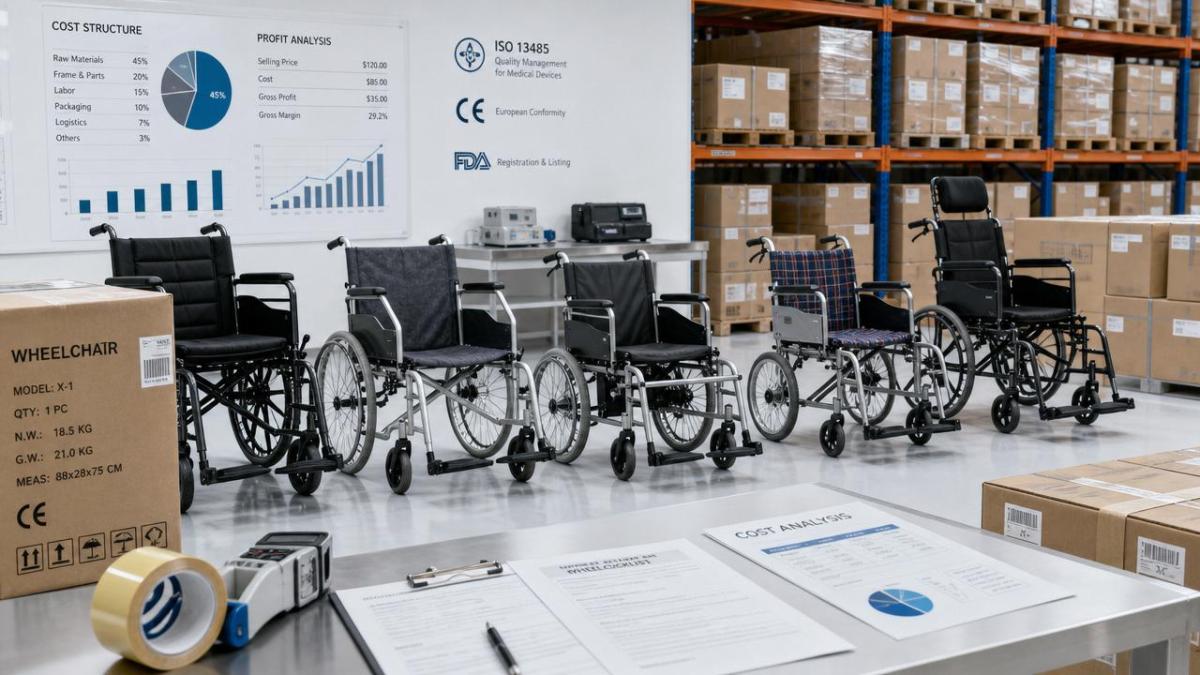
Understanding wheelchairswholesale pricing is not just about comparing catalog numbers.
Real cost sits behind frame materials, compliance paperwork, packaging, freight, and after-sales risk.
That is why two chairs with a similar look can land at very different wholesale prices.
For buyers managing dealer channels, margin depends on seeing the full cost stack early.
In practical sourcing, the best wheelchairswholesale deal is rarely the lowest factory quote.
It is the offer that protects sell-through, reduces claims, and leaves room for channel profit.
This guide breaks down what really shapes wheelchairswholesale cost and where margins are usually won or lost.
Why Wholesale Wheelchair Prices Vary So Much
The first driver is product type.
Standard manual wheelchairs, lightweight transport chairs, reclining models, and heavy-duty designs all carry different production costs.
A basic steel model is cheaper to produce.
An aluminum chair with ergonomic seating and quick-release parts costs more before shipping even starts.
The second driver is buyer expectation.
Some markets want a low entry price.
Others care more about durability, compliance, and long service life.
That difference changes the entire wheelchairswholesale pricing logic.
More importantly, the cost that matters is landed cost, not ex-works price.
A low quote can become expensive once accessories, inspection, duty, and replacement parts are added.
Core Cost Drivers in Wheelchairswholesale Sourcing
From recent market shifts, buyers are looking harder at component quality.
That makes sense because hidden component choices often decide future claim rates.
1. Frame Material and Build Design
Steel frames usually lower unit cost.
They also increase product weight, freight cost, and handling difficulty.
Aluminum frames cost more upfront.
Still, they can improve perceived value and reduce logistics strain.
If a market rewards portability, higher frame cost may still improve margin.
2. Seating, Comfort, and Functional Features
Seat width options, cushioning, detachable armrests, elevating leg rests, and reclining systems add cost quickly.
These features also raise assembly complexity.
In wheelchairswholesale, complexity often means longer lead times and more spare-part planning.
3. Tires, Brakes, and Small Components
Small parts rarely get enough attention during price comparison.
Yet wheel hubs, brake locks, bearings, and footrests often drive warranty issues.
Lower-grade components may protect the quote.
They usually hurt repeat orders.
4. Compliance and Certification
Target markets may require ISO-related quality systems, test records, labeling compliance, or local medical device documentation.
Certification is not free.
It adds direct cost and administrative lead time.
But in regulated channels, compliant wheelchairswholesale supply protects margin better than a cheaper noncompliant option.
Order Volume, MOQ, and Factory Pricing Logic
Many buyers expect bigger orders to automatically unlock strong discounts.
That is true, but only up to a point.
Factories calculate price around material purchasing, production scheduling, and packaging efficiency.
If the order mix is too fragmented, discounts shrink.
MOQ also matters more than many expect.
A low MOQ gives flexibility, but usually raises unit cost.
A higher MOQ can reduce wheelchairswholesale pricing, yet it increases inventory pressure.
So the right question is not only, “What is the MOQ?”
The better question is, “What order structure keeps inventory moving without compressing margin?”
A Simple Pricing View
Shipping, Packaging, and Landed Cost Reality
A more obvious signal in today’s sourcing environment is logistics volatility.
Bulky products like wheelchairs feel that pressure fast.
Packaging design changes container utilization.
Folded dimensions, carton strength, and protective inserts influence both freight and damage rates.
This also means wheelchairswholesale buyers should ask for carton data early.
Do not wait until booking season to learn the real cubic volume.
Landed cost should include more than freight.
It should include duty, inland transport, inspection, warehouse handling, and likely replacement stock.
When those costs are mapped correctly, some “cheap” offers stop looking cheap.
How Customization Changes Margin
Customization can improve market fit, but it needs discipline.
Private label packaging, color changes, seat options, branded manuals, and accessory bundles all add value.
They also add tooling, setup, and inventory complexity.
In real business, customization works best when it clearly supports a pricing premium.
If it only makes purchasing more complicated, margin usually erodes.
A smart wheelchairswholesale strategy separates must-have customization from cosmetic extras.
- Keep core SKUs standardized for faster replenishment.
- Use customization on proven high-volume models first.
- Ask suppliers to quote setup fees separately.
- Review whether custom features increase after-sales support.
Practical Ways to Protect Profit in Wheelchairswholesale Buying
Margin protection starts before negotiation.
It starts with a sharper buying brief.
When suppliers price against vague specifications, comparison becomes unreliable.
A detailed RFQ helps expose true differences in wheelchairswholesale offers.
Use This Buying Checklist
- Define target product tier before asking for quotes.
- Request full component specifications, not summary sheets.
- Confirm carton size, loading quantity, and packaging method.
- Verify compliance documents for the destination market.
- Model landed cost with warranty and spare-part assumptions.
- Test one stable SKU before expanding the range.
This process sounds simple.
Still, it is often the difference between healthy resale margin and a discount-driven cleanup sale.
What Buyers Should Ask Suppliers Before Placing an Order
Good sourcing decisions usually come from better questions.
Before committing to a wheelchairswholesale order, it helps to ask:
- Which components are produced in-house, and which are outsourced?
- What failure points appear most often in past shipments?
- How are spare parts stocked and supplied after delivery?
- Can the supplier hold pricing for repeat orders?
- What changes if order volume increases or model count decreases?
These questions move the conversation beyond basic price.
That is where stronger margins usually appear.
Final Takeaway for Smarter Wheelchairswholesale Decisions
wheelchairswholesale pricing is shaped by far more than the unit quote.
Material choice, feature set, certification, MOQ, packaging, and freight all affect the final margin picture.
The stronger buying approach is to compare total commercial value, not just opening price.
When sourcing teams clarify specifications, validate compliance, and model landed cost carefully, decisions become much more profitable.
That also creates a more stable path for repeat business.
If the goal is better profitability, start by auditing one current wheelchairswholesale SKU from quote to final delivery cost.
That single review often reveals the fastest margin improvements.
Get weekly intelligence in your inbox.
No noise. No sponsored content. Pure intelligence.
 Sep 15, 2026Smart HVAC investment insights for North American heat recovery projectsSmart HVAC investment insights North America: evaluate heat recovery, lifecycle costs, controls, and performance for resilient project decisions.
 Sep 14, 2026How SEMI standards shape water treatment design for semiconductor fabsSemiconductor water treatment SEMI guidance shapes resilient UPW design, contamination control, monitoring, reclaim strategy, and fab-ready validation.
 Sep 13, 2026What drives Biosafety Containment Systems cost in BSL-3 projects?Biosafety Containment Systems cost in BSL-3 projects depends on HVAC, layout, decontamination, controls, and commissioning. Discover how to build a credible budget.
 Sep 12, 2026How to qualify a fine chemical process solutions supplier for purity controlFine Chemical Process Solutions supplier qualification guide: evaluate purity control, traceability, contamination prevention, and safety for reliable high-purity production.
 Sep 11, 2026What drives cleanroom certification cost for ISO Class 1–9 projects?Cleanroom certification cost depends on ISO Class 1–9 requirements, test scope, HVAC readiness, documentation, and retesting. Explore practical budgeting insights to control project risk.
 Sep 10, 2026When should Procurement Directors prioritize heat recovery payback?Procurement Directors: learn when heat recovery delivers reliable payback, lower lifecycle costs, and safe performance in controlled industrial environments.
 Sep 09, 2026How to select an environmental monitoring system for cleanroomsEnvironmental monitoring system selection for cleanrooms: compare sensors, alarms, data integrity, integration, and installation to ensure reliable control.
 Sep 08, 2026How temperature stability affects semiconductor manufacturing yieldSemiconductor manufacturing temperature stability directly affects yield, overlay, metrology, and process control. Explore practical HVAC, monitoring, and zoning strategies.
 Sep 07, 2026How to prepare for a Regulatory Frameworks audit of cleanroom controlsRegulatory Frameworks audit readiness for cleanroom controls: build traceable evidence, verify alarms and monitoring, and close compliance gaps with confidence.
 Sep 07, 2026How to choose reverse osmosis systems with the right recovery rateReverse osmosis systems: learn how to select the right recovery rate for reliable water quality, lower scaling risk, efficient concentrate control, and stable long-term performance.
 Sep 05, 2026How does a negative pressure room work to contain airborne contaminants?How does a negative pressure room work? Discover how inward airflow, controlled exhaust, monitoring, and room design help contain airborne contaminants safely.
 Sep 04, 2026What TOC Limits Should Be Set and Monitored for a UPW Loop?What are our TOC limits for the UPW loop? Learn how to set defensible TOC thresholds, monitor trends, protect critical processes, and improve water-quality control.
 Sep 04, 2026What Are the Best Retrofit Options for Upgrading Existing Pharmaceutical Cleanrooms?What are the best retrofit options to upgrade existing pharma cleanrooms? Explore FFUs, HVAC modernization, pressure cascades, monitoring, and sealed finishes for compliant performance.
 Sep 04, 2026How Does a Negative Air Pressure Room Protect Adjacent Areas?What is a negative air pressure room? Learn how controlled airflow contains airborne hazards, protects adjacent spaces, and supports safer facility operations.
 Sep 04, 2026What Is ISO Class 1 Cleanroom Classification, and Where Is It Used?What is ISO Class 1? Explore its ultra-low particle limits, critical cleanroom design factors, verification methods, and uses in semiconductor, optics, and quantum manufacturing.
 Sep 04, 2026How Long After a UPW Deviation Does Yield Impact Typically Appear?What is the typical time lag from UPW deviation to yield impact? Learn how contamination, process sensitivity, exposure windows, and testing stages shape detection timing.
 Sep 04, 2026What Testing Data Should Engineers Review Before Approving a UPW Material?What testing data should be reviewed before approving a UPW material? Explore extractables, TOC, particle release, ionic leaching, corrosion, and reliability data for confident approval.
 Sep 04, 2026How Should Pharmaceutical Cleanrooms Choose Climate Control Systems?Which climate control systems are recommended for pharmaceutical cleanroom environments? Explore HVAC, humidity, pressure, HEPA filtration, and GMP-ready monitoring strategies.
 Sep 04, 2026Airtight Door Problems in Medical Spaces and How Buyers Prevent ThemA problem-solving guide for airtight door procurement, covering sealing performance, sensors, wall coordination, cleaning, maintenance, and acceptance risk.
 Sep 04, 2026What drives cleanroom design cost for ISO Class 7 projects?Cleanroom design cost for ISO Class 7 projects depends on HVAC, filtration, utilities, validation, and lifecycle strategy. Learn how to control budgets without compromising compliance or performance.
 Sep 03, 2026When do heat pipe heat exchangers suit pharmaceutical cleanrooms?Heat Pipe Heat Exchangers for pharmaceutical plants: discover when they support cleanroom energy recovery, airflow separation, humidity control, and GMP-ready HVAC design.
 Sep 02, 2026What determines biosafety cabinets price across different modelsBiosafety cabinets price varies by class, airflow design, filtration, size, certification, and installation. Compare models confidently to choose safe, cost-effective containment.
 Sep 01, 2026When does thermal energy storage cut peak-demand costs in plants?Thermal energy storage for industrial plants can cut peak-demand costs when tariffs, load profiles, and controls align. Explore practical savings, resilience, and integration factors.
 Aug 31, 2026How a digital environmental monitoring system supports audit-ready cleanroomsDigital environmental monitoring system strategies for audit-ready cleanrooms: improve traceability, alarm response, data integrity, and compliance confidence.
 Aug 30, 2026When does next-gen thermal management closed loop reduce chiller energy use?Next-gen thermal management closed loop systems can cut chiller energy by reducing lift, optimizing flows, enabling heat recovery, and improving controls. Discover when savings are real.
 Aug 29, 2026How chilled water piping layout affects pump energy useChilled water piping layout directly affects pump energy, control stability, and lifecycle costs. Explore practical design insights for efficient, reliable systems.
 Aug 28, 2026When thermal energy storage systems cut peak cooling costs in pharma plantsThermal Energy Storage Systems for pharmaceutical plants cut peak cooling costs, support compliance, and strengthen resilience. Explore the business case.