AS9100 Aerospace Machining: Key Quality Risks to Check First
Why do the first checks matter so much in AS9100 aerospace machining?
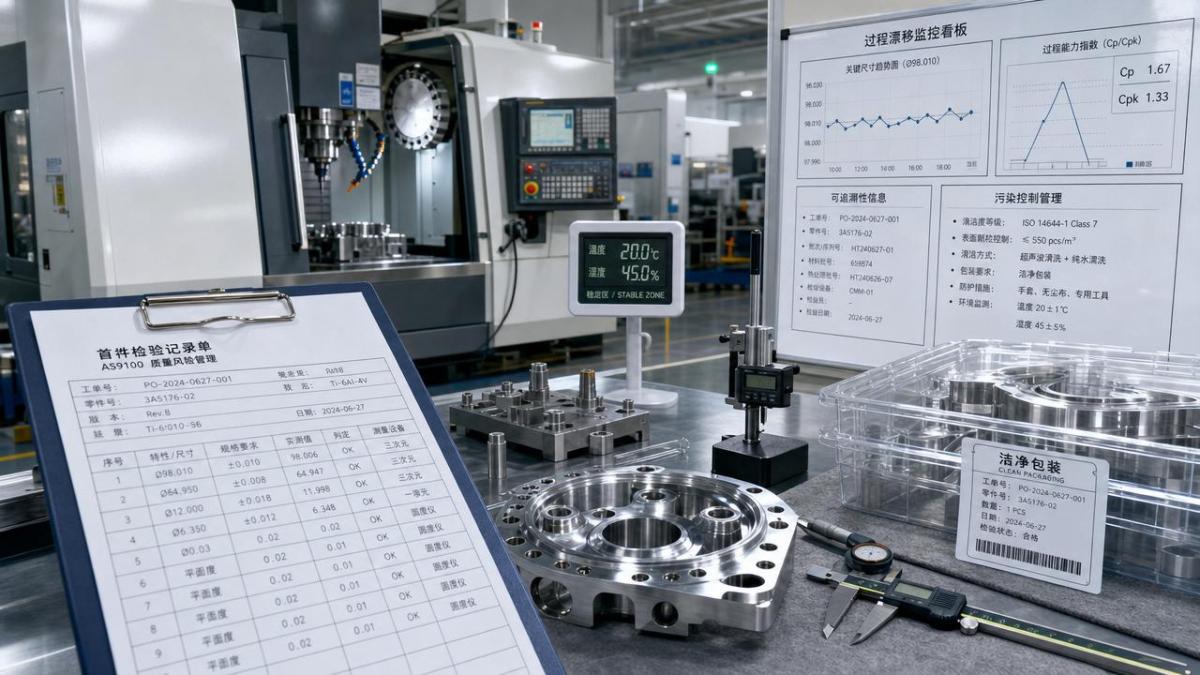
In AS9100 aerospace machining, early risk checks are rarely about one dramatic failure.
More often, trouble starts with small control losses that stay invisible until scrap, escape, or audit findings appear.
That is why the first review should focus on where variation accumulates fastest.
Typical examples include process drift, weak traceability, contamination, incomplete inspection discipline, and unclear change control.
For flight-related parts, even minor deviations can affect fit, fatigue life, sealing performance, or downstream assembly confidence.
The real question is not whether a shop has AS9100 paperwork.
It is whether the machining process stays stable under daily production pressure.
In practice, organizations with stronger environmental control usually detect these issues earlier.
That is also where a framework like G-ICE becomes relevant.
Its focus on contamination control, thermal stability, process utilities, and monitoring mirrors the hidden conditions that influence machining quality.
When people ask about the biggest AS9100 aerospace machining risk, is process drift still first?
Yes, and for good reason.
Process drift is often the earliest warning that capability is being consumed before anyone notices a nonconformance.
Tool wear, fixture relaxation, spindle thermal growth, coolant inconsistency, and program revision errors can all shift results gradually.
The danger is that each shift may remain inside tolerance for a while.
By the time parts fail, the lot history is already complicated.
A useful first check is simple.
Look at trend charts, offset adjustments, tool life records, first article data, and rework frequency together, not separately.
If operators are making frequent compensation changes without a clear reaction plan, drift is probably already active.
Thermal stability matters here more than many teams expect.
A tightly managed production environment reduces dimensional variation caused by room temperature swings and unstable airflow.
That is why environmental benchmarking, similar to the G-ICE approach, supports machining consistency even outside cleanroom industries.
Early signs that drift is becoming a quality event
- Repeated tool offset edits on the same feature
- Capability indices falling before final dimensions fail
- Different results between shifts on identical programs
- First-piece approval passing, but in-process checks widening
- Rising burr, chatter, or surface finish variation
How do traceability gaps create bigger exposure than many shops expect?
Traceability problems look administrative until something goes wrong.
Then they become a containment problem, a customer trust problem, and sometimes a safety problem.
In AS9100 aerospace machining, the basic requirement is not just lot identity.
It is a reliable chain linking raw material, machine route, tooling state, inspection status, revisions, and release decisions.
A common weakness appears during split lots, subcontracted processing, or urgent engineering changes.
Records exist, but they do not connect cleanly.
When that happens, one suspect part can force a broader quarantine than necessary.
The better approach is to test traceability backward and forward.
Can one finished part be tied to material heat, machine, operator, gauge, program version, and inspection evidence within minutes?
If not, the system may pass routine audits but fail under pressure.
This kind of table works best when paired with live record checks, not document review alone.
Is contamination really a top concern in AS9100 aerospace machining?
It is, especially for precision features, sealing surfaces, thin-wall parts, and assemblies with strict cleanliness requirements.
Contamination does not only mean dust on a part.
It can include degraded coolant, tramp oil, residual chips, dirty fixtures, packaging fibers, and airborne particles during inspection.
More subtle cases involve water quality used in cleaning or unstable airflow around measurement stations.
That is why lessons from controlled industrial environments are useful.
G-ICE emphasizes contamination control, precision HVAC, process fluid integrity, and monitoring discipline.
Those same principles help reduce false readings, part recontamination, and unexplained cosmetic or functional defects in machining operations.
A good first question is practical.
Where can the part be contaminated after the last controlled process and before final release?
That transfer zone often causes more escapes than the machine itself.
Points that deserve a quick contamination review
- Coolant concentration, filtration, and replacement intervals
- Chip evacuation around deep features and blind holes
- Cleaning chemistry compatibility with aerospace alloys
- Airflow and temperature stability in metrology areas
- Packaging controls after final inspection
What usually goes wrong with inspection control, even in certified operations?
Inspection failure is often not the absence of inspection.
It is inspection that looks complete but is poorly triggered, poorly sequenced, or disconnected from process risk.
For example, a gauge may be calibrated but unsuitable for the feature.
A sampling plan may be statistically neat but blind to startup instability.
A CMM program may verify dimensions while missing edge condition, orientation shift, or cleanliness status.
The stronger method is to rank inspections by failure consequence.
Flight-critical, mating, pressure-bearing, or fatigue-sensitive features deserve tighter reaction rules than low-risk cosmetic surfaces.
In AS9100 aerospace machining, uncontrolled inspection steps often hide in handoffs.
A part moves from machining to deburr, then to clean, then to final inspection.
If acceptance ownership is blurred at any point, the control plan weakens immediately.
It helps to ask whether each checkpoint has a defined reaction, not only an acceptance criterion.
How can you tell whether the system is audit-ready or just document-ready?
This is where many assessments become more realistic.
A document-ready system can produce procedures, records, and signatures.
An audit-ready system can also prove that controls work under actual production conditions.
A few short tests reveal the difference quickly.
- Pull one shipped part and reconstruct its full history
- Challenge one out-of-trend measurement and follow the reaction path
- Check whether environmental conditions are recorded where accuracy depends on them
- Review whether cleaning and packaging controls match actual sensitivity of the part
- Verify that engineering changes reach setups, tools, gauges, and inspection software together
More mature operations also integrate facility data into quality oversight.
Temperature, humidity, airflow, and fluid quality are not side topics when precision is tight.
That broader view aligns with G-ICE thinking.
Quality is not only created by the machine tool.
It is protected by the surrounding environment and the discipline used to monitor it.
So where should the next improvement step begin?
Start with the risks that expand fastest when they are missed.
In most AS9100 aerospace machining operations, that means process drift, traceability breaks, contamination exposure, and weak inspection reactions.
Do not review them as separate compliance boxes.
Treat them as one connected control chain.
A stable machine with poor traceability is still risky.
A clean part with weak inspection discipline is still risky.
A complete procedure with unstable temperature control is still risky.
The most practical next step is to run a focused gap review around one representative part family.
Map the process, verify records, test environmental controls, and challenge each release point.
From there, build a tighter control standard that reflects actual production risk, not only certification language.
That is usually the fastest route to stronger compliance, lower escape risk, and more reliable aerospace machining performance.
Get weekly intelligence in your inbox.
No noise. No sponsored content. Pure intelligence.
 Sep 15, 2026Smart HVAC investment insights for North American heat recovery projectsSmart HVAC investment insights North America: evaluate heat recovery, lifecycle costs, controls, and performance for resilient project decisions.
 Sep 14, 2026How SEMI standards shape water treatment design for semiconductor fabsSemiconductor water treatment SEMI guidance shapes resilient UPW design, contamination control, monitoring, reclaim strategy, and fab-ready validation.
 Sep 13, 2026What drives Biosafety Containment Systems cost in BSL-3 projects?Biosafety Containment Systems cost in BSL-3 projects depends on HVAC, layout, decontamination, controls, and commissioning. Discover how to build a credible budget.
 Sep 12, 2026How to qualify a fine chemical process solutions supplier for purity controlFine Chemical Process Solutions supplier qualification guide: evaluate purity control, traceability, contamination prevention, and safety for reliable high-purity production.
 Sep 11, 2026What drives cleanroom certification cost for ISO Class 1–9 projects?Cleanroom certification cost depends on ISO Class 1–9 requirements, test scope, HVAC readiness, documentation, and retesting. Explore practical budgeting insights to control project risk.
 Sep 10, 2026When should Procurement Directors prioritize heat recovery payback?Procurement Directors: learn when heat recovery delivers reliable payback, lower lifecycle costs, and safe performance in controlled industrial environments.
 Sep 09, 2026How to select an environmental monitoring system for cleanroomsEnvironmental monitoring system selection for cleanrooms: compare sensors, alarms, data integrity, integration, and installation to ensure reliable control.
 Sep 08, 2026How temperature stability affects semiconductor manufacturing yieldSemiconductor manufacturing temperature stability directly affects yield, overlay, metrology, and process control. Explore practical HVAC, monitoring, and zoning strategies.
 Sep 07, 2026How to prepare for a Regulatory Frameworks audit of cleanroom controlsRegulatory Frameworks audit readiness for cleanroom controls: build traceable evidence, verify alarms and monitoring, and close compliance gaps with confidence.
 Sep 07, 2026How to choose reverse osmosis systems with the right recovery rateReverse osmosis systems: learn how to select the right recovery rate for reliable water quality, lower scaling risk, efficient concentrate control, and stable long-term performance.
 Sep 05, 2026How does a negative pressure room work to contain airborne contaminants?How does a negative pressure room work? Discover how inward airflow, controlled exhaust, monitoring, and room design help contain airborne contaminants safely.
 Sep 04, 2026What TOC Limits Should Be Set and Monitored for a UPW Loop?What are our TOC limits for the UPW loop? Learn how to set defensible TOC thresholds, monitor trends, protect critical processes, and improve water-quality control.
 Sep 04, 2026What Are the Best Retrofit Options for Upgrading Existing Pharmaceutical Cleanrooms?What are the best retrofit options to upgrade existing pharma cleanrooms? Explore FFUs, HVAC modernization, pressure cascades, monitoring, and sealed finishes for compliant performance.
 Sep 04, 2026How Does a Negative Air Pressure Room Protect Adjacent Areas?What is a negative air pressure room? Learn how controlled airflow contains airborne hazards, protects adjacent spaces, and supports safer facility operations.
 Sep 04, 2026What Is ISO Class 1 Cleanroom Classification, and Where Is It Used?What is ISO Class 1? Explore its ultra-low particle limits, critical cleanroom design factors, verification methods, and uses in semiconductor, optics, and quantum manufacturing.
 Sep 04, 2026How Long After a UPW Deviation Does Yield Impact Typically Appear?What is the typical time lag from UPW deviation to yield impact? Learn how contamination, process sensitivity, exposure windows, and testing stages shape detection timing.
 Sep 04, 2026What Testing Data Should Engineers Review Before Approving a UPW Material?What testing data should be reviewed before approving a UPW material? Explore extractables, TOC, particle release, ionic leaching, corrosion, and reliability data for confident approval.
 Sep 04, 2026How Should Pharmaceutical Cleanrooms Choose Climate Control Systems?Which climate control systems are recommended for pharmaceutical cleanroom environments? Explore HVAC, humidity, pressure, HEPA filtration, and GMP-ready monitoring strategies.
 Sep 04, 2026Airtight Door Problems in Medical Spaces and How Buyers Prevent ThemA problem-solving guide for airtight door procurement, covering sealing performance, sensors, wall coordination, cleaning, maintenance, and acceptance risk.
 Sep 04, 2026What drives cleanroom design cost for ISO Class 7 projects?Cleanroom design cost for ISO Class 7 projects depends on HVAC, filtration, utilities, validation, and lifecycle strategy. Learn how to control budgets without compromising compliance or performance.
 Sep 03, 2026When do heat pipe heat exchangers suit pharmaceutical cleanrooms?Heat Pipe Heat Exchangers for pharmaceutical plants: discover when they support cleanroom energy recovery, airflow separation, humidity control, and GMP-ready HVAC design.
 Sep 02, 2026What determines biosafety cabinets price across different modelsBiosafety cabinets price varies by class, airflow design, filtration, size, certification, and installation. Compare models confidently to choose safe, cost-effective containment.
 Sep 01, 2026When does thermal energy storage cut peak-demand costs in plants?Thermal energy storage for industrial plants can cut peak-demand costs when tariffs, load profiles, and controls align. Explore practical savings, resilience, and integration factors.
 Aug 31, 2026How a digital environmental monitoring system supports audit-ready cleanroomsDigital environmental monitoring system strategies for audit-ready cleanrooms: improve traceability, alarm response, data integrity, and compliance confidence.
 Aug 30, 2026When does next-gen thermal management closed loop reduce chiller energy use?Next-gen thermal management closed loop systems can cut chiller energy by reducing lift, optimizing flows, enabling heat recovery, and improving controls. Discover when savings are real.
 Aug 29, 2026How chilled water piping layout affects pump energy useChilled water piping layout directly affects pump energy, control stability, and lifecycle costs. Explore practical design insights for efficient, reliable systems.
 Aug 28, 2026When thermal energy storage systems cut peak cooling costs in pharma plantsThermal Energy Storage Systems for pharmaceutical plants cut peak cooling costs, support compliance, and strengthen resilience. Explore the business case.