How Voice Picking Systems Reduce Picking Errors
How Voice Picking Systems Reduce Picking Errors
In fast-paced warehouse and industrial operations, small mistakes quickly become expensive problems.
A wrong item, missed location, or bad quantity can slow shipping and disrupt inventory accuracy.
That is why many teams now turn to voice picking systems.
These systems guide each step with spoken instructions and simple verbal confirmations.
The result is a smoother process that helps reduce picking errors without adding complicated screens or paperwork.
In practice, voice picking systems work well because they fit the way people move.
Hands stay free, eyes stay on products, and attention stays on the task.
That simple shift often makes accuracy easier to maintain during busy shifts.
Why Picking Errors Happen So Often
Before improving accuracy, it helps to understand where mistakes begin.
Most errors do not come from carelessness alone.
They usually come from pressure, distractions, and inconsistent process control.
- Paper pick lists can be hard to follow during peak activity.
- Handheld screens may pull attention away from shelves and labels.
- Similar product codes increase the risk of selecting the wrong item.
- Fatigue makes counting and confirmation less reliable late in a shift.
- New staff often need time to learn routes, zones, and check steps.
In operations with temperature-sensitive, regulated, or high-value materials, the cost is even higher.
A single wrong pick can affect traceability, handling conditions, and downstream compliance.
This matters in advanced manufacturing, pharmaceuticals, cleanroom supply chains, and controlled industrial environments.
How Voice Picking Systems Work on the Floor
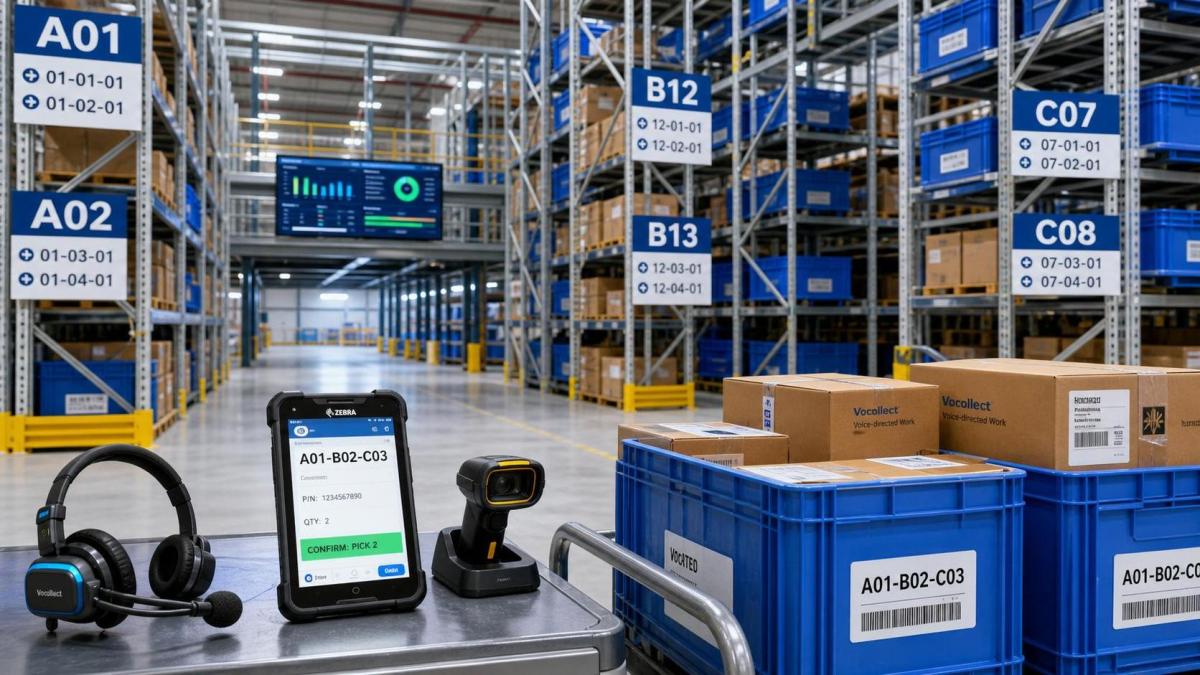
Voice picking systems use headsets, mobile devices, and warehouse software to direct work in real time.
The operator hears the next location, quantity, or task instruction.
Then the operator speaks back a short confirmation, check digit, or quantity response.
That interaction sounds simple, but it closes many common error gaps.
- The system gives one clear instruction at a time.
- The operator confirms the exact location before picking.
- The system verifies quantity and next action immediately.
- Exceptions can be reported without stopping the workflow.
Because voice picking systems are hands-free, movement feels more natural than scanning a paper sheet or screen every few seconds.
This also reduces mental switching between reading, walking, counting, and carrying product.
The Main Ways Voice Picking Systems Reduce Picking Errors
The strongest benefit of voice picking systems is not just speed.
It is reliable accuracy built into daily movement.
1. They reduce visual overload
Operators do not need to keep checking labels on a screen.
They can focus on rack positions, product markings, and safe handling.
2. They confirm location before the pick
A spoken check digit or slot confirmation helps prevent wrong-bin selection.
This is especially useful in dense storage layouts.
3. They make quantity checks more consistent
Voice prompts slow the process just enough to verify critical quantities.
That balance supports both speed and control.
4. They standardize work across shifts
Every operator receives the same sequence and wording.
That consistency reduces process drift between teams and shift changes.
5. They support faster training
New staff can follow guided steps instead of memorizing routes too early.
This reduces beginner mistakes and builds confidence more quickly.
Where Voice Picking Systems Deliver the Most Value
Voice picking systems fit many environments, but some operations benefit more than others.
The common factor is simple: errors are costly, and workflow must stay moving.
In facilities shaped by strict environmental control, disciplined picking supports broader operational stability.
That aligns with the priorities seen across advanced HVAC, cleanroom, biosafety, and process-control ecosystems.
What to Check Before Implementation
Voice picking systems are practical, but success depends on setup quality.
A weak rollout can limit the accuracy gains you expect.
- Map current error patterns by zone, product type, and shift.
- Choose clear voice commands that are easy to repeat in noisy areas.
- Set practical check digits for shelves, bins, or pallet positions.
- Integrate with WMS, ERP, or inventory systems for live data accuracy.
- Test headsets for comfort, speech recognition, and battery life.
- Build exception handling for shortages, damaged goods, and location mismatches.
From a user perspective, comfort and clarity matter as much as software integration.
If speech prompts feel awkward, adoption will drop.
If prompts feel natural, the process quickly becomes routine.
Best Practices to Get Better Results Faster
The best voice picking systems improve over time when teams fine-tune workflows.
A few practical habits make a big difference.
- Start with one zone that already shows frequent picking errors.
- Measure baseline accuracy, travel time, and exception rates first.
- Use short command scripts and avoid unnecessary wording.
- Review mis-picks weekly and adjust location verification logic.
- Ask operators which prompts feel confusing or too repetitive.
- Expand only after the first workflow is stable and trusted.
This step-by-step approach keeps implementation grounded in real floor conditions.
It also helps prove whether voice picking systems are reducing picking errors in measurable ways.
A Smarter Way to Improve Accuracy
Voice picking systems are not a trend for trend’s sake.
They solve a daily operational problem with a practical, human-centered method.
By guiding movement, confirming locations, and standardizing each pick, voice picking systems reduce picking errors where they happen most.
That means fewer corrections, cleaner inventory data, and less frustration during busy hours.
For operations dealing with tight tolerances, sensitive materials, or demanding service levels, that improvement carries real business value.
If accuracy issues keep returning, reviewing your current process and testing voice picking systems in one focused area is a smart next move.
Get weekly intelligence in your inbox.
No noise. No sponsored content. Pure intelligence.
 Sep 19, 2026When does heat recovery make sustainable cooling worth the investment?Sustainable cooling technology heat recovery: learn when reliable heat demand, temperature matching, and lifecycle savings make recovery a smart investment.
 Sep 18, 2026How to set alarm limits for semiconductor cleanroom monitoringSemiconductor cleanroom monitoring: learn how to set risk-based alarm limits for particles, humidity, pressure, and airflow to protect yield and reduce nuisance alerts.
 Sep 17, 2026How plastic injection molding affects ESD protection in cleanroomsPlastic injection molding affects ESD protection in cleanrooms. Learn how resin choice, molding consistency, grounding, and particle control support reliable compliance.
 Sep 16, 2026What to verify before choosing an industrial air quality monitoring supplierIndustrial air quality monitoring supplier checklist: verify measurement accuracy, calibration traceability, data integration, compliance support, and lifecycle service before you buy.
 Sep 15, 2026Smart HVAC investment insights for North American heat recovery projectsSmart HVAC investment insights North America: evaluate heat recovery, lifecycle costs, controls, and performance for resilient project decisions.
 Sep 14, 2026How SEMI standards shape water treatment design for semiconductor fabsSemiconductor water treatment SEMI guidance shapes resilient UPW design, contamination control, monitoring, reclaim strategy, and fab-ready validation.
 Sep 13, 2026What drives Biosafety Containment Systems cost in BSL-3 projects?Biosafety Containment Systems cost in BSL-3 projects depends on HVAC, layout, decontamination, controls, and commissioning. Discover how to build a credible budget.
 Sep 12, 2026How to qualify a fine chemical process solutions supplier for purity controlFine Chemical Process Solutions supplier qualification guide: evaluate purity control, traceability, contamination prevention, and safety for reliable high-purity production.
 Sep 11, 2026What drives cleanroom certification cost for ISO Class 1–9 projects?Cleanroom certification cost depends on ISO Class 1–9 requirements, test scope, HVAC readiness, documentation, and retesting. Explore practical budgeting insights to control project risk.
 Sep 10, 2026When should Procurement Directors prioritize heat recovery payback?Procurement Directors: learn when heat recovery delivers reliable payback, lower lifecycle costs, and safe performance in controlled industrial environments.
 Sep 09, 2026How to select an environmental monitoring system for cleanroomsEnvironmental monitoring system selection for cleanrooms: compare sensors, alarms, data integrity, integration, and installation to ensure reliable control.
 Sep 08, 2026How temperature stability affects semiconductor manufacturing yieldSemiconductor manufacturing temperature stability directly affects yield, overlay, metrology, and process control. Explore practical HVAC, monitoring, and zoning strategies.
 Sep 07, 2026How to prepare for a Regulatory Frameworks audit of cleanroom controlsRegulatory Frameworks audit readiness for cleanroom controls: build traceable evidence, verify alarms and monitoring, and close compliance gaps with confidence.
 Sep 07, 2026How to choose reverse osmosis systems with the right recovery rateReverse osmosis systems: learn how to select the right recovery rate for reliable water quality, lower scaling risk, efficient concentrate control, and stable long-term performance.
 Sep 05, 2026How does a negative pressure room work to contain airborne contaminants?How does a negative pressure room work? Discover how inward airflow, controlled exhaust, monitoring, and room design help contain airborne contaminants safely.
 Sep 04, 2026How Should Semiconductor Facilities Select Vibration Isolation Systems?Vibration isolation semiconductor guide: learn how to match tool limits, site vibration, utilities, and cleanroom needs for stable, high-yield fab performance.
 Sep 04, 2026What TOC Limits Should Be Set and Monitored for a UPW Loop?What are our TOC limits for the UPW loop? Learn how to set defensible TOC thresholds, monitor trends, protect critical processes, and improve water-quality control.
 Sep 04, 2026What Are the Best Retrofit Options for Upgrading Existing Pharmaceutical Cleanrooms?What are the best retrofit options to upgrade existing pharma cleanrooms? Explore FFUs, HVAC modernization, pressure cascades, monitoring, and sealed finishes for compliant performance.
 Sep 04, 2026How Does a Negative Air Pressure Room Protect Adjacent Areas?What is a negative air pressure room? Learn how controlled airflow contains airborne hazards, protects adjacent spaces, and supports safer facility operations.
 Sep 04, 2026What Is ISO Class 1 Cleanroom Classification, and Where Is It Used?What is ISO Class 1? Explore its ultra-low particle limits, critical cleanroom design factors, verification methods, and uses in semiconductor, optics, and quantum manufacturing.
 Sep 04, 2026How Long After a UPW Deviation Does Yield Impact Typically Appear?What is the typical time lag from UPW deviation to yield impact? Learn how contamination, process sensitivity, exposure windows, and testing stages shape detection timing.
 Sep 04, 2026What Testing Data Should Engineers Review Before Approving a UPW Material?What testing data should be reviewed before approving a UPW material? Explore extractables, TOC, particle release, ionic leaching, corrosion, and reliability data for confident approval.
 Sep 04, 2026How Should Pharmaceutical Cleanrooms Choose Climate Control Systems?Which climate control systems are recommended for pharmaceutical cleanroom environments? Explore HVAC, humidity, pressure, HEPA filtration, and GMP-ready monitoring strategies.
 Sep 04, 2026Airtight Door Problems in Medical Spaces and How Buyers Prevent ThemA problem-solving guide for airtight door procurement, covering sealing performance, sensors, wall coordination, cleaning, maintenance, and acceptance risk.
 Sep 04, 2026What drives cleanroom design cost for ISO Class 7 projects?Cleanroom design cost for ISO Class 7 projects depends on HVAC, filtration, utilities, validation, and lifecycle strategy. Learn how to control budgets without compromising compliance or performance.
 Sep 03, 2026When do heat pipe heat exchangers suit pharmaceutical cleanrooms?Heat Pipe Heat Exchangers for pharmaceutical plants: discover when they support cleanroom energy recovery, airflow separation, humidity control, and GMP-ready HVAC design.
 Sep 02, 2026What determines biosafety cabinets price across different modelsBiosafety cabinets price varies by class, airflow design, filtration, size, certification, and installation. Compare models confidently to choose safe, cost-effective containment.