Solar Charge Controllers: MPPT vs PWM Payback
Off-grid and resilience-focused power investments are changing fast. The choice between MPPT and PWM solar charge controllers is now a payback decision, not only a technical detail.
In industrial climate-control, cleanroom monitoring, remote sensing, and backup infrastructure, small harvest gains can affect uptime, battery life, and lifecycle cost.
This comparison views solar charge controllers through ROI, reliability, and operational risk, especially where energy continuity supports critical environmental control.
Solar Charge Controllers Are Moving From Component Choice to Payback Strategy
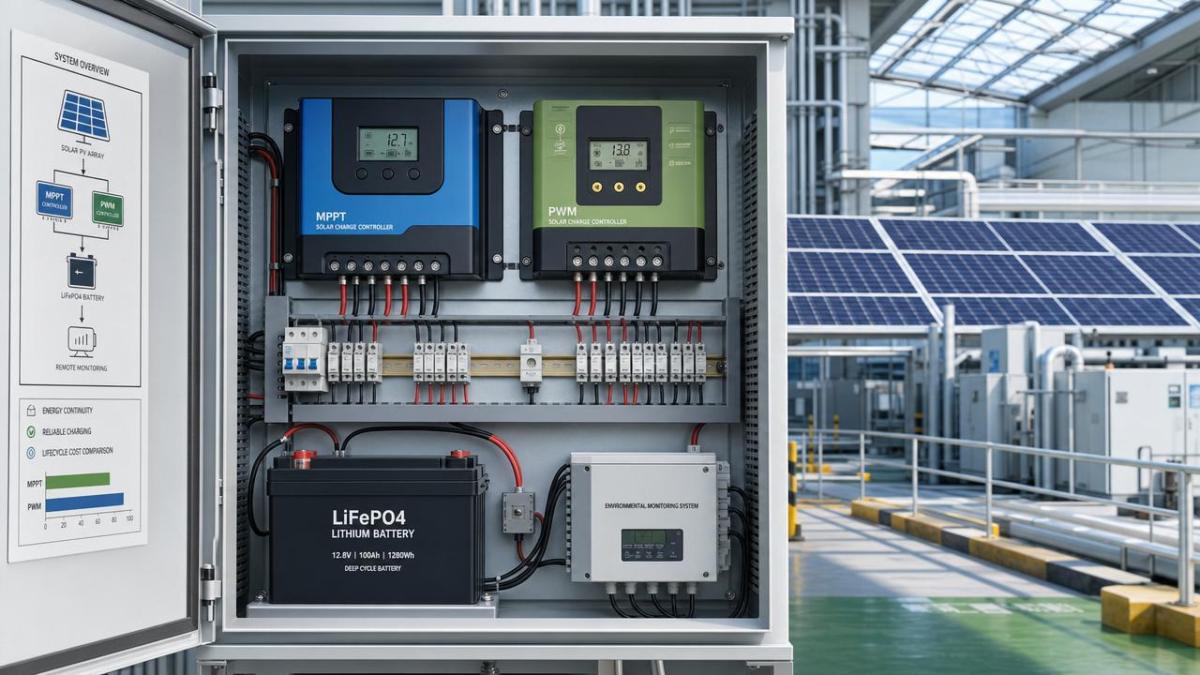
The market signal is clear: solar charge controllers are no longer selected only by amperage, voltage, or brand familiarity.
They are being evaluated as financial control points within battery-based power systems, especially in distributed industrial environments.
MPPT units usually cost more upfront, while PWM units remain attractive for simple, low-cost installations.
The payback question is whether MPPT’s additional harvest, battery protection, and operational flexibility offset the price gap.
For G-ICE-aligned environments, the answer often depends on the value of uninterrupted monitoring, ventilation, water treatment, or containment systems.
Trend Signals: Why MPPT vs PWM Decisions Are Getting More Financial
Several changes are pushing solar charge controllers into stronger lifecycle-cost scrutiny.
Energy resilience is becoming a requirement for facilities that cannot tolerate data gaps, cooling interruptions, or sensor downtime.
Battery prices have improved, but premature battery degradation still creates avoidable replacement cost and maintenance exposure.
At the same time, higher-voltage solar arrays make MPPT solar charge controllers more practical across remote industrial applications.
What Technically Separates MPPT and PWM Solar Charge Controllers
PWM, or pulse width modulation, connects the panel closer to battery voltage during charging.
It is simple, reliable, and cost-effective when panel voltage closely matches battery voltage.
However, PWM solar charge controllers cannot fully convert extra panel voltage into usable battery current.
MPPT, or maximum power point tracking, actively finds the best voltage-current operating point of the solar array.
MPPT solar charge controllers then convert higher panel voltage into additional charging current with electronic conversion.
In cold weather, partial cloud, long cable runs, or mismatched array conditions, that conversion can become financially meaningful.
- PWM often fits small systems with short cables and predictable sunlight.
- MPPT often fits larger systems, colder locations, and critical loads.
- PWM reduces capital cost but may require more panel capacity.
- MPPT improves energy yield but requires stronger economic justification.
Where MPPT Payback Becomes Visible in Industrial Applications
Payback is easiest to see where solar charge controllers support assets with measurable downtime cost.
Examples include remote environmental monitoring stations, telecom shelters, field laboratories, water-treatment skids, and backup control cabinets.
In precision HVAC and cleanroom-related infrastructure, power stability supports sensors, alarms, actuators, and communication gateways.
A small energy shortfall may not stop production directly, but it can create blind spots in environmental assurance.
MPPT solar charge controllers are especially relevant when batteries must recover quickly after cloudy periods.
They can also reduce the solar array size needed to reach the same usable daily energy target.
Typical Conditions Favoring MPPT Solar Charge Controllers
- Panel voltage is much higher than battery voltage.
- Ambient temperatures are low, increasing panel voltage.
- Cable distances create voltage-drop concerns.
- Critical loads need stronger low-light performance.
- Battery replacement is expensive or logistically difficult.
Typical Conditions Favoring PWM Solar Charge Controllers
- System size is small and energy demand is modest.
- Panel voltage closely matches battery voltage.
- Sunlight is consistent and seasonal variation is limited.
- The load is noncritical and easy to service.
- Capital cost is the dominant constraint.
Payback Math: The Practical Way to Compare Solar Charge Controllers
A useful payback calculation starts with usable daily energy, not only controller price.
If MPPT increases harvest by 10% to 25%, the value depends on energy scarcity and load criticality.
For a small lighting system, that gain may not justify higher upfront cost.
For a remote monitoring cabinet, it may prevent larger batteries, extra panels, or emergency maintenance trips.
The strongest ROI cases usually include at least two savings categories, not only energy gain.
A simple approach is to compare annual avoided costs against the MPPT premium.
Include avoided panel area, battery replacement delay, reduced truck rolls, and lower outage exposure.
This gives solar charge controllers a direct place in total cost of ownership modeling.
Operational Impact Across Cleanroom, HVAC, Water, and Monitoring Systems
Industrial climate and environmental control systems increasingly depend on distributed sensing and edge devices.
These devices may monitor pressure cascades, particle counts, humidity, process water quality, or containment conditions.
When solar charge controllers underperform, the result is often not immediate equipment failure.
The bigger risk is lost data continuity, delayed alarms, weaker compliance evidence, and reduced digital-twin fidelity.
In G-ICE benchmarking terms, controller selection affects environmental integrity and operational supremacy indirectly but materially.
- Cleanrooms need stable monitoring for ISO 14644 evidence trails.
- Precision HVAC systems need uninterrupted control feedback.
- UPW and process-fluid assets need continuous water-quality signals.
- Biosafety sites need dependable alarms and containment supervision.
- Digital twins need consistent field data to remain useful.
Key Evaluation Points Before Selecting Solar Charge Controllers
The best decision starts with the load profile, not the controller catalog.
Map the daily watt-hour requirement, autonomy days, seasonal solar resource, and acceptable outage probability.
Then compare PWM and MPPT solar charge controllers under realistic site conditions.
- Confirm battery chemistry, voltage, charge limits, and temperature range.
- Check controller efficiency at expected power levels, not only peak rating.
- Model winter and low-irradiance days, not only annual averages.
- Include cable losses and possible future load growth.
- Review data logging, alarms, communication protocols, and remote diagnostics.
- Evaluate enclosure rating, thermal derating, surge protection, and grounding.
For critical infrastructure, solar charge controllers should be treated as reliability devices, not commodity accessories.
Decision Matrix: When the MPPT Premium Is Justified
A practical matrix can prevent overbuying while avoiding underpowered resilience systems.
Next-Step Thinking for Resilient Power Planning
The direction of travel favors smarter solar charge controllers where resilience has measurable business value.
PWM will remain relevant for simple, low-risk systems with clear cost limits.
MPPT will gain share where energy uncertainty, battery cost, and monitoring continuity matter more than initial price.
The most defensible decision is not “MPPT is always better” or “PWM is cheaper.”
It is whether the selected solar charge controllers improve system economics under real operating conditions.
- Build an energy balance using worst-month solar data.
- Assign financial value to downtime and service visits.
- Compare total system cost, not only controller cost.
- Specify monitoring features for assets tied to compliance.
- Review payback again when loads or autonomy targets change.
Action Guide: Turning Controller Choice Into Measurable ROI
Start by classifying each site as low-risk, serviceable, remote, or mission-critical.
For each site, document battery size, array voltage, load criticality, and seasonal operating constraints.
Then shortlist solar charge controllers using energy yield, battery protection, communications, and environmental durability.
Where the MPPT premium pays back within the asset planning window, specify MPPT with clear performance assumptions.
Where payback is weak, PWM remains a rational choice for controlled, modest, and accessible systems.
For industrial climate, cleanroom, UPW, biosafety, and monitoring applications, the final decision should protect both energy continuity and evidence continuity.
Use G-ICE-style benchmarking to connect solar charge controllers with uptime targets, lifecycle cost, ESG reporting, and infrastructure resilience.
That approach turns a small electrical component into a measurable element of operational risk control.
Get weekly intelligence in your inbox.
No noise. No sponsored content. Pure intelligence.
 Oct 21, 2026How often is cleanroom certification required under ISO 14644-2?Cleanroom Certification is generally recommended annually under ISO 14644-2. Learn when risk-based extensions apply and which changes trigger earlier testing to plan with confidence.
 Oct 21, 2026FASEB Comments on NIH Draft Policy for Research Involving BiohazardsFASEB comments on NIH’s draft biohazard research policy call for risk-based biosafety oversight. Explore potential implications for laboratories, suppliers, and compliance teams.
 Oct 20, 2026How to disinfect ultrasound machines without damaging surfacesLearn how to disinfect ultrasoundmachines without surface damage. Explore compatible products, wet contact times, and probe care to protect patients and equipment.
 Oct 20, 2026Ultrapure Water in Semiconductor Manufacturing: Reuse and Quality Control InsightsExplore ultrapure water reuse in semiconductor manufacturing, key UPW quality benchmarks and analytical insights to help evaluate suppliers and protect process purity.
 Oct 19, 2026How cooling affects warpage in injection-molded consumer electronics housingsOptimize plastic injection molding for consumer electronics with cooling strategies to reduce housing warpage and improve assembly fit. Discover practical checks for stable, efficient production.
 Oct 18, 2026Can air leaks prevent a dehumidifier from holding its target dew point?Why can't our dehumidifier maintain the target dew point? Discover how air leaks increase moisture loads, spot hidden faults, and find practical fixes to restore reliable dew-point control.
 Oct 17, 2026How semiconductor process water treatment removes trace organicsSee how semiconductor process water treatment removes trace organics with RO, UV oxidation, and polishing. Learn how TOC monitoring helps verify purity and pinpoint contamination.
 Oct 16, 2026How to choose ultra pure water piping materials to limit leachingChoose ultra pure water piping with confidence. Compare PVDF, PFA, and stainless steel, assess leaching risks, and learn how to qualify your system for reliable purity.
 Oct 15, 2026How to size a skid-mounted deionized water system for peak demandCompare deionized water systems skid configurations for peak demand. Learn how to balance production, storage, and pump capacity to prevent shortages and avoid costly oversizing.
 Oct 14, 2026When is collaborative laboratory robotics suitable for sample sorting?Explore when collaborative laboratory robotics suits sample sorting. Discover key checks for safety, traceability, container compatibility, and throughput before choosing your solution.
 Oct 13, 2026How sandwich panel joints affect airtightness in cleanroom systemsCleanroom Systems sandwich panels need reliable joints for airtightness. Discover how gaskets, sealants, and testing help reduce leakage and protect cleanroom pressure control.
 Oct 12, 2026How to verify USP compliance for ultra pure water systemsUltra Pure Water Systems USP compliance: learn how to verify water quality, sampling, sanitization, trends, and validation controls at every point of use.
 Oct 11, 2026How tight temperature control prevents cleanroom process driftCleanroom process temperature control systems prevent costly drift by stabilizing critical conditions, improving repeatability, and protecting sensitive production workflows.
 Oct 10, 2026When does organic contaminant removal require TOC treatment?Organic contaminant removal requires TOC treatment when dissolved organics threaten product quality, equipment reliability, or process control. Learn how to assess risks and choose the right solution.
 Oct 08, 2026What affects lead times for sheet metal bending services in Canada?Sheet metal bending services Canada: discover how material supply, tooling, tolerances, finishing, documentation, and freight affect lead times for reliable project delivery.
 Oct 07, 2026How HVAC design for semiconductor fabs prevents airborne contaminationHVAC design for semiconductor fabs prevents airborne contamination through advanced filtration, pressure cascades, airflow control, and real-time monitoring. Explore key strategies for cleaner, more reliable wafer production.
 Oct 06, 2026How photovoltaic modules waterproof technology prevents moisture damagephotovoltaic modules waterproof technology prevents moisture damage with durable seals, drainage, and junction-box protection. Explore practical selection and testing insights.
 Oct 05, 2026How ISO 14644 Europe requirements affect cleanroom qualificationISO 14644 Europe requirements shape cleanroom qualification, from particle classification and recovery testing to monitoring, GMP alignment, and change control.
 Oct 04, 2026How to assess a pharmaceutical cleanroom solutions supplier’s ISO capabilityPharmaceutical Cleanroom Solutions supplier assessment guide: evaluate ISO 14644 capability, validation evidence, airflow design, documentation, and long-term GMP readiness.
 Oct 03, 2026What EU standards govern the design of BSL-3 laboratories in Europe?BSL-3 laboratories Europe: explore EU directives, EN standards, HVAC containment, commissioning, and practical design strategies for compliant, resilient high-containment facilities.
 Oct 02, 2026How EN 1822 defines HEPA filtration efficiency for cleanroomsHEPA filtration EN 1822 explained: learn how MPPS testing, local leakage limits, and filter classes support reliable cleanroom decisions.
 Oct 01, 2026How pharmaceutical process water systems control microbial riskProcess water systems pharmaceutical teams rely on can control microbial risk through hygienic design, monitoring, and validated sanitization. Explore practical compliance strategies.
 Sep 30, 2026When does a negative pressure laboratory need BSL-3 containment?Negative pressure laboratory or BSL-3? Discover the risk factors, engineering controls, and containment requirements needed for safe, compliant laboratory planning.
 Sep 29, 2026How to evaluate a TOC-zero water treatment supplier for UPW systemsChoose a TOC-zero water treatment supplier with confidence. Compare UPW performance, monitoring, validation, materials, service capability, and lifecycle cost.
 Sep 28, 2026What drives sustainable cooling cost in high-precision facilities?Sustainable cooling cost in high-precision facilities depends on thermal stability, energy, water, controls, and resilience. Explore smarter lifecycle strategies.
 Sep 27, 2026How to compare freight forwarding services for time-critical shipmentsCompare freight forwarding services for time-critical shipments with practical insights on routing, customs, visibility, specialized handling, and contingency planning.
 Sep 26, 2026How environmental integrity in laboratories supports reliable test resultsEnvironmental Integrity in laboratories safeguards samples, instruments, and staff. Discover practical controls for contamination, monitoring, and reliable test results.