Hazardous-Material IBCs: Checks Before Filling
Hazardous-Material IBCs: Checks Before Filling
Before any transfer begins, intermediate bulk containers for hazardous materials must be verified as fit for service, compatible with the substance, and compliant with site safety procedures.
These pre-fill checks are no longer routine paperwork. They are control barriers against leaks, contamination, pressure incidents, and regulatory exposure.
As industrial operations become more automated, distributed, and audited, container readiness is becoming a measurable safety and continuity indicator.
Why Pre-Fill Verification Is Becoming a Strategic Safety Signal
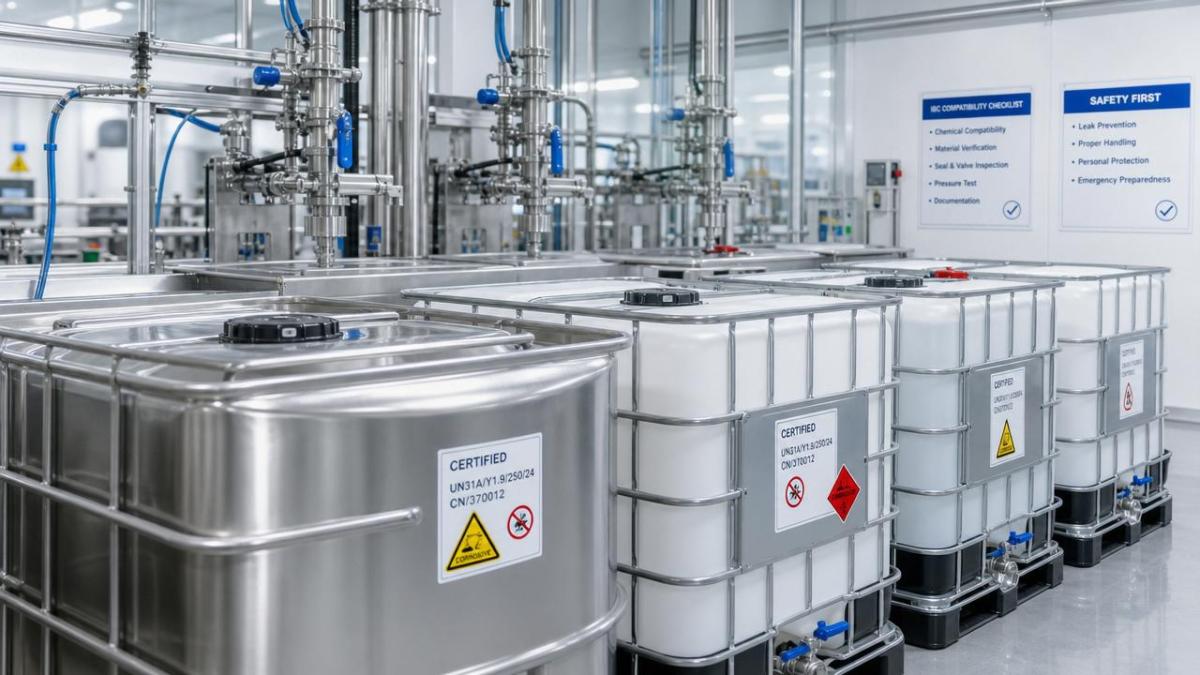
The use of intermediate bulk containers for hazardous materials is expanding across chemicals, energy storage, laboratories, coatings, water treatment, and advanced manufacturing.
This wider adoption creates a sharper focus on container condition, traceability, closure integrity, and material compatibility before each filling event.
A container that passed inspection months ago may not remain suitable after transport, storage, cleaning, reconditioning, or exposure to temperature swings.
For hazardous liquids, small defects can develop into major incidents during filling, stacking, transport, heating, or emergency response.
The trend is clear: pre-fill checks are moving from informal visual reviews toward documented, risk-based inspection systems.
Current Change Signals in Hazardous-Material Container Control
Several operational changes are increasing scrutiny on intermediate bulk containers for hazardous materials before filling begins.
Audits now expect clearer evidence that packaging selection, inspection status, and chemical compatibility were assessed before transfer.
Digital logistics platforms also expose inconsistencies between container labels, batch records, cleaning history, and dangerous goods documentation.
Meanwhile, sustainability programs are increasing reuse, which makes lifecycle condition monitoring more important than one-time acceptance checks.
- More reconditioned IBCs are entering controlled hazardous-material workflows.
- Regulatory audits increasingly request documented inspection evidence.
- Higher-value chemicals demand stronger contamination-prevention practices.
- Automated filling lines require predictable container geometry and closure performance.
- ESG reporting places new attention on spill prevention and packaging reuse.
Key Drivers Behind Stricter Pre-Fill Checks
The tightening of inspection discipline is not driven by one factor. It reflects converging technical, legal, and operational pressures.
These drivers turn a simple container check into a front-line risk control within industrial handling systems.
Container Identity and Certification Should Be Confirmed First
The first inspection step is confirming that the container is the right legal and technical package for the intended material.
Intermediate bulk containers for hazardous materials must carry valid markings, approval codes, capacity information, and applicable test status.
Unreadable marks, missing plates, expired test dates, or inconsistent documentation should stop filling until the issue is resolved.
- Confirm UN marking or required local approval information.
- Check container capacity against the planned fill quantity.
- Verify test date, inspection date, and reconditioning status.
- Match label information with the batch, product, and destination.
- Reject containers with altered or suspicious identification plates.
Identity checks also protect traceability if a defect, recall, contamination event, or transport claim arises later.
Structural Condition Is the Next Critical Trend Focus
Structural damage is becoming a leading reason for pre-fill rejection, especially in reused or long-distance logistics cycles.
Inspect the bottle, cage, pallet, frame, base, top bars, lifting points, and stacking surfaces before connecting any filling equipment.
For intermediate bulk containers for hazardous materials, small cracks, deformation, corrosion, and impact marks deserve conservative assessment.
Bulging panels may indicate previous pressure exposure, product incompatibility, heat damage, or internal residue reaction.
Metal IBCs require attention to welds, seams, dents, pitting, gasket seats, and signs of stress around fittings.
Physical Rejection Triggers
- Visible cracks in the inner bottle or shell.
- Damaged discharge valve, cap, vent, or closure thread.
- Corroded cage, broken welds, or unstable pallet structure.
- Significant staining, residue, odor, or unknown previous contents.
- Distorted shape that may affect filling, stacking, or transport.
Compatibility Checks Are Becoming More Data-Driven
Compatibility is no longer limited to asking whether a container once held a similar substance.
Intermediate bulk containers for hazardous materials must be assessed against product chemistry, temperature, vapor pressure, density, and exposure duration.
High-purity, corrosive, oxidizing, flammable, or reactive substances require closer review of liner, gasket, valve, and closure materials.
A technically sound container can still fail if seals swell, valves embrittle, or liners absorb previous product residues.
Cleanliness and Contamination Control Are Expanding Beyond Laboratories
Contamination control is increasingly relevant outside pharmaceutical, semiconductor, and laboratory environments.
Industrial chemicals, water-treatment additives, battery materials, and specialty coatings may all suffer from low-level cross-contamination.
Before filling intermediate bulk containers for hazardous materials, check internal cleanliness, closure cleanliness, and evidence of verified washing.
Cleaning certificates should align with the actual container identification, not just with a general shipment group.
If the previous cargo is unknown, sensitive, incompatible, or poorly documented, do not treat the container as clean.
Signals of Inadequate Cleanliness
- Persistent odor after cleaning or drying.
- Residue around the valve, cap, threads, or bottom sump.
- Cloudiness, staining, crystals, flakes, or visible moisture.
- Missing cleaning records or mismatched container numbers.
- Unsealed openings after cleaning and before receipt.
Closures, Valves, and Vents Need Practical Functional Testing
Many incidents begin at interfaces, not through the main container body.
Closures, valves, caps, plugs, vents, gaskets, and tamper-evident devices should be checked before the fill line is opened.
For intermediate bulk containers for hazardous materials, valve handles should move correctly and return to the required closed position.
Threads should engage smoothly, caps should seat evenly, and gaskets should be present, clean, undamaged, and correctly placed.
Where pressure or vapor behavior is relevant, venting equipment must be suitable for the material and expected storage conditions.
- Confirm discharge valve is closed before positioning the container.
- Inspect outlet caps and secondary seals for damage.
- Check top closures before and after filling.
- Use correct torque or closure method where specified.
- Apply seals only after final verification is complete.
Operational Impacts Across the Filling Workflow
Stronger pre-fill checks affect more than the inspection station. They influence scheduling, material planning, training, and emergency readiness.
A rejected container can delay production if no qualified spare is available. This makes approved inventory planning more important.
Intermediate bulk containers for hazardous materials also shape downstream transport acceptance, warehouse segregation, and customer receiving confidence.
When inspection standards are unclear, teams may make inconsistent decisions under time pressure.
A documented checklist reduces variation and supports faster escalation when defects are found.
Business Areas Most Affected
- Receiving: verifies incoming condition and document alignment.
- Production: avoids filling delays and unexpected equipment stops.
- Quality: protects product integrity and batch traceability.
- EHS: reduces spill, exposure, and emergency response risk.
- Logistics: supports transport approval and load security.
Priority Points for a Future-Ready Pre-Fill Program
The strongest programs combine visual inspection, documentation review, compatibility assessment, and defined rejection criteria.
They also create a feedback loop between incidents, near misses, supplier performance, and container purchasing decisions.
- Build a product-specific compatibility matrix for common hazardous substances.
- Separate checks for new, reused, and reconditioned containers.
- Record photo evidence for rejected or borderline containers.
- Link inspection records to batch, container ID, and operator signoff.
- Set quarantine rules for containers awaiting technical decision.
- Review supplier quality data for recurring container defects.
These actions make intermediate bulk containers for hazardous materials part of a controlled safety system, not just packaging inventory.
Decision Framework for Pre-Fill Acceptance
A simple decision framework helps prevent rushed acceptance when defects appear minor but consequences may be severe.
How Digital Monitoring Will Shape the Next Phase
The next stage is tighter integration between container inspection and digital operational control.
Barcode, RFID, and digital batch systems can prevent filling when inspection status, approval date, or compatibility data is missing.
Smart environmental monitoring may also show whether stored containers experienced heat, freezing, humidity, or impact conditions.
For facilities managing intermediate bulk containers for hazardous materials, digital records reduce reliance on memory and manual paperwork.
They also support faster root-cause analysis when leaks, contamination, or transport nonconformities occur.
Practical Next Steps Before the Next Filling Cycle
Start by comparing current inspection practice with the actual risk profile of handled substances.
Then revise the checklist so it covers identity, certification, structure, cleanliness, compatibility, closures, venting, and documentation.
Train the process around real rejection examples, not only ideal container images.
Set clear stop-fill rules, escalation paths, and quarantine locations for questionable containers.
Finally, review each incident or near miss to improve inspection criteria for intermediate bulk containers for hazardous materials.
A disciplined pre-fill system protects personnel, product quality, equipment uptime, and regulatory confidence.
Before the next transfer, verify the container as deliberately as the material inside it.
Get weekly intelligence in your inbox.
No noise. No sponsored content. Pure intelligence.
 Oct 21, 2026How often is cleanroom certification required under ISO 14644-2?Cleanroom Certification is generally recommended annually under ISO 14644-2. Learn when risk-based extensions apply and which changes trigger earlier testing to plan with confidence.
 Oct 21, 2026FASEB Comments on NIH Draft Policy for Research Involving BiohazardsFASEB comments on NIH’s draft biohazard research policy call for risk-based biosafety oversight. Explore potential implications for laboratories, suppliers, and compliance teams.
 Oct 20, 2026How to disinfect ultrasound machines without damaging surfacesLearn how to disinfect ultrasoundmachines without surface damage. Explore compatible products, wet contact times, and probe care to protect patients and equipment.
 Oct 20, 2026Ultrapure Water in Semiconductor Manufacturing: Reuse and Quality Control InsightsExplore ultrapure water reuse in semiconductor manufacturing, key UPW quality benchmarks and analytical insights to help evaluate suppliers and protect process purity.
 Oct 19, 2026How cooling affects warpage in injection-molded consumer electronics housingsOptimize plastic injection molding for consumer electronics with cooling strategies to reduce housing warpage and improve assembly fit. Discover practical checks for stable, efficient production.
 Oct 18, 2026Can air leaks prevent a dehumidifier from holding its target dew point?Why can't our dehumidifier maintain the target dew point? Discover how air leaks increase moisture loads, spot hidden faults, and find practical fixes to restore reliable dew-point control.
 Oct 17, 2026How semiconductor process water treatment removes trace organicsSee how semiconductor process water treatment removes trace organics with RO, UV oxidation, and polishing. Learn how TOC monitoring helps verify purity and pinpoint contamination.
 Oct 16, 2026How to choose ultra pure water piping materials to limit leachingChoose ultra pure water piping with confidence. Compare PVDF, PFA, and stainless steel, assess leaching risks, and learn how to qualify your system for reliable purity.
 Oct 15, 2026How to size a skid-mounted deionized water system for peak demandCompare deionized water systems skid configurations for peak demand. Learn how to balance production, storage, and pump capacity to prevent shortages and avoid costly oversizing.
 Oct 14, 2026When is collaborative laboratory robotics suitable for sample sorting?Explore when collaborative laboratory robotics suits sample sorting. Discover key checks for safety, traceability, container compatibility, and throughput before choosing your solution.
 Oct 13, 2026How sandwich panel joints affect airtightness in cleanroom systemsCleanroom Systems sandwich panels need reliable joints for airtightness. Discover how gaskets, sealants, and testing help reduce leakage and protect cleanroom pressure control.
 Oct 12, 2026How to verify USP compliance for ultra pure water systemsUltra Pure Water Systems USP compliance: learn how to verify water quality, sampling, sanitization, trends, and validation controls at every point of use.
 Oct 11, 2026How tight temperature control prevents cleanroom process driftCleanroom process temperature control systems prevent costly drift by stabilizing critical conditions, improving repeatability, and protecting sensitive production workflows.
 Oct 10, 2026When does organic contaminant removal require TOC treatment?Organic contaminant removal requires TOC treatment when dissolved organics threaten product quality, equipment reliability, or process control. Learn how to assess risks and choose the right solution.
 Oct 08, 2026What affects lead times for sheet metal bending services in Canada?Sheet metal bending services Canada: discover how material supply, tooling, tolerances, finishing, documentation, and freight affect lead times for reliable project delivery.
 Oct 07, 2026How HVAC design for semiconductor fabs prevents airborne contaminationHVAC design for semiconductor fabs prevents airborne contamination through advanced filtration, pressure cascades, airflow control, and real-time monitoring. Explore key strategies for cleaner, more reliable wafer production.
 Oct 06, 2026How photovoltaic modules waterproof technology prevents moisture damagephotovoltaic modules waterproof technology prevents moisture damage with durable seals, drainage, and junction-box protection. Explore practical selection and testing insights.
 Oct 05, 2026How ISO 14644 Europe requirements affect cleanroom qualificationISO 14644 Europe requirements shape cleanroom qualification, from particle classification and recovery testing to monitoring, GMP alignment, and change control.
 Oct 04, 2026How to assess a pharmaceutical cleanroom solutions supplier’s ISO capabilityPharmaceutical Cleanroom Solutions supplier assessment guide: evaluate ISO 14644 capability, validation evidence, airflow design, documentation, and long-term GMP readiness.
 Oct 03, 2026What EU standards govern the design of BSL-3 laboratories in Europe?BSL-3 laboratories Europe: explore EU directives, EN standards, HVAC containment, commissioning, and practical design strategies for compliant, resilient high-containment facilities.
 Oct 02, 2026How EN 1822 defines HEPA filtration efficiency for cleanroomsHEPA filtration EN 1822 explained: learn how MPPS testing, local leakage limits, and filter classes support reliable cleanroom decisions.
 Oct 01, 2026How pharmaceutical process water systems control microbial riskProcess water systems pharmaceutical teams rely on can control microbial risk through hygienic design, monitoring, and validated sanitization. Explore practical compliance strategies.
 Sep 30, 2026When does a negative pressure laboratory need BSL-3 containment?Negative pressure laboratory or BSL-3? Discover the risk factors, engineering controls, and containment requirements needed for safe, compliant laboratory planning.
 Sep 29, 2026How to evaluate a TOC-zero water treatment supplier for UPW systemsChoose a TOC-zero water treatment supplier with confidence. Compare UPW performance, monitoring, validation, materials, service capability, and lifecycle cost.
 Sep 28, 2026What drives sustainable cooling cost in high-precision facilities?Sustainable cooling cost in high-precision facilities depends on thermal stability, energy, water, controls, and resilience. Explore smarter lifecycle strategies.
 Sep 27, 2026How to compare freight forwarding services for time-critical shipmentsCompare freight forwarding services for time-critical shipments with practical insights on routing, customs, visibility, specialized handling, and contingency planning.
 Sep 26, 2026How environmental integrity in laboratories supports reliable test resultsEnvironmental Integrity in laboratories safeguards samples, instruments, and staff. Discover practical controls for contamination, monitoring, and reliable test results.