Medical Grade Silicone: Key Safety Checks
In controlled industrial, pharmaceutical, and cleanroom environments, medical grade silicone is often selected for its biocompatibility, thermal stability, and resistance to contamination. However, for quality control and safety management teams, material claims are not enough. Every silicone component must be verified against regulatory, chemical, and performance requirements before entering critical processes. This guide outlines the key safety checks that help reduce compliance risk, prevent product contamination, and support reliable operation in high-stakes environments.
Why medical grade silicone needs stricter verification in critical facilities
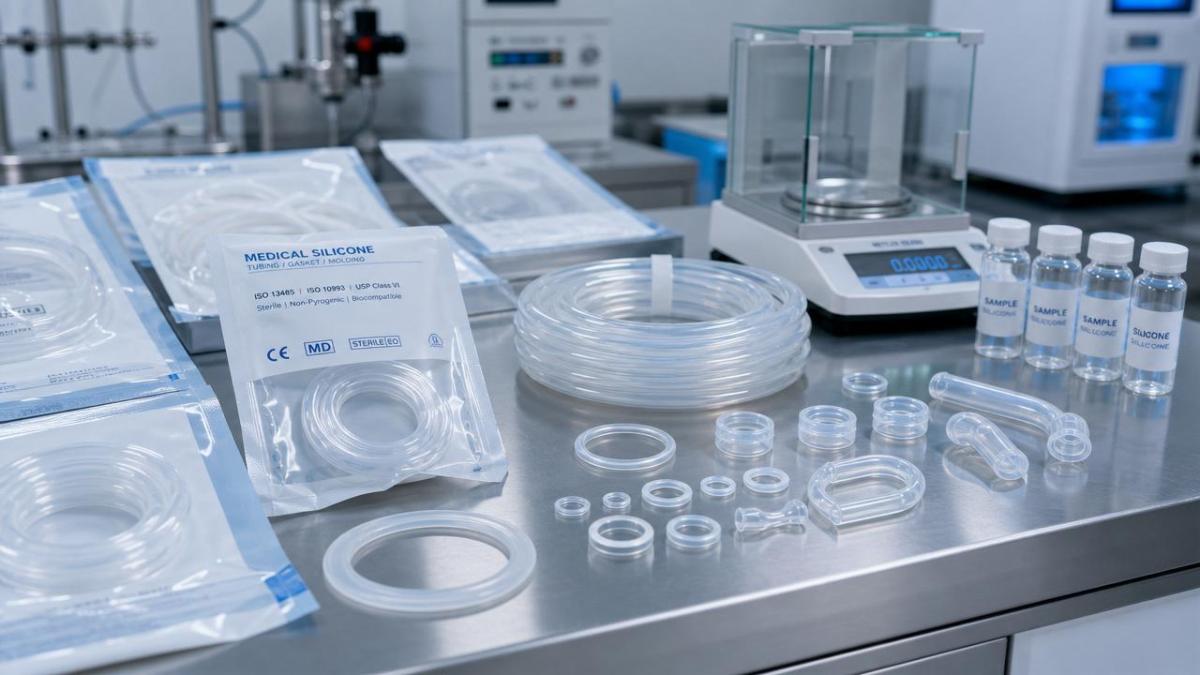
Medical grade silicone is not a single universal material. It may refer to elastomers, tubing, gaskets, membranes, seals, molded parts, or fluid-contact components.
For quality teams, the risk is rarely the base polymer alone. Additives, curing systems, extractables, surface residues, and supplier traceability often decide suitability.
In semiconductor, pharmaceutical, biosafety, and precision HVAC systems, a failed silicone part can introduce particles, leachables, microbial risk, or process instability.
Core risk signals to check before approval
- Unclear material formulation, especially when the supplier cannot state curing method, filler type, or post-curing conditions.
- Missing lot traceability, which makes deviation investigation difficult after contamination or biocompatibility concerns arise.
- Certificates that do not match the supplied component, production site, material grade, or intended contact application.
- No documented compatibility with sterilization, cleaning chemicals, temperature cycling, or ultra-pure water exposure.
G-ICE views these checks through contamination control, thermal management, process fluid treatment, biosafety containment, and monitoring integration.
What safety checks should QC teams perform first?
Before price negotiation, quality control teams should define the use environment. Medical grade silicone for a door seal is different from tubing in fluid transfer.
The first review should connect component function, exposure conditions, regulatory expectations, and failure consequences. This prevents overbuying or under-specifying.
The following table helps translate typical application conditions into practical acceptance checks for medical grade silicone components.
This framework helps safety managers avoid accepting medical grade silicone based only on a supplier label or a generic datasheet.
How to evaluate certification and compliance documents
Certification review should confirm relevance, not just existence. A document may be valid but still unrelated to the purchased medical grade silicone component.
QC personnel should compare certificate scope, material code, manufacturing location, test method, and expiration or revision status.
Documents usually worth requesting
- Material safety information and composition disclosure appropriate for internal risk assessment and chemical compatibility review.
- Lot-specific certificate of conformance showing material grade, batch number, production date, and inspection reference.
- Biocompatibility or pharmacopeia evidence where patient-contact, drug-contact, or biologics-related processes are involved.
- Change notification policy covering formulation, processing site, curing method, packaging, and critical raw material changes.
For G-ICE-aligned facilities, document review should also consider ISO 14644 cleanroom expectations, ASHRAE-controlled environments, and SEMI-sensitive contamination requirements.
Use this compliance table to clarify which references may apply to medical grade silicone in different regulated environments.
No single standard proves universal suitability. Medical grade silicone approval should be tied to process risk, not treated as a blanket permission.
Key performance parameters that affect safety and uptime
Safety is also mechanical. A compliant material can fail if its hardness, geometry, compression behavior, or thermal range is unsuitable.
In critical environments, failed seals and tubing are not maintenance events only. They may trigger deviation reports, revalidation, downtime, or batch loss.
Performance checks for medical grade silicone selection
- Confirm durometer range against sealing pressure, installation tolerance, and repeated compression cycles.
- Validate temperature range under normal operation, sterilization, cleaning, and emergency shutdown conditions.
- Assess chemical compatibility with disinfectants, solvents, acids, alkalis, ozone, steam, and process fluids.
- Check transparency, flexibility, tear strength, and bend radius when medical grade silicone tubing is specified.
- Review packaging integrity and storage life because dust, deformation, or aging can compromise clean installation.
These parameters are especially important in G-ICE environments where thermal stability, biosafety containment, and contamination control must operate together.
Medical grade silicone versus common alternatives
Procurement teams often compare medical grade silicone with EPDM, PTFE, fluorosilicone, or thermoplastic elastomers. Each option has a different risk profile.
The lowest unit price may increase lifecycle cost if the component requires frequent replacement, special validation, or extensive deviation investigation.
This comparison supports early screening before detailed supplier qualification and sample testing.
Medical grade silicone is often preferred when flexibility, cleanliness, and biocompatibility matter together, but compatibility testing remains essential.
Procurement checklist for quality and safety managers
A strong purchasing process reduces emergency substitutions. It also prevents suppliers from treating medical grade silicone as a generic commodity.
The checklist should be shared with procurement, engineering, validation, EHS, and operations before a purchase order is released.
Pre-purchase approval checklist
- Define whether the component is product-contact, indirect-contact, cleanroom-exposed, or purely mechanical.
- Request a complete datasheet, certificate of conformance, shelf-life statement, and packaging description.
- Confirm whether the supplied medical grade silicone is peroxide-cured, platinum-cured, or otherwise processed.
- Ask for change control commitments when validated systems or regulated production lines are involved.
- Conduct sample inspection under actual installation, cleaning, sterilization, and environmental conditions.
For complex facilities, G-ICE can help teams translate system requirements into material specifications, acceptance criteria, and supplier questions.
Implementation controls after receiving medical grade silicone parts
Incoming inspection should not stop at quantity and appearance. Controlled environments need documented handling from receipt to installation.
Improper storage can deform seals, attract particles, or compromise sterile packaging. Even qualified medical grade silicone can become unsuitable before use.
Receiving and installation controls
- Verify label information against purchase documents, including material grade, lot number, dimensions, and quantity.
- Inspect packaging for punctures, dust, moisture, deformation, or mixed lots before materials enter controlled areas.
- Segregate parts awaiting quality release from approved stock to prevent accidental installation.
- Record installation location, system tag, batch number, and technician details for future traceability.
- Monitor early operation for leakage, odor, discoloration, swelling, compression loss, or particle observations.
These controls support deviation handling and maintenance planning, especially where downtime or contamination events carry high business impact.
Common mistakes that create hidden compliance risk
Many failures begin with reasonable shortcuts. Teams may reuse a familiar part number without checking whether the process has changed.
Another common mistake is assuming all transparent silicone is medical grade silicone. Appearance does not prove formulation, cleanliness, or compliance.
Risk patterns to avoid
- Approving a component based on a distributor catalog while skipping manufacturer-level traceability.
- Using a compliant material in an incompatible chemical environment without exposure testing.
- Replacing custom gaskets with similar dimensions but different durometer or compression behavior.
- Ignoring packaging cleanliness when components are introduced into ISO-classified cleanrooms.
Safety managers should treat medical grade silicone substitutions as controlled changes, not simple maintenance purchases.
FAQ: practical questions before approval
How do I know if medical grade silicone is necessary?
Use medical grade silicone when biocompatibility, cleanliness, validated contact, or contamination control requirements exceed ordinary industrial elastomer expectations.
If the part contacts products, process fluids, sterile zones, or cleanroom airflow paths, a higher documentation level is usually justified.
Is platinum-cured silicone always better?
Platinum-cured materials are often preferred for lower by-product concerns, but “better” depends on application, supplier controls, and compatibility data.
QC teams should compare actual test reports, not rely only on curing terminology or marketing language.
What should be checked when delivery is urgent?
When timelines are tight, prioritize lot traceability, certificate relevance, dimensional inspection, packaging condition, and compatibility with critical exposure conditions.
Emergency approval should still include documented risk acceptance and a plan for post-installation monitoring.
Can medical grade silicone be reused after cleaning?
Reuse depends on exposure, deformation, cleaning chemistry, sterilization cycles, and validated procedures. Single-use assemblies should not be reused without formal assessment.
For reusable seals, define inspection criteria for cracks, tackiness, swelling, compression set, discoloration, and loss of elasticity.
Why choose G-ICE for material safety decisions
G-ICE supports quality and safety teams that must connect material selection with cleanroom performance, HVAC stability, UPW integrity, and biosafety controls.
Our approach is not limited to choosing medical grade silicone. We help define what the component must prove inside your process.
Consult us when you need a defensible decision
- Parameter confirmation for seals, tubing, gaskets, molded parts, and fluid-contact silicone components.
- Selection support when medical grade silicone must be compared with PTFE, EPDM, or specialized elastomers.
- Certification requirement mapping for cleanroom, pharmaceutical, semiconductor, laboratory, and controlled industrial environments.
- Sample review planning, supplier documentation checks, delivery cycle discussion, and quotation preparation.
Contact G-ICE to discuss your process conditions, acceptance criteria, certification expectations, and delivery constraints before finalizing medical grade silicone procurement.
Get weekly intelligence in your inbox.
No noise. No sponsored content. Pure intelligence.
 Oct 21, 2026How often is cleanroom certification required under ISO 14644-2?Cleanroom Certification is generally recommended annually under ISO 14644-2. Learn when risk-based extensions apply and which changes trigger earlier testing to plan with confidence.
 Oct 21, 2026FASEB Comments on NIH Draft Policy for Research Involving BiohazardsFASEB comments on NIH’s draft biohazard research policy call for risk-based biosafety oversight. Explore potential implications for laboratories, suppliers, and compliance teams.
 Oct 20, 2026How to disinfect ultrasound machines without damaging surfacesLearn how to disinfect ultrasoundmachines without surface damage. Explore compatible products, wet contact times, and probe care to protect patients and equipment.
 Oct 20, 2026Ultrapure Water in Semiconductor Manufacturing: Reuse and Quality Control InsightsExplore ultrapure water reuse in semiconductor manufacturing, key UPW quality benchmarks and analytical insights to help evaluate suppliers and protect process purity.
 Oct 19, 2026How cooling affects warpage in injection-molded consumer electronics housingsOptimize plastic injection molding for consumer electronics with cooling strategies to reduce housing warpage and improve assembly fit. Discover practical checks for stable, efficient production.
 Oct 18, 2026Can air leaks prevent a dehumidifier from holding its target dew point?Why can't our dehumidifier maintain the target dew point? Discover how air leaks increase moisture loads, spot hidden faults, and find practical fixes to restore reliable dew-point control.
 Oct 17, 2026How semiconductor process water treatment removes trace organicsSee how semiconductor process water treatment removes trace organics with RO, UV oxidation, and polishing. Learn how TOC monitoring helps verify purity and pinpoint contamination.
 Oct 16, 2026How to choose ultra pure water piping materials to limit leachingChoose ultra pure water piping with confidence. Compare PVDF, PFA, and stainless steel, assess leaching risks, and learn how to qualify your system for reliable purity.
 Oct 15, 2026How to size a skid-mounted deionized water system for peak demandCompare deionized water systems skid configurations for peak demand. Learn how to balance production, storage, and pump capacity to prevent shortages and avoid costly oversizing.
 Oct 14, 2026When is collaborative laboratory robotics suitable for sample sorting?Explore when collaborative laboratory robotics suits sample sorting. Discover key checks for safety, traceability, container compatibility, and throughput before choosing your solution.
 Oct 13, 2026How sandwich panel joints affect airtightness in cleanroom systemsCleanroom Systems sandwich panels need reliable joints for airtightness. Discover how gaskets, sealants, and testing help reduce leakage and protect cleanroom pressure control.
 Oct 12, 2026How to verify USP compliance for ultra pure water systemsUltra Pure Water Systems USP compliance: learn how to verify water quality, sampling, sanitization, trends, and validation controls at every point of use.
 Oct 11, 2026How tight temperature control prevents cleanroom process driftCleanroom process temperature control systems prevent costly drift by stabilizing critical conditions, improving repeatability, and protecting sensitive production workflows.
 Oct 10, 2026When does organic contaminant removal require TOC treatment?Organic contaminant removal requires TOC treatment when dissolved organics threaten product quality, equipment reliability, or process control. Learn how to assess risks and choose the right solution.
 Oct 08, 2026What affects lead times for sheet metal bending services in Canada?Sheet metal bending services Canada: discover how material supply, tooling, tolerances, finishing, documentation, and freight affect lead times for reliable project delivery.
 Oct 07, 2026How HVAC design for semiconductor fabs prevents airborne contaminationHVAC design for semiconductor fabs prevents airborne contamination through advanced filtration, pressure cascades, airflow control, and real-time monitoring. Explore key strategies for cleaner, more reliable wafer production.
 Oct 06, 2026How photovoltaic modules waterproof technology prevents moisture damagephotovoltaic modules waterproof technology prevents moisture damage with durable seals, drainage, and junction-box protection. Explore practical selection and testing insights.
 Oct 05, 2026How ISO 14644 Europe requirements affect cleanroom qualificationISO 14644 Europe requirements shape cleanroom qualification, from particle classification and recovery testing to monitoring, GMP alignment, and change control.
 Oct 04, 2026How to assess a pharmaceutical cleanroom solutions supplier’s ISO capabilityPharmaceutical Cleanroom Solutions supplier assessment guide: evaluate ISO 14644 capability, validation evidence, airflow design, documentation, and long-term GMP readiness.
 Oct 03, 2026What EU standards govern the design of BSL-3 laboratories in Europe?BSL-3 laboratories Europe: explore EU directives, EN standards, HVAC containment, commissioning, and practical design strategies for compliant, resilient high-containment facilities.
 Oct 02, 2026How EN 1822 defines HEPA filtration efficiency for cleanroomsHEPA filtration EN 1822 explained: learn how MPPS testing, local leakage limits, and filter classes support reliable cleanroom decisions.
 Oct 01, 2026How pharmaceutical process water systems control microbial riskProcess water systems pharmaceutical teams rely on can control microbial risk through hygienic design, monitoring, and validated sanitization. Explore practical compliance strategies.
 Sep 30, 2026When does a negative pressure laboratory need BSL-3 containment?Negative pressure laboratory or BSL-3? Discover the risk factors, engineering controls, and containment requirements needed for safe, compliant laboratory planning.
 Sep 29, 2026How to evaluate a TOC-zero water treatment supplier for UPW systemsChoose a TOC-zero water treatment supplier with confidence. Compare UPW performance, monitoring, validation, materials, service capability, and lifecycle cost.
 Sep 28, 2026What drives sustainable cooling cost in high-precision facilities?Sustainable cooling cost in high-precision facilities depends on thermal stability, energy, water, controls, and resilience. Explore smarter lifecycle strategies.
 Sep 27, 2026How to compare freight forwarding services for time-critical shipmentsCompare freight forwarding services for time-critical shipments with practical insights on routing, customs, visibility, specialized handling, and contingency planning.
 Sep 26, 2026How environmental integrity in laboratories supports reliable test resultsEnvironmental Integrity in laboratories safeguards samples, instruments, and staff. Discover practical controls for contamination, monitoring, and reliable test results.